Master the F# 7(#9) Guitar Chord: Interactive Learning Tool
Want a structured chord roadmap instead of jumping between pages?
Go to the full guitar chords tutorial.
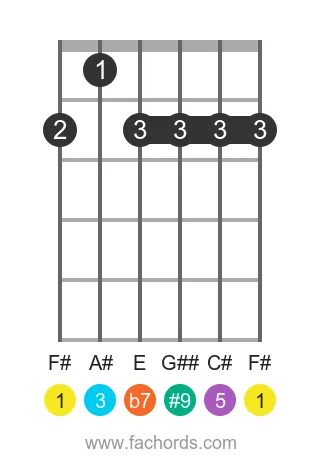
The F# 7(#9) chord, a rich and complex member of the Dominant Chords family, is fundamentally constructed from the intervals 1 (Root), 3 (Major Third), 5 (Perfect Fifth), b7 (Minor Seventh), and #9 (Augmented Ninth). These intervals translate to the specific notes F#, A#, C#, E, and G##, forming a distinctive extended dominant harmony. To systematically explore its unique sound, utilize our interactive fretboard tool to visualize every fingering and listen to the chord played as a strum or arpeggio. Verify your playing accuracy instantly with real-time mic feedback, ensuring disciplined practice.
This powerful chord, frequently heard in jazz and blues, significantly expands your musical expression by adding harmonic richness and color as an extended harmony. To deepen your understanding of its construction, explore our guide on Ninth Chords and learn more about the crucial role of the Dominant Chord family in music theory. For a foundational perspective on how notes stack to form any chord, refer to our comprehensive Chord Construction tutorial. Mastering the F# 7(#9) will also benefit from working on your chord changes to integrate it smoothly into your playing.
As you continue, you'll find detailed chord diagrams, carefully ranked from the easiest open positions to more advanced movable shapes. We'll also delve deeper into the music theory behind the F# 7(#9), highlight songs where it shines, and reveal the keys in which it commonly appears. For optimal retention and precision, we strongly encourage you to begin your disciplined practice with the interactive tool above. Utilize the drum & BPM tool to establish your rhythm, strum the chord, and allow the mic feedback to guide you toward perfect articulation. This systematic, hands-on approach is essential for embedding new chords into both your muscle memory and ear effectively.
Notes that compose the F# 7(#9) chord:
Chord Structure:
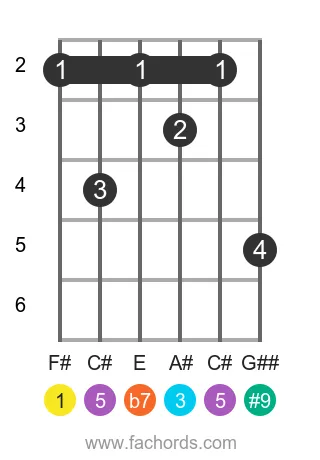
F# Dominant Seventh Sharp Ninth Added Guitar Chord Fingers Positions
Position 1
Movable
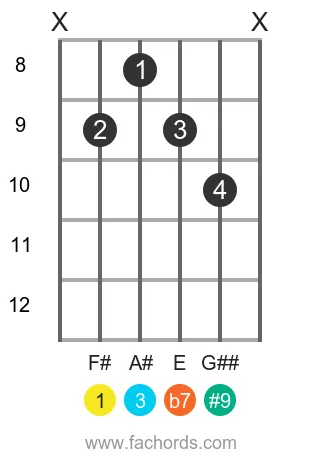
Position 2
Barre
Movable
Position 3
Barre
Movable
 Find more shapes in our all guitar chords online library. If you
prefer a printable pdf, download
the Free Guitar Chords Chart Pdf
Find more shapes in our all guitar chords online library. If you
prefer a printable pdf, download
the Free Guitar Chords Chart Pdf
You can also use this accessible F#7(#9) chord page, with written diagram instructions and screen-reader support for blind users.


Created by
Giancarlo is a musician (teaching guitar since 2000), software engineer, AI consultant and published researcher
FAQ
What are the specific notes that form the F# 7(#9) chord?
The F# 7(#9) chord is composed of the notes F#, A#, C#, E, and G##. These notes correspond to the root, major third, perfect fifth, minor seventh, and augmented ninth intervals, respectively, all built from the F# root note.
What intervals are used to construct the F# 7(#9) chord?
This chord is built using five specific intervals relative to the root: the 1st (Root), 3rd (Major Third), 5th (Perfect Fifth), b7th (Minor Seventh), and #9th (Augmented Ninth). Understanding these intervals is key to recognizing and playing the chord.
Why is the F# 7(#9) chord classified as a 'Dominant Chord family member'?
The F# 7(#9) chord belongs to the Dominant Chords family because its structure includes a root, major third, perfect fifth, and a minor seventh (b7). The addition of the #9 interval extends this dominant quality, making it a more complex and rich-sounding dominant chord.
What specific characteristic does the #9 (Augmented Ninth) interval add to the F# 7(#9) chord's sound?
The #9 (Augmented Ninth) interval is a key element that contributes to the F# 7(#9) chord's characteristic 'rich, complex sound'. It adds a distinct harmonic tension and flavor that is highly valued in genres like jazz and blues, expanding the chord's expressive capabilities.
In which musical genres is the F# 7(#9) chord frequently used?
The F# 7(#9) chord is a versatile and expressive chord that finds frequent use in various musical genres, most notably in jazz and blues. Its rich and complex sound makes it a popular choice for adding harmonic color and tension.
