F# 13 Guitar Chord
Chord Diagrams, Interactive Fretboard and Chord Theory
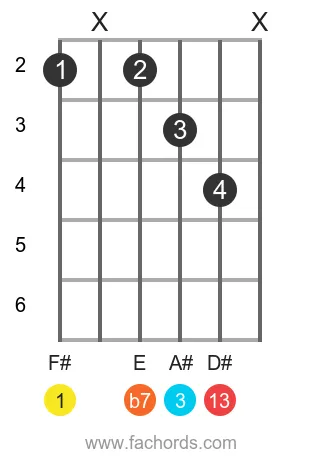
F# dominant 13th guitar chord is also written as F#13, F#dom13 or F#7(13).
Position 1
Movable
Position 2
Movable
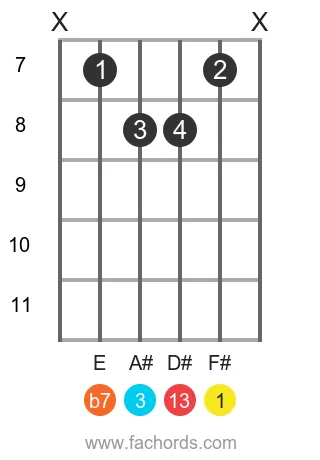
Position 3
Barre
Movable
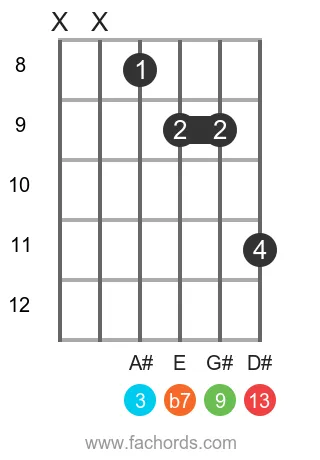
Position 4
Barre
Movable
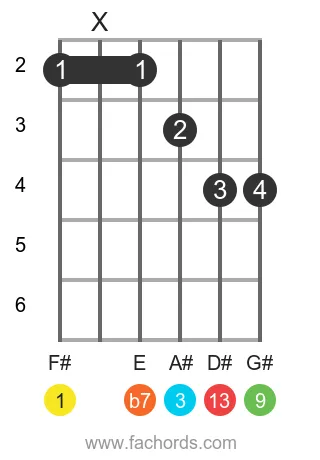
Position 5
Barre
Movable
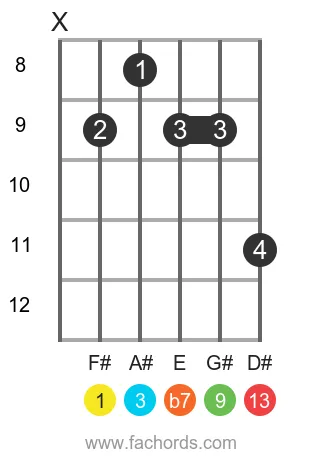
Position 6
Barre
Movable
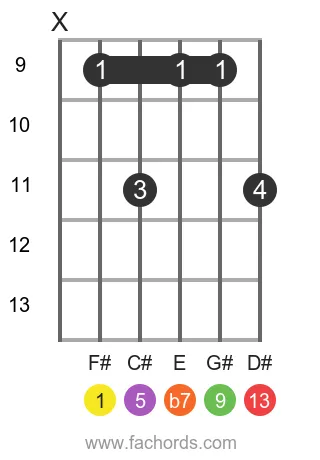
 Find more shapes in our all guitar chords online library. If you
prefer a printable pdf, download
the Free Guitar Chords Chart Pdf
Find more shapes in our all guitar chords online library. If you
prefer a printable pdf, download
the Free Guitar Chords Chart Pdf
You can also use this accessible F#13 chord page, with written diagram instructions and screen-reader support for blind users.
Explore F#13 Guitar Chord Shapes: Interactive Learning & Practice
Want a structured chord roadmap instead of jumping between pages?
Go to the full guitar chords tutorial.
The F#13 chord presents a rich landscape of movable shapes and voicings across the guitar fretboard, ideal for visualizing complex harmony. Dive into its visual layout with our interactive fretboard tool, exploring every fingering and hearing it played as a strum or arpeggio. Verify your finger placement and execution instantly with real-time microphone feedback, ensuring you're accurately sounding out this sophisticated dominant chord. The F#13 belongs to the Dominant Chords family and is built from the notes F#, A#, C#, E, G#, B, and D#, representing the intervals Root, Major Third, Perfect Fifth, Minor Seventh, Major Ninth, Perfect Eleventh, and Major Thirteenth.
As an extended dominant chord, the F#13 significantly enriches genres like jazz, moving beyond simpler triads and adding sophisticated color. Its complex construction provides a deeper understanding of harmony, building upon concepts found in Dominant Chords and extending similar ideas from Ninth Chords. For a full grasp of how these rich voicings are built, consult our guide on Chord Construction. Many F#13 shapes incorporate barre forms; if you're working on these, our Guitar Bar Chords tutorial can help you master these essential positions.
Below, you'll find numerous F#13 chord diagrams, presented from the simplest open positions to more intricate barre shapes, accompanied by detailed music theory, example songs featuring this chord, and the keys where it commonly appears. Before attempting to memorize these diagrams, make sure to thoroughly explore the interactive tool above. Set your preferred tempo with the drum tool, try out various voicings, and let the mic feedback guide your hands as you discover the optimal finger placements for this chord. This interactive exploration of shapes is key to truly internalizing the F#13.
F# 13 chord Notes:
Tones of the Dominant Thirteen chord:
Play This Chord With Other Roots
C 13 | D 13 | E 13 | F 13 | G 13 | A 13 | B 13 | C#13 | D#13 | F#13 | G#13 | A#13 | Ab13 | Bb13 | Db13 | Eb13 | Gb13

Created by
Giancarlo is a musician (teaching guitar since 2000), software engineer, AI consultant and published researcher
FAQ
What are the specific notes that make up the F# 13 chord?
The F# 13 chord is composed of seven distinct notes: F#, A#, C#, E, G#, B, and D#. These notes represent the Root, Major Third, Perfect Fifth, Minor Seventh, Major Ninth, Perfect Eleventh, and Major Thirteenth intervals, respectively.
Why is the F# 13 chord classified as a 'Dominant Chord'?
The F# 13 chord belongs to the Dominant Chords family because its interval structure includes a minor seventh (E, in this case). This interval is a defining characteristic of dominant chords, which create a specific harmonic tension.
How is the F# 13 chord built using music intervals?
The F# 13 chord is built by 'stacking intervals' starting from its root note, F#. This means adding the Major Third, Perfect Fifth, Minor Seventh, Major Ninth, Perfect Eleventh, and Major Thirteenth in sequence above the root.
What makes the F# 13 chord considered an advanced chord for guitarists?
It is considered advanced due to its complexity. It contains seven distinct notes and requires a solid understanding of music theory and precise finger placement on the fretboard to execute effectively, going beyond typical beginner chord shapes.
When might a guitarist typically use an F# 13 chord in their music?
The F# 13 chord is especially useful in music genres that favor complex harmony, such as jazz. It adds a rich, sophisticated sound and is a great tool for guitarists who want to expand their theoretical knowledge and practical fretboard skills.