Explore the Em7 Guitar Chord: Unleash Its Groove
Want a structured chord roadmap instead of jumping between pages?
Go to the full guitar chords tutorial.
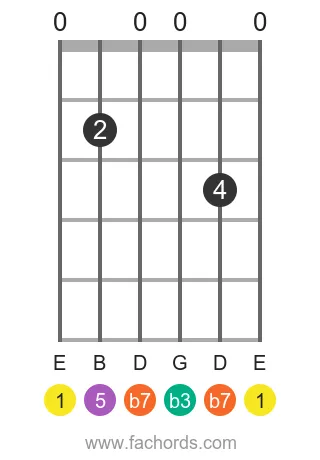
Unlock the soulful sounds of the Em7 guitar chord, a foundational element in jazz, R&B, and many contemporary genres. This versatile chord, part of the Minor Chords family, is constructed from the notes E, G, B, and D, corresponding to the intervals of 1, b3, 5, and b7. Use our interactive fretboard to experiment with fingerings and instantly verify your accuracy with real-time mic feedback. Our virtual fretboard acts as your personal exploration lab, letting you hear the chord's unique color immediately.
Understanding the Em7 chord's construction, with its minor third and minor seventh, is key to developing a rich harmonic vocabulary. It's often used to create a smooth, melancholic groove or as a modal center. While often thought of in jazz, its structure of a root, minor third, perfect fifth, and minor seventh makes it vital for understanding general chord construction. For those looking to simplify their approach, exploring 3-note 7th chords can provide a leaner, yet equally effective, sound. Practicing the transitions to and from this chord will also significantly improve your chord changes and overall fluency.
Scroll down to find comprehensive chord diagrams for Em7, ordered from easiest to most advanced fingerings, alongside explanations of the underlying theory. Don't just memorize shapes; listen to how they sound in context. Before diving deep into the theory, grab your guitar and play along with the chord playback, experimenting with different inversions across various keys. Apply what you learn directly to songs, and let your ears guide you through the musical possibilities.
Notes that compose the E m7 chord:
Chord Formula:
E Minor Seventh Chord | Construction, Keys and Songs
We can see the E minor seventh chord like an E minor chord (E, G and B) with an additional note, D, that is a minor seventh from the root (10 half-steps).
Creating the Em7 chord is easy, just take the E minor scale:
E F# G A B C D
And select the first, third, fifth and seventh note. You get E, G, B and D.
It is a cool chord that you can play with a couple of really easy shapes, suitable for beginners.
For example, position 4 sounds beautiful and you only have to use one finger, on the 2nd fret of the A string.
Keys With The E Minor Seventh Chords
Here below we show the most common keys that contain the E Minor Seventh chord.
As this chord is composed of 4 notes (E, G, B and D) we use 4 tones harmonization tables.
C Major Key
In the C major key, you find the E m7 at the 3rd degree.
| C maj7 | D m7 | E m7 | F maj7 | G 7 | A m7 | B m7/b5 |
|---|---|---|---|---|---|---|
| B (7) G (5) E (3) C (1) |
C (1) A (6) F (4) D (2) |
D (2) B (7) G (5) E (3) |
E (3) C (1) A (6) F (4) |
F (4) D (2) B (7) G (5) |
G (5) E (3) C (1) A (6) |
A (6) F (4) D (2) B (7) |
G Major Key
E m7 in the relative minor chord (6th) of the G major key.
| G maj7 | A m7 | B m7 | C maj7 | D 7 | E m7 | F# m7/b5 |
|---|---|---|---|---|---|---|
| F# (7) D (5) B (3) G (1) |
G (1) E (6) C (4) A (2) |
A (2) F# (7) D (5) B (3) |
B (3) G (1) E (6) C (4) |
C (4) A (2) F# (7) D (5) |
D (5) B (3) G (1) E (6) |
E (6) C (4) A (2) F# (7) |
D Major Key
The 2nd chord of the D major key is our E m7.
| D maj7 | E m7 | F# m7 | G maj7 | A 7 | B m7 | C# m7/b5 |
|---|---|---|---|---|---|---|
| C# (7) A (5) F# (3) D (1) |
D (1) B (6) G (4) E (2) |
E (2) C# (7) A (5) F# (3) |
F# (3) D (1) B (6) G (4) |
G (4) E (2) C# (7) A (5) |
A (5) F# (3) D (1) B (6) |
B (6) G (4) E (2) C# (7) |
Songs With E minor 7
There are tons of songs with the E minor 7 chord; on the guitar, this chord can be played with many open strings, so it has a really powerful sound.
Here are some popular songs that contain this chord:
- Grateful Dead: Shakedown Street
- Nat King Cole: Autumn Leaves
- Ben E. King: Stand By Me
- The Beatles: Yesterday
- Bob Marley: Redemption Song
Em7 - Practice And Playing Tips
Here are a few more suggestions that will help you with this chord.
- Finger Placement: Ensure your fingers are curled and pressing down just behind the frets to avoid buzzing sounds.
- Strumming: You can use shapes with all six strings for a full, resonant sound.
- Hand Position: Keep your wrist relaxed and slightly bent to easily reach the frets.
- Chord Transitions: Practice switching between Em7 and other chords like G, D, or C to enhance muscle memory.
- Use in Songs: Incorporate Em7 into songs you know, especially those in genres like folk, rock, or blues, to appreciate its versatile nature.
E Minor Seventh Guitar Chord Shapes
Position 1
Movable
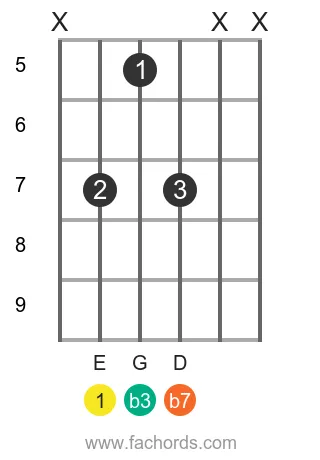
Position 2
Movable
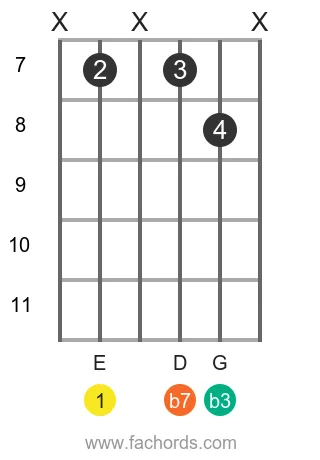
Position 3
Open
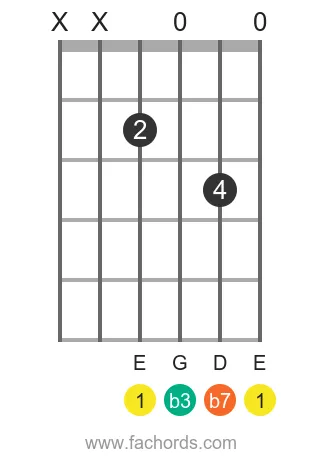
Position 4
Open
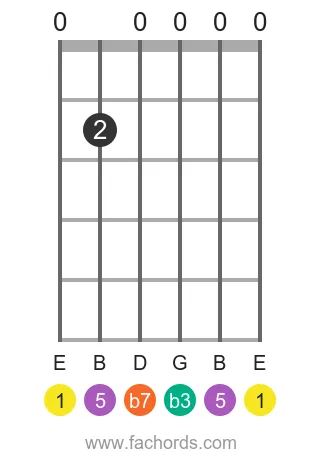
Position 5
Open
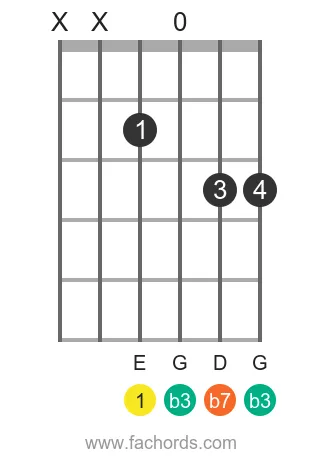
Position 6
Open
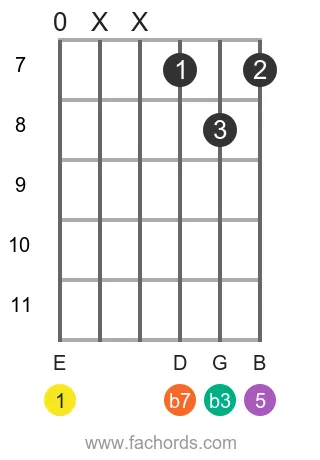
Position 7
Open
Position 8
Open
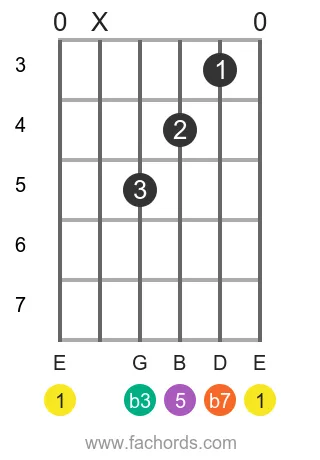
Position 9
Movable
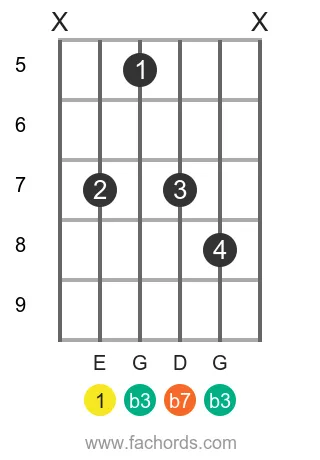
Position 10
Movable
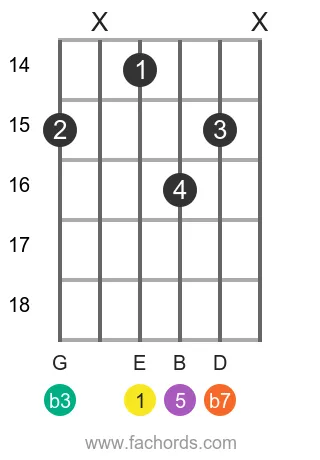
Position 11
Open
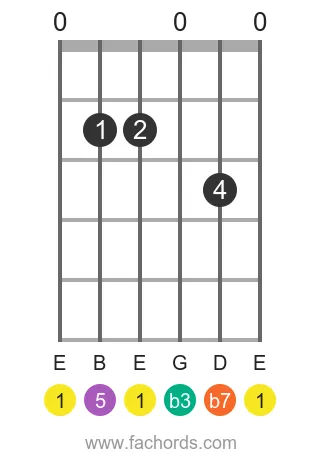
Position 12
Barre
Movable
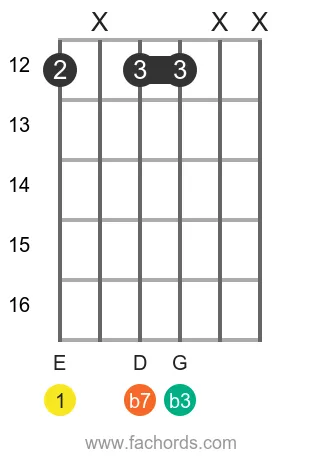
Position 13
Open
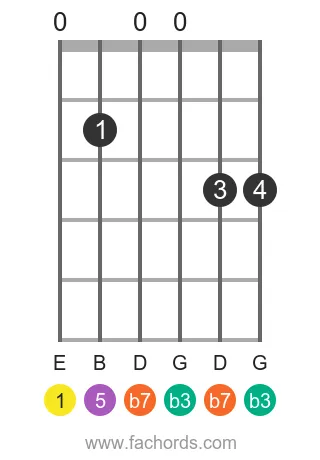
Position 14
Barre
Movable
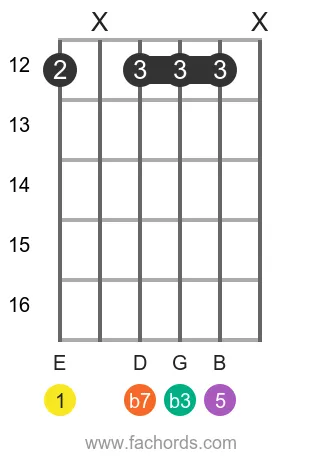
Position 15
Barre
Movable
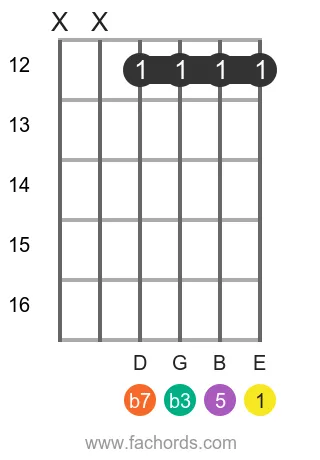
Position 16
Barre
Movable
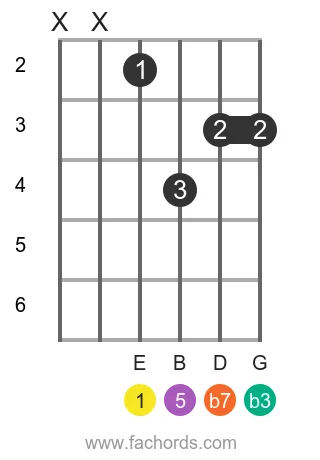
Position 17
Barre
Movable
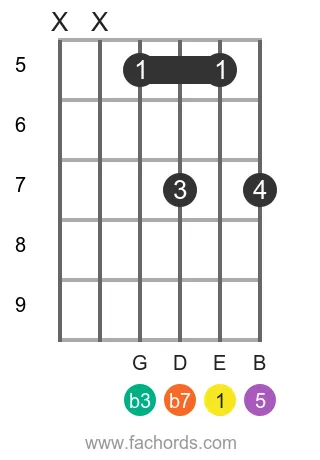
Position 18
Barre
Movable
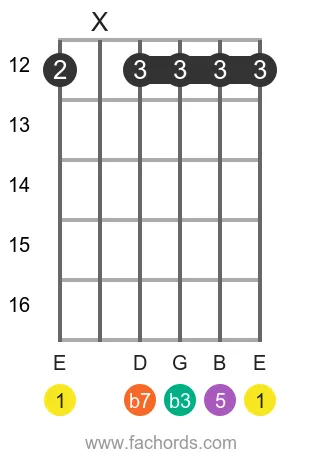
Position 19
Barre
Movable
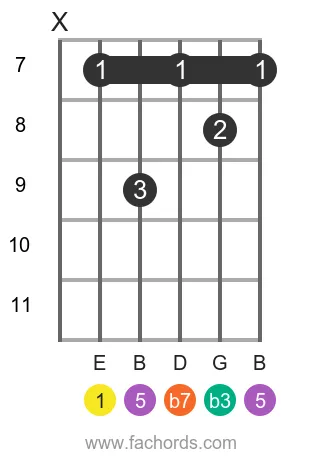
Position 20
Barre
Open
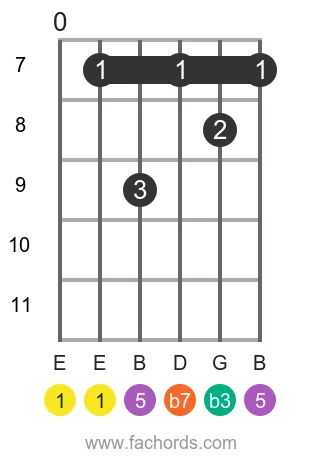
Position 21
Barre
Movable
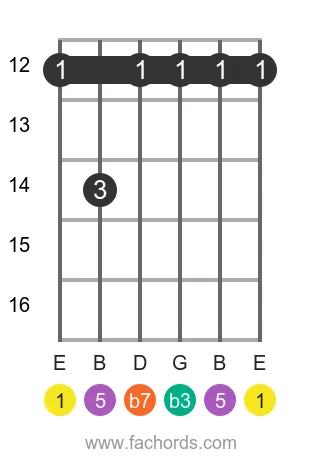
 Find more shapes in our all guitar chords online library. If you
prefer a printable pdf, download
the Free Guitar Chords Chart Pdf
Find more shapes in our all guitar chords online library. If you
prefer a printable pdf, download
the Free Guitar Chords Chart Pdf
You can also use this accessible Em7 chord page, with written diagram instructions and screen-reader support for blind users.

FAQ
What notes and intervals make up an Em7 chord?
The Em7 chord is composed of the notes E, G, B, and D. These correspond to the intervals of the Root (1), Minor Third (b3), Perfect Fifth (5), and Minor Seventh (b7) respectively.
How is the Em7 chord constructed from a scale?
To construct the Em7 chord, you can take the E minor scale (E F# G A B C D) and select the first, third, fifth, and seventh notes from it. This yields E, G, B, and D.
In which musical keys can I expect to find the Em7 chord?
The Em7 chord appears in several major keys. It is the 3rd degree chord in C Major, the 6th degree chord (relative minor) in G Major, and the 2nd degree chord in D Major. It is also a common component in jazz chord progressions.
Are there easy ways for beginners to play the Em7 chord?
Yes, the Em7 chord offers several easy shapes suitable for beginners. For example, there's a simple shape in 'position 4' that only requires one finger on the 2nd fret of the A string, allowing you to play the chord with many open strings for a full sound.
What are some practical tips for practicing and playing the Em7 chord effectively?
For effective practice, ensure your fingers are curled and pressed just behind the frets to avoid buzzing. Keep your wrist relaxed, practice transitioning between Em7 and common chords like G, D, or C to build muscle memory, and incorporate it into songs to understand its versatile nature.
How does an Em7 chord differ from a standard E minor chord?
An Em7 chord extends a standard E minor chord. An E minor chord consists of E, G, and B (Root, Minor Third, Perfect Fifth). The Em7 adds one more note, D, which is the minor seventh interval (b7) from the root E.
