Play the E m6 Chord: Interactive Fretboard for Real-Time Practice
Want a structured chord roadmap instead of jumping between pages?
Go to the full guitar chords tutorial.
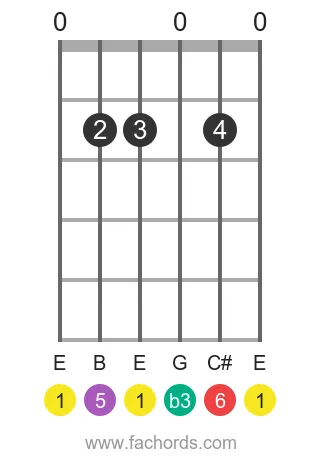
Explore the rich, often melancholic, yet sophisticated sound of the E m6 chord, a captivating member of the Minor Chords family. This chord is built from the notes E, G, B, and C#, corresponding to the intervals 1, b3, 5, and 6 (Root, Minor Third, Perfect Fifth, and Major Sixth). Use our interactive fretboard as your personal exploration lab to hear its unique voicing, play along with adjustable rhythm tracks, and instantly verify your accuracy with real-time mic feedback.
The characteristic 'sweetness' of sixth chords like the E m6 adds a distinctive flavor, often associated with jazz and vintage pop. Understanding the foundational chord construction based on intervals, such as the Root, Minor Third, Perfect Fifth, and Major Sixth, is crucial for truly mastering this unique sound. This knowledge empowers you to not just memorize shapes, but to grasp the harmonic essence and apply it across the fretboard.
Before delving into traditional chord diagrams, which are presented from easiest to hardest, try experimenting with the interactive fretboard yourself. This allows you to explore the E m6 chord across different keys and contexts, understanding its theory through direct interaction. Discover practical applications in various songs and solidify your knowledge of guitar chord theory with hands-on practice first.
E minor 6th guitar chord is also written as Em6, Emin6 or E-6.
Notes of the E m6 chord:
How to create the Minor Sixth chord:
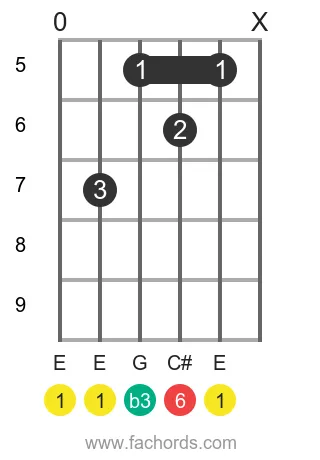
E M6 Guitar Chord Diagrams
Position 1
Open
Position 2
Open
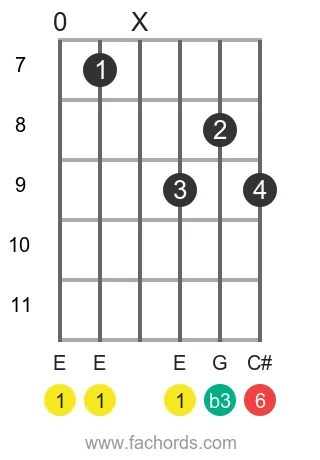
Position 3
Barre
Open
 Find more shapes in our all guitar chords online library. If you
prefer a printable pdf, download
the Free Guitar Chords Chart Pdf
Find more shapes in our all guitar chords online library. If you
prefer a printable pdf, download
the Free Guitar Chords Chart Pdf
You can also use this accessible Em6 chord page, with written diagram instructions and screen-reader support for blind users.

Created by
Giancarlo is a musician (teaching guitar since 2000), software engineer, AI consultant and published researcher
FAQ
What notes make up the E m6 chord on guitar?
The E m6 chord is composed of four specific notes: E, G, B, and C#. These notes together create its unique sound.
What are the specific intervals that form the E m6 chord?
The E m6 chord is built using the intervals 1 (Root), b3 (Minor Third), 5 (Perfect Fifth), and 6 (Major Sixth). Understanding these intervals is crucial for comprehending the chord's construction.
How does the E m6 chord differ from a standard E minor chord?
The E m6 chord is distinct from a basic E minor chord because it adds the Major Sixth (C#) interval. A standard E minor chord typically consists of only the Root (E), Minor Third (G), and Perfect Fifth (B). The added C# gives the E m6 a richer and more complex sound, moving it beyond basic chord voicings.
What kind of sound does the E m6 chord add to music?
The E m6 chord has a distinctive, rich, and complex sound. It's often used to add depth and sophistication to musical pieces, offering a more nuanced harmonic color than simpler chords.
Is the E m6 considered a minor or a major chord?
Despite its complexity, the E m6 chord is fundamentally a minor chord. The 'm' in 'm6' signifies its minor quality, which is determined by the presence of the minor third interval (b3) within its structure. It belongs to the family of Minor Chords.