Learn the E7(b9) Guitar Chord on Our Interactive Fretboard
Want a structured chord roadmap instead of jumping between pages?
Go to the full guitar chords tutorial.
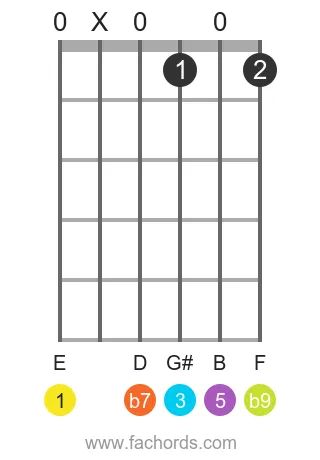
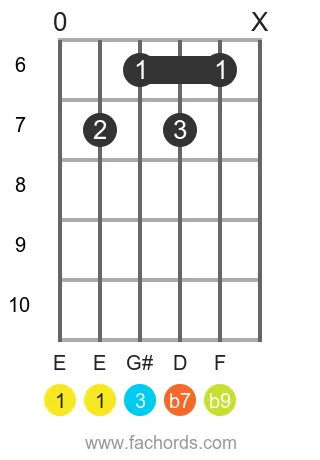
The E7(b9) chord, a distinctive member of the Dominant Chords family, is fundamentally built upon a specific interval construction. It comprises the notes E, G#, B, D, and F, corresponding to the intervals 1 (Root), 3 (Major Third), 5 (Perfect Fifth), b7 (Minor Seventh), and b9 (Minor Ninth). To truly grasp this harmonic complexity, our interactive virtual fretboard provides a dynamic environment for exploration. Here, you can visualize the notes in real-time, hear the chord or arpeggio playback, and verify your playing accuracy instantly with our real-time mic feedback.
Understanding the tension-resolution characteristic inherent in dominant chords, especially those with extended harmonies like the E7(b9), is crucial for effective songwriting and improvisation in blues and jazz. This particular chord introduces a pungent minor ninth, adding a rich, sometimes dissonant, color that craves resolution. For a deeper dive into how these complex structures are formed, explore our comprehensive chord construction tutorial. To broaden your understanding of this foundational chord type, our dedicated Dominant Chord tutorial offers further insights into their function and application across various musical contexts.
Below, you'll discover a variety of E7(b9) chord diagrams, thoughtfully ranked from the easiest to the most challenging, along with theoretical explanations, musical applications in songs, and how they function across different keys. We highly recommend engaging with the virtual fretboard and mic feedback first to internalize the sound and feel of the chord. Disciplined practice with these interactive tools will solidify your understanding and technique, ensuring you integrate the E7(b9) seamlessly into your playing.
E 7th with flat 9th guitar chord is also written as E7(b9), E7b9 or E7-9.
Notes of the E 7(b9) chord:
Tones in the Dominant Seventh Flat Nine Added chord:
E 7(B9) Guitar Chord Diagrams
Position 1
Open
Position 2
Open
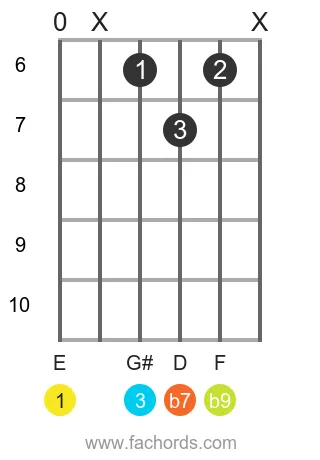
Position 3
Open
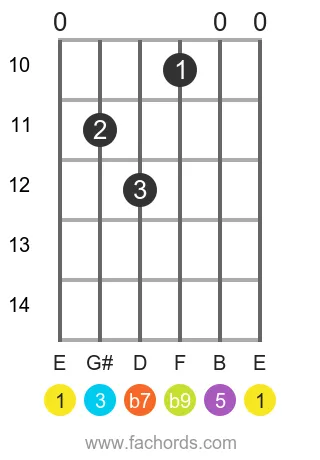
Position 4
Open
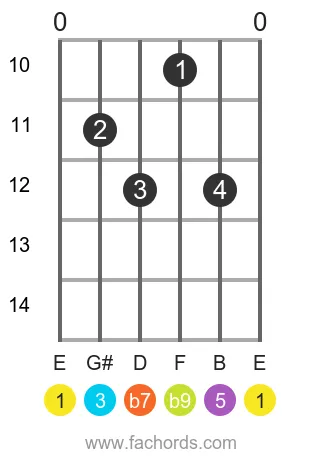
Position 5
Barre
Movable
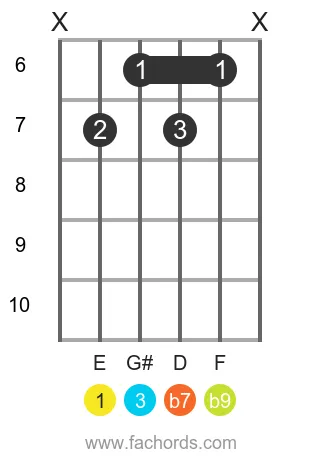
Position 6
Barre
Open
 Find more shapes in our all guitar chords online library. If you
prefer a printable pdf, download
the Free Guitar Chords Chart Pdf
Find more shapes in our all guitar chords online library. If you
prefer a printable pdf, download
the Free Guitar Chords Chart Pdf
You can also use this accessible E7(b9) chord page, with written diagram instructions and screen-reader support for blind users.

Created by
Giancarlo is a musician (teaching guitar since 2000), software engineer, AI consultant and published researcher
FAQ
What notes and intervals make up the E7(b9) chord?
The E7(b9) chord is composed of the notes E, G#, B, D, and F. These notes correspond to the intervals 1 (Root), 3 (Major Third), 5 (Perfect Fifth), b7 (Minor Seventh), and b9 (Minor Ninth) relative to the root E.
What does the 'b9' in E7(b9) specifically refer to?
The 'b9' in E7(b9) signifies the Minor Ninth interval. For an E7(b9) chord, this means the note F (a minor ninth above E) is added to the standard E7 chord structure, giving it its unique harmonic complexity.
What family of chords does the E7(b9) belong to?
The E7(b9) chord is a member of the Dominant (7) Chords family. This classification indicates its distinct harmonic qualities and typical function within music.
How is the E7(b9) chord different from a standard E7 chord?
The E7(b9) chord differs from a standard E7 chord by the inclusion of the minor ninth (b9) interval. A standard E7 chord contains the root, major third, perfect fifth, and minor seventh (E, G#, B, D), while the E7(b9) adds the minor ninth (F) to this combination.
Is the E7(b9) chord typically used by beginner guitarists?
No, the E7(b9) chord is considered more advanced than basic beginner chords. It is often encountered when expanding one's chord repertoire beyond the fundamentals.
In what musical contexts is the E7(b9) chord commonly found?
The E7(b9) chord, with its rich harmonic complexity, is frequently used in jazz chord progressions, where it contributes to sophisticated and nuanced harmonic landscapes.
