Explore E13 Chord Shapes on Guitar
Want a structured chord roadmap instead of jumping between pages?
Download the step-by-step Guitar Chord Ebook
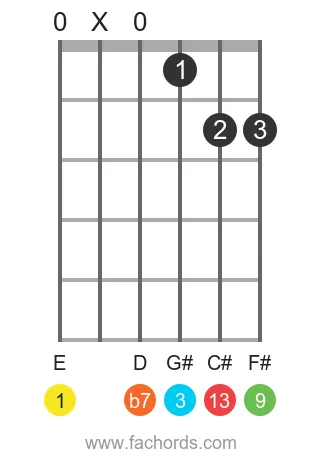
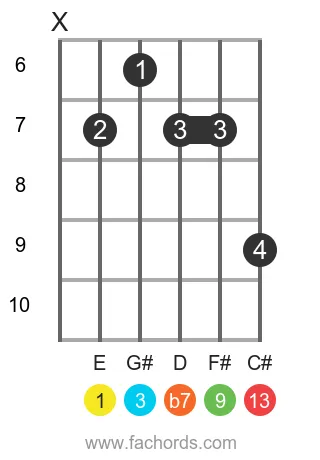
Unlock the intricate fretboard geometry of the E 13 chord. This sophisticated Dominant Chord is celebrated for its rich, extended sound, built from the notes E, G#, B, D, F#, A, and C#, corresponding to the intervals 1, 3, 5, b7, 9, 11, and 13. Our interactive virtual fretboard allows you to visualize these shapes across the strings immediately. Practice playing them, and receive real-time feedback on your accuracy directly from your microphone, ensuring every note is perfectly placed.
Understanding the unique interval structure is key to mastering this complex voicing. The '1' signifies the Root, '3' the Major Third, '5' the Perfect Fifth, 'b7' the Minor Seventh, '9' the Major Ninth, '11' the Perfect Eleventh, and '13' the Major Thirteenth. This comprehensive construction allows for rich harmonic possibilities. Dive deeper into how chords are put together with our tutorial on Chord Construction, or explore how to apply these shapes across the neck using Transposing Guitar Chords.
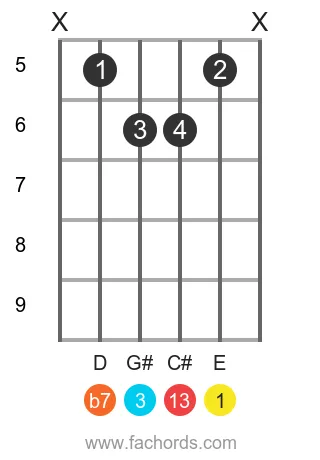
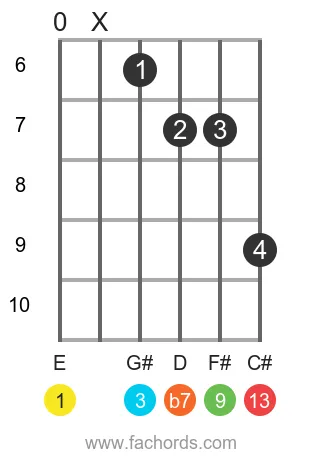
Scroll down to discover multiple E 13 chord diagrams, presented from the simplest voicings to more challenging shapes, ready for you to explore visually. Each diagram includes detailed theory and shows how the chord integrates into various keys and songs. Before committing to memorization, experiment with these shapes on our virtual fretboard to truly internalize their spatial logic and sound.
Notes that compose the E 13 chord:
Tones in the Dominant Thirteen chord:
E Dominant Thirteen Guitar Chord Shapes
Position 1
Open
Position 2
Movable
Position 3
Open
Position 4
Open
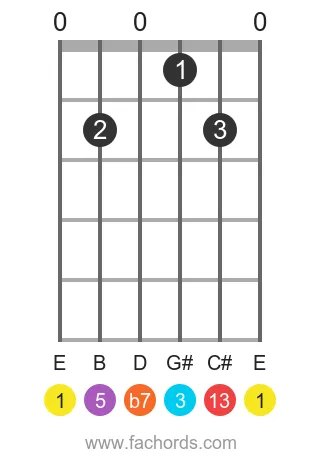
Position 5
Open
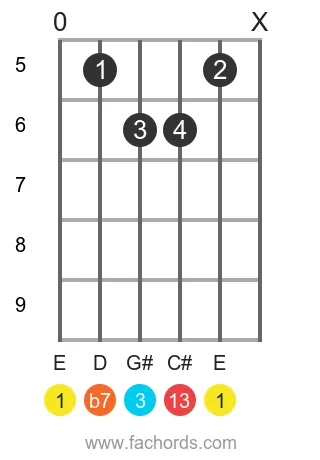
Position 6
Barre
Movable
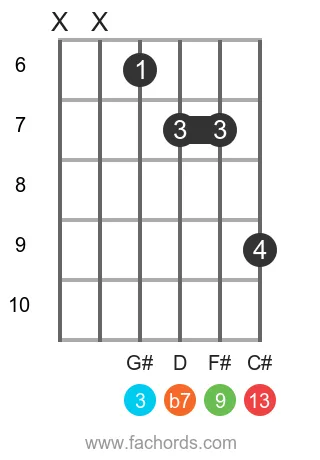
Position 7
Barre
Open
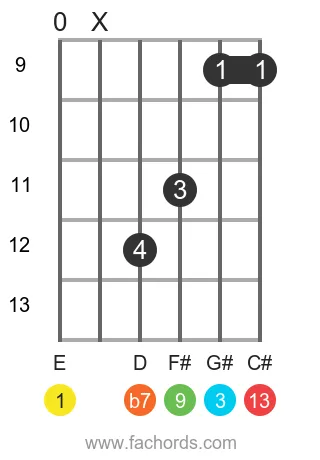
Position 8
Barre
Movable
 Find more shapes in our all guitar chords online library. If you
prefer a printable pdf, download
the Free Guitar Chords Chart Pdf
Find more shapes in our all guitar chords online library. If you
prefer a printable pdf, download
the Free Guitar Chords Chart Pdf
You can also use this accessible E13 chord page, with written diagram instructions and screen-reader support for blind users.
FAQ
What defines an E13 chord and what are its key components?
The E13 chord is a complex chord belonging to the Dominant Chords family, known for its sophisticated and rich sound. It is composed of the notes E, G#, B, D, F#, A, and C#. These notes represent the intervals 1 (Root), 3 (Major Third), 5 (Perfect Fifth), b7 (Minor Seventh), 9 (Major Ninth), 11 (Perfect Eleventh), and 13 (Major Thirteenth).
Why is the E13 chord classified as a Dominant Chord?
The E13 chord is part of the Dominant Chords family because its fundamental structure includes the root, major third, perfect fifth, and minor seventh (1, 3, 5, b7). These intervals are characteristic of dominant 7th chords, with the 9th, 11th, and 13th intervals serving as extended harmonies built upon this dominant foundation.
What do the specific interval numbers (1, 3, 5, b7, 9, 11, 13) signify in the E13 chord?
These numbers represent the musical distance, or interval, of each note from the root note E. '1' is the Root (E), '3' is the Major Third (G#), '5' is the Perfect Fifth (B), 'b7' is the Minor Seventh (D), '9' is the Major Ninth (F#), '11' is the Perfect Eleventh (A), and '13' is the Major Thirteenth (C#). Understanding these intervals is crucial for comprehending the chord's construction.
In what musical styles is the E13 chord typically used?
Due to its sophisticated and rich harmonic quality, the E13 chord is frequently used in jazz and blues music. Its extended intervals provide a unique color and tension often sought after in these genres.
How do visual aids like chord diagrams and fretboard patterns help in learning the E13 chord?
Chord diagrams and fretboard patterns provide visual representations of where to place your fingers to play the E13 chord. They help you understand the physical arrangement of the notes on the guitar fretboard, making it easier to grasp the chord's structure and learn to play it efficiently.