E 11 Guitar Chord
Chord Diagrams, Interactive Fretboard and Chord Theory
E dominant 11th guitar chord is also written as E11, Edom11 or E7(11).
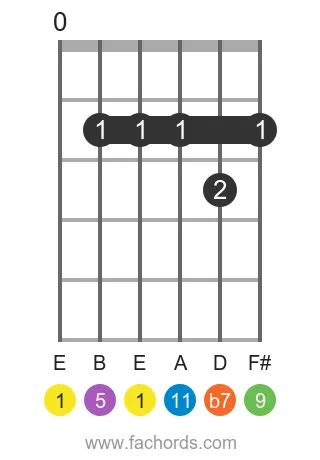
Position 1
Open
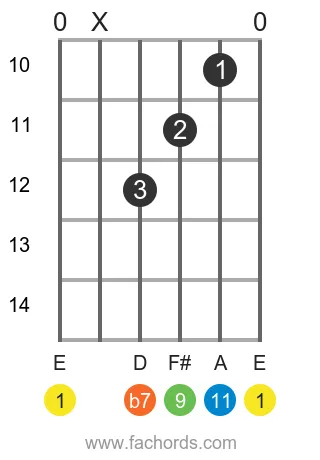
Position 2
Barre
Open
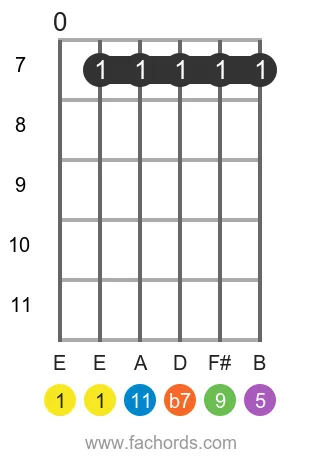
Position 3
Barre
Open
 Find more shapes in our all guitar chords online library. If you
prefer a printable pdf, download
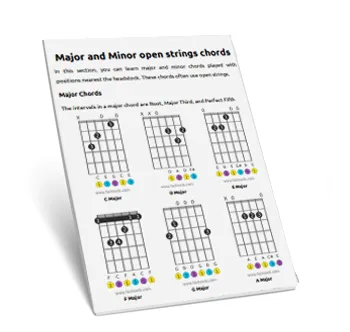
the Free Guitar Chords Chart Pdf
Find more shapes in our all guitar chords online library. If you
prefer a printable pdf, download
the Free Guitar Chords Chart Pdf
You can also use this accessible E11 chord page, with written diagram instructions and screen-reader support for blind users.
Practice E11 Chord for Guitar: Unlocking Its Musical Potential
Want a structured chord roadmap instead of jumping between pages?
Go to the full guitar chords tutorial.
Dive into the rich, complex sound of the E11 chord, a captivating member of the Dominant Chords family that adds a sophisticated flavor to jazz, funk, and R&B progressions. This extended harmony is composed of the notes E, G#, B, D, F#, and A, representing the Root (1), Major Third (3), Perfect Fifth (5), Minor Seventh (b7), Major Ninth (9), and Perfect Eleventh (11) intervals. Explore its voicings directly on our interactive fretboard, where you can instantly hear its unique character played back and verify your accuracy in real-time using our mic feedback tool, ensuring you're hitting every note perfectly.
The Eleventh is a fascinating extension, adding a vibrant layer of dissonance that enriches the dominant sound. Building on the foundation of Ninth Chords, the E11's unique interval structure, particularly the eleventh (A natural over E), creates a rich harmonic tension. A solid grasp of Chord Construction principles will greatly enhance your understanding of how these complex voicings are built and how they function within a progression. This is key to not only playing the chord but also understanding its role and potential for resolution.
Before diving deep into chord theory and analyzing diagrams from easiest to hardest, or exploring specific songs and keys where the E11 chord shines, we encourage you to spend time simply playing. Experiment with different voicings on our virtual fretboard to discover the E11's expressive potential. Let your ears guide you as you start expanding your chord vocabulary and integrate this powerful sound into your guitar playing.
Notes in the E 11 chord:
Chord Structure:
Play This Chord With Other Roots
C 11 | D 11 | E 11 | F 11 | G 11 | A 11 | B 11 | C#11 | D#11 | F#11 | G#11 | A#11 | Ab11 | Bb11 | Db11 | Eb11 | Gb11

Created by
Giancarlo is a musician (teaching guitar since 2000), software engineer, AI consultant and published researcher
FAQ
What is an E 11 chord and what are its constituent notes?
The E 11 chord is a complex dominant chord composed of six specific notes: E, G#, B, D, F#, and A. It's a member of the Dominant Chords family, which often creates a sense of tension leading to resolution in music.
What intervals make up the E 11 chord?
The E 11 chord is built upon the following intervals relative to its root (E): the Root (1), Major Third (3), Perfect Fifth (5), Minor Seventh (b7), Major Ninth (9), and Perfect Eleventh (11). These intervals correspond to the notes E, G#, B, D, F#, and A respectively.
Why is the E 11 classified as a 'Dominant Chord'?
The E 11 chord is classified as a dominant chord primarily because of its Minor Seventh (b7) interval, which is the note D in this case. This characteristic interval creates a specific harmonic tension that is typical of dominant chords and often resolves to a tonic chord.
What is the significance of including the 9th (F#) and 11th (A) intervals in the E 11 chord?
The inclusion of the Major Ninth (F#) and Perfect Eleventh (A) extends the basic dominant 7th chord, adding richness, complexity, and a distinct 'open' or 'suspended' quality to the E 11. These higher extensions provide more color and harmonic options, opening up new musical possibilities.
What role do chord diagrams and fretboard patterns play in mastering the E 11 chord?
Chord diagrams and fretboard patterns are visual aids that clearly illustrate where each of the E 11 chord's notes (E, G#, B, D, F#, A) are located on the guitar fretboard. They are essential for helping guitarists visualize the chord's construction, understand note placement, and learn various practical voicings to play the chord.