Eb 7(#9) Guitar Chord | Play, Hear and Practice Interactively
Want a structured chord roadmap instead of jumping between pages?
Go to the full guitar chords tutorial.
The Eb 7(#9) chord, a distinct member of the Dominant Chords family, is built from the notes Eb, G, Bb, Db, and F#. These correspond to the intervals 1 (Root), 3 (Major Third), 5 (Perfect Fifth), b7 (Minor Seventh), and #9 (Augmented Ninth). Use the interactive fretboard tool at the top of this page to visually explore fingerings, hear the chord played as a strum or arpeggio, and get instant guidance with real-time microphone feedback on your playing accuracy.
This particular dominant chord, often called the 'Hendrix chord' due to its characteristic bluesy-jazz sound, adds a rich, complex harmonic flavor to your playing. To understand its construction fully, delve into our Chord Construction tutorial, and explore how it fits into the broader family of Dominant Chords. For deeper insight into its specific interval, check out our guide on Ninth Chords. Mastering these complex shapes can also benefit from tips in our Improve Chords Change guide.
Scroll down this page to discover a comprehensive collection of Eb 7(#9) chord diagrams, arranged from the most accessible open positions to more challenging movable shapes. You'll also find relevant music theory, popular songs that feature this chord, and a list of keys where it commonly appears. But before you dive into static diagrams, take a moment to engage with the interactive tool above – use the drum and BPM tool to set your tempo, practice strumming or arpeggiating the chord, and rely on the mic feedback to refine your technique. This active learning approach is the quickest way to integrate the Eb 7(#9) into your repertoire.
Eb 7th with sharp 9th guitar chord is also written as Eb7(#9), Eb7#9 or Eb7+9. It is also known as the Hendrix chord.
Notes that compose the Eb 7(#9) chord:
Chord Structure:
Eb 7(#9) Guitar Chord Diagrams
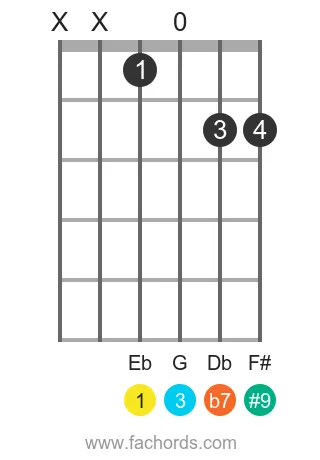
Position 1 Open
Finger Positions
- Mute the low E string
- Mute the A string
- Let the G string play without pressing any fret
- Place your index finger (1) on the fret 1 of the D string
- Place your ring finger (3) on the fret 2 of the B string
- Place your pinky finger (4) on the fret 2 of the high E string
Position 2 Movable
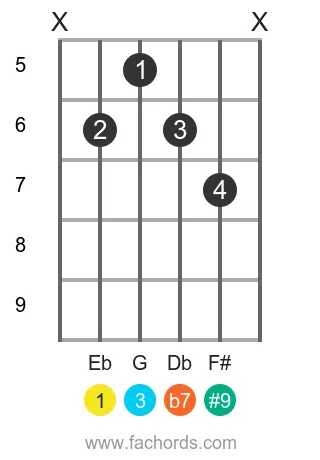
Finger Positions
- Mute the low E string
- Mute the high E string
- Place your index finger (1) on the fret 5 of the D string
- Place your middle finger (2) on the fret 6 of the A string
- Place your ring finger (3) on the fret 6 of the G string
- Place your pinky finger (4) on the fret 7 of the B string
Position 3 Barre Movable
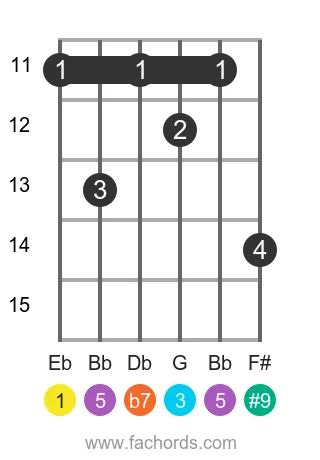
Finger Positions
- Place your index finger (1) on the fret 11 of the low E, D and B strings at the same time
- Place your middle finger (2) on the fret 12 of the G string
- Place your ring finger (3) on the fret 13 of the A string
- Place your pinky finger (4) on the fret 14 of the high E string
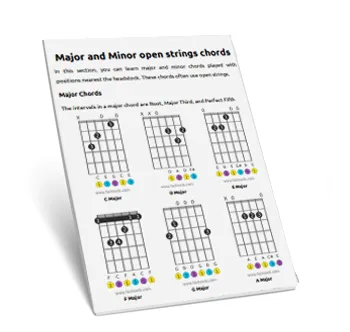
 Find more shapes in our all guitar chords online library. If you
prefer a printable pdf, download
the Free Guitar Chords Chart Pdf
Find more shapes in our all guitar chords online library. If you
prefer a printable pdf, download
the Free Guitar Chords Chart Pdf

Created by
Giancarlo is a musician (teaching guitar since 2000), software engineer, AI consultant and published researcher
FAQ
What notes make up the Eb 7(#9) chord?
The Eb 7(#9) chord is composed of the notes Eb, G, Bb, Db, and F#. These notes are derived from specific intervals built upon the root Eb.
What intervals are used to build the Eb 7(#9) chord?
The Eb 7(#9) chord is constructed using the intervals 1 (Root), 3 (Major Third), 5 (Perfect Fifth), b7 (Minor Seventh), and #9 (Augmented Ninth).
What does the '7' and '#9' mean in the Eb 7(#9) chord name?
In the Eb 7(#9) chord, the '7' indicates that the chord includes a Minor Seventh interval from the root (Db). The '#9' signifies the inclusion of an Augmented Ninth interval (F#), which adds a specific color and tension to the chord.
Why is the Eb 7(#9) considered a dominant chord?
The Eb 7(#9) chord is part of the Dominant Chords family because it contains the root, major third, perfect fifth, and minor seventh (Eb, G, Bb, Db). The #9 is an extension often added to dominant chords to enhance their characteristic sound and function.
When is the Eb 7(#9) chord typically used in music?
The Eb 7(#9) chord, like other dominant chords, is frequently used to add depth and complexity in genres such as blues, jazz, and rock music. It provides a unique, tension-filled sound.
What is the role or effect of the #9 interval in the Eb 7(#9) chord?
The #9 (Augmented Ninth) interval, which is F# in the Eb 7(#9) chord, adds a distinctive, often bluesy or jazzy, tension and color to the chord. It creates a rich, expressive sound that makes the chord stand out.