Eb7(b9) Guitar Chord | Play, Hear, and Master It Interactively
Want a structured chord roadmap instead of jumping between pages?
Go to the full guitar chords tutorial.
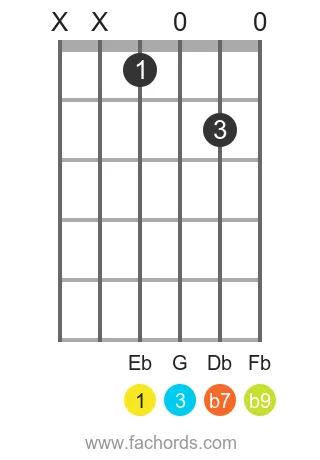
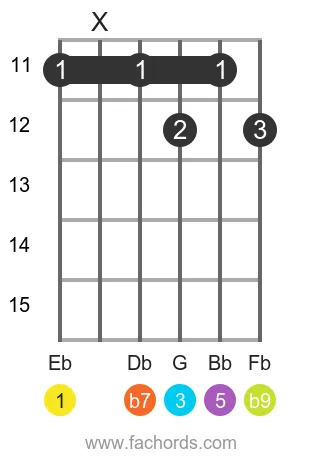
The Eb 7(b9) chord, a captivating member of the Dominant Chords family, is built from the notes Eb, G, Bb, Db, and Fb, corresponding to the intervals Root (1), Major Third (3), Perfect Fifth (5), Minor Seventh (b7), and Minor Ninth (b9). Use the interactive fretboard tool at the top of this page to visualize fingerings, hear the chord played as a strum or arpeggio, and get instant feedback on your playing with the real-time microphone detection.
This complex chord adds a unique, rich tension that's a staple in jazz and blues. To deepen your understanding of its role, explore our guide on the Dominant Chord family, or delve into the specifics of added tensions like the b9 with our Ninth Chords tutorial. For a comprehensive look at how chords are built, check out our Chord Construction resource. Mastering chords like this also means smooth transitions – improve your playing with tips from our Improve Chords Change guide.
As you scroll down, you'll discover a collection of chord diagrams, carefully ranked from the easiest open positions to more challenging barre shapes, alongside detailed music theory, popular songs featuring the Eb7(b9), and the keys where it shines. Before you dive into the diagrams, make sure to spend some quality time with the interactive tool above – use the integrated drum machine to set a comfortable tempo, strum the chord, and let the mic feedback guide your hand placement. This hands-on practice is the quickest route to truly internalizing this powerful chord.
Notes that compose the Eb 7(b9) chord:
How the Dominant Seventh Flat Nine Added chord is built:
Eb Dominant Seventh Flat Nine Added Guitar Chord Diagrams
Position 1
Open
Position 2
Movable
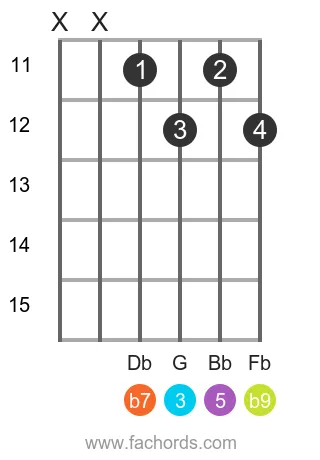
Position 3
Movable
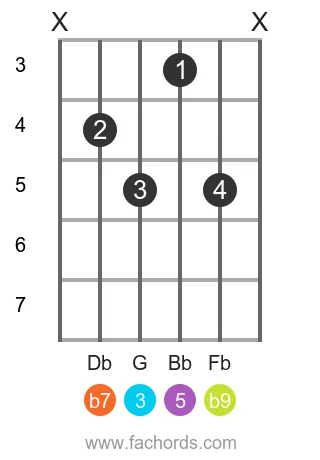
Position 4
Barre
Movable
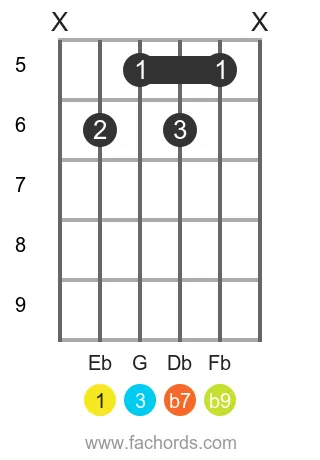
Position 5
Barre
Movable
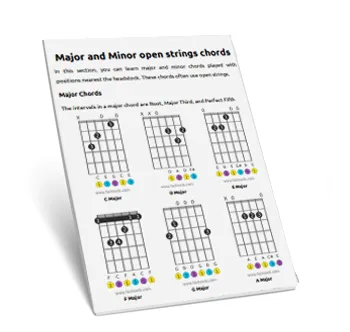
 Find more shapes in our all guitar chords online library. If you
prefer a printable pdf, download
the Free Guitar Chords Chart Pdf
Find more shapes in our all guitar chords online library. If you
prefer a printable pdf, download
the Free Guitar Chords Chart Pdf
You can also use this accessible Eb7(b9) chord page, with written diagram instructions and screen-reader support for blind users.
FAQ
What are the essential notes and intervals that make up the Eb 7(b9) chord?
The Eb 7(b9) chord is comprised of five specific notes: Eb, G, Bb, Db, and Fb. These notes correspond to the following intervals relative to the root Eb: the Root (1), Major Third (3), Perfect Fifth (5), Minor Seventh (b7), and Minor Ninth (b9).
What does 'dominant' mean in the context of the Eb 7(b9) chord, and how does the 'b9' interval influence its sound?
The Eb 7(b9) chord belongs to the Dominant Chords family, which are known for creating musical tension that typically leads to resolution. The 'b9' (minor ninth) interval specifically adds a rich, complex, and unique flavor to this dominant sound, making it particularly expressive and often utilized in blues and jazz.
Why is 'Fb' listed as a note in the Eb 7(b9) chord instead of E natural?
The note Fb is used to accurately represent the minor ninth interval (b9) from the root Eb, following standard music theory conventions for stacking intervals. Although Fb sounds enharmonically equivalent to E natural, Fb is the theoretically correct spelling to maintain the proper sequence of diatonic interval degrees within the chord structure.
How is the Eb 7(b9) chord structurally built from its constituent intervals?
The Eb 7(b9) chord is built by stacking specific intervals above its root, Eb. This construction involves adding a Major Third (G), a Perfect Fifth (Bb), a Minor Seventh (Db), and then a Minor Ninth (Fb) on top of the root. This precise layering of intervals defines the chord's unique harmonic character.
In what musical situations or genres would I typically use an Eb 7(b9) chord on guitar?
The Eb 7(b9) chord is highly effective in creating tension and driving harmonic movement, making it a prominent feature in genres like blues and jazz. Understanding its structure allows you to identify where it fits into common chord progressions, which in turn helps you add greater depth and complexity to your music.
