D sus4 Guitar Chord
Chord Diagrams, Interactive Fretboard and Chord Theory
D suspended 4th guitar chord is also written as Dsus4, Dsus or D4.
Position 1
Open
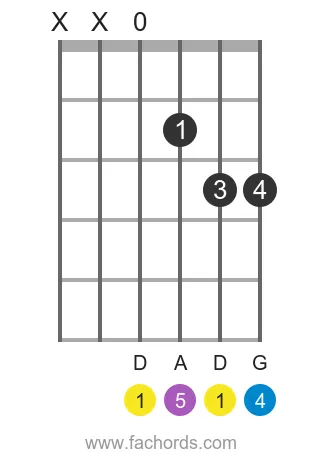
Position 2
Open
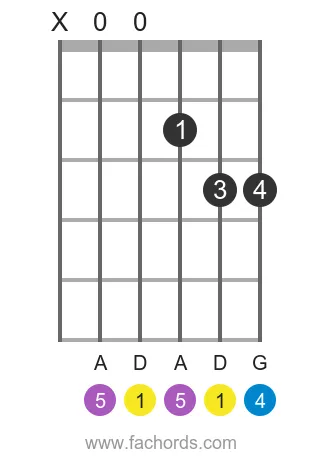
Position 3
Barre
Movable
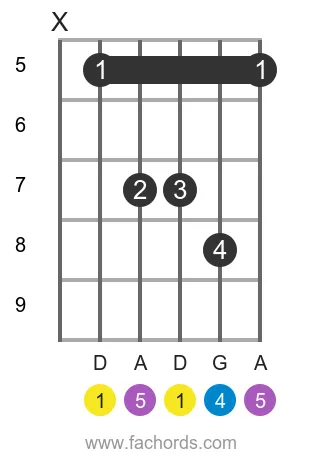
Position 4
Barre
Movable
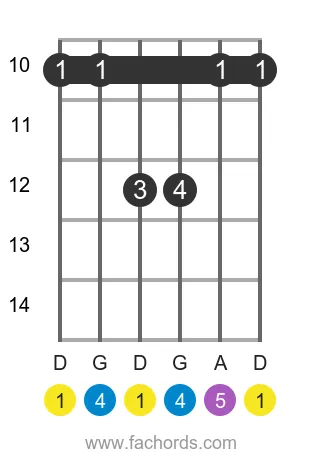
 Find more shapes in our all guitar chords online library. If you
prefer a printable pdf, download
the Free Guitar Chords Chart Pdf
Find more shapes in our all guitar chords online library. If you
prefer a printable pdf, download
the Free Guitar Chords Chart Pdf
You can also use this accessible Dsus4 chord page, with written diagram instructions and screen-reader support for blind users.
Explore the D sus4 Chord: Play and Understand this Suspended Sound
Want a structured chord roadmap instead of jumping between pages?
Go to the full guitar chords tutorial.
Elevate your sound with the D sus4 chord, a captivating addition to the suspended chords family, perfect for creating tension and release in your music. This chord, comprised of the notes D, G, and A, is constructed using the 1 (Root), 4 (Perfect Fourth), and 5 (Perfect Fifth) intervals. Dive into its unique character using our interactive fretboard, where you can experiment with its sound through chord playback and receive instant real-time mic feedback to confirm your accuracy as you play.
The defining characteristic of the D sus4 chord is the absence of a third interval, which substitutes a perfect fourth, creating its signature unresolved, 'suspended' quality. This unique harmonic structure makes it an excellent choice for building tension that longs for resolution, adding a sophisticated touch to various musical pieces. Understanding how this specific interval structure contributes to its sound can deepen your appreciation for chord dynamics. For a comprehensive overview of how chords are built, explore our guide on Chord Construction. If you're keen to master chords that evoke similar tension, our tutorial on Suspended Chords offers further insights. Additionally, refining your transitions between chords, including sus4 shapes, can significantly improve your playing fluidity; consider our tips to Improve Chords Change.
This page provides a clear path to mastering the D sus4 chord, from understanding its theoretical underpinnings to applying it in real songs and various keys. You'll find a range of chord diagrams presented from the easiest fingerings to more advanced positions, helping you visualize and play the different voicings. Before diving deep into the theory, we encourage you to first experiment with the chord on our interactive fretboard. Play it, hear it, and then refine your understanding to truly make this suspended chord your own.
Notes in the D sus4 chord:
How the Suspended Fourth chord is built:
Play This Chord With Other Roots
C sus4 | D sus4 | E sus4 | F sus4 | G sus4 | A sus4 | B sus4 | C#sus4 | D#sus4 | F#sus4 | G#sus4 | A#sus4 | Absus4 | Bbsus4 | Dbsus4 | Ebsus4 | Gbsus4

Created by
Giancarlo is a musician (teaching guitar since 2000), software engineer, AI consultant and published researcher
FAQ
What notes are in a D sus4 chord?
The D sus4 chord is composed of three distinct notes: D (the root), G (the perfect fourth above D), and A (the perfect fifth above D).
Which intervals define the D sus4 chord?
The D sus4 chord is characterized by the Root, a Perfect Fourth, and a Perfect Fifth. These intervals are represented as 1, 4, and 5 when counting from the root note D.
Why does the D sus4 chord have a unique 'suspended' sound?
The D sus4 chord sounds 'suspended' because it deliberately omits the third interval (which would make it major or minor). Replacing the third with a perfect fourth creates a distinct unresolved quality, building tension and anticipation in the music.
How is a D sus4 chord different from a standard D major or D minor chord?
The main difference is the absence of the third interval. While D major and D minor chords include a major or minor third respectively, the D sus4 replaces this with a perfect fourth, resulting in a more open, unresolved sound that often implies movement or resolution.
When should I use a D sus4 chord in my guitar playing?
You can effectively use the D sus4 chord to create a feeling of tension and release in your music. It's often employed to build anticipation before resolving to a D major or D minor chord, adding a dynamic and expressive element to your progressions across many genres.