Master the D Minor 7th Guitar Chord
Want a structured chord roadmap instead of jumping between pages?
Download the step-by-step Guitar Chord Ebook
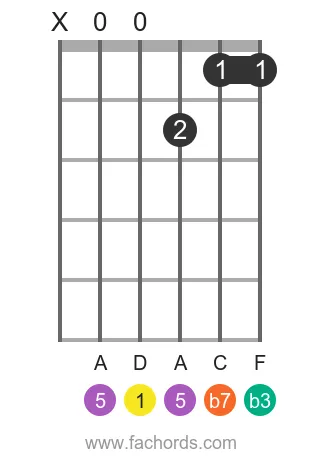
The D minor 7 (Dm7) chord is fundamentally constructed from the root, a minor third, a perfect fifth, and a minor seventh. This specific intervalic structure gives it its distinct sound within the Minor Chords family. Specifically, the notes that form the Dm7 are D, F, A, and C. To truly understand and internalize this construction, use our interactive fretboard tool where you can explore its fingerings, play the chord and its arpeggio, and receive precise, real-time mic feedback to confirm your accuracy.
The Dm7 chord holds significant importance for creating rich harmonies, especially when exploring modal applications and developing a strong rhythmic groove. Its characteristic sound makes it a cornerstone in many genres, notably jazz and R&B. Understanding its theoretical foundation is crucial; learning about chord construction will deepen your musical understanding. This knowledge forms the basis for mastering various forms, including 3-note 7th chords, which provide efficient ways to play this versatile chord. Additionally, practicing your chord changes to and from Dm7 will enhance your fluidity on the fretboard.
After exploring the Dm7 with the interactive tool, delve into the various chord diagrams provided, ranging from the most accessible shapes to more challenging voicings. Solidify your understanding by connecting the theory to practical applications within different songs and musical keys. Consistent and disciplined practice, coupled with the immediate feedback from our virtual fretboard, is the most effective path to truly mastering the Dm7 chord.
Notes in the D m7 chord:
Chord Formula:
Dm7 Guitar Chord | Full Tutorial
Dm7 is a versatile and emotionally rich chord that can add depth to your music.
Whether in pop, funk, or blues, its unique sound enhances musical expression, making it a valuable addition to your guitar-playing repertoire.
Experiment with different positions and listen to its use in various songs to fully appreciate and master this chord.
Here below you find important information about this chord.
The Dm7 3 Most Common Voicings
Open String Voicing
This is the most frequent shape that guitar players learn at the beginning.
- Middle finger on the 2nd fret of the G (3rd) string
- Partial barre across the 6th and 5th strings, with the index finger
- Let the D string ring open
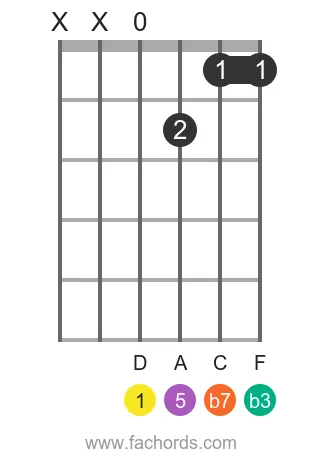
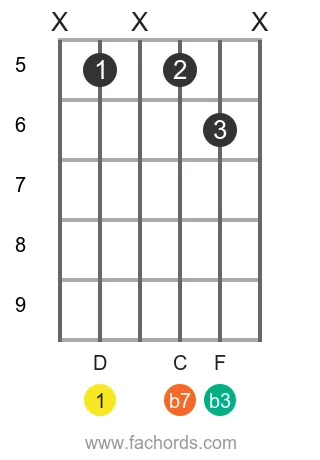
Movable Shape Version 1
This is a quite difficult shape that use a 5-string barre. You can move this shape up or down the fretboard to play other m7 chord, because it does not use open strings.
- 5-strings barre (5th to 1st) with index finger at the 5th fret.
- Middle finger on the 6th fret of the B (2nd) string
- Ring finger on the 7th fret of the D (3rd) string
- Mute the E lowest string
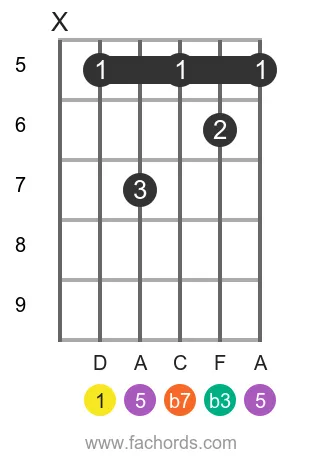
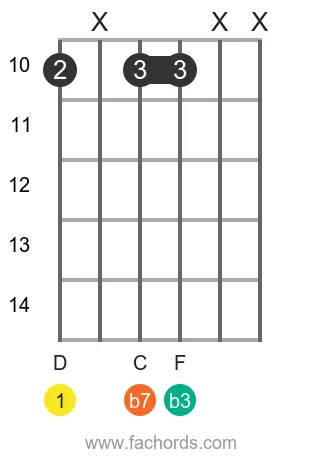
Movable Shape - Shell Chord
This is a shell chord shape, often used in Jazz.
- Index finger on the 10th fret of the 6th string (E string).
- Place your middle finger on the 10th fret of the 3rd string (D string)
- Place your ring finger on the 10th fret of the 4th string (G string)
- Mute the 5th (A), 1st (E) and 2nd (B) strings.
Keys And Roles Of Dm7 Chord
The Dm7 is common in C Major and F Major keys.
In the C Major key, Dm7 is the 2nd degree, called the supertonic, and it's quite common in ii-V-I Jazz progression
In the F Major key, D is the relative minor (6th degree), the submediant.
C Major Key
| C maj7 | D m7 | E m7 | F maj7 | G 7 | A m7 | B m7/b5 |
|---|---|---|---|---|---|---|
| B (7) G (5) E (3) C (1) |
C (1) A (6) F (4) D (2) |
D (2) B (7) G (5) E (3) |
E (3) C (1) A (6) F (4) |
F (4) D (2) B (7) G (5) |
G (5) E (3) C (1) A (6) |
A (6) F (4) D (2) B (7) |
F Major Key
| F maj7 | G m7 | A m7 | Bb maj7 | C 7 | D m7 | E m7/b5 |
|---|---|---|---|---|---|---|
| E (7) C (5) A (3) F (1) |
F (1) D (6) Bb (4) G (2) |
G (2) E (7) C (5) A (3) |
A (3) F (1) D (6) Bb (4) |
Bb (4) G (2) E (7) C (5) |
C (5) A (3) F (1) D (6) |
D (6) Bb (4) G (2) E (7) |
Typical Chord Progression With Dm7
Here are some common chord progressions in which you'll find this chord:
- In C Major: Dm7 as ii, in a ii-V-I Jazz progression: Dm7 - G7 - Cmaj7
- In Bb Major: Dm7 as iii, in a I-iii7-ii7 progression: Bb - Dm7 - Cm7
- In F Major: Dm7 as vi, in a I-ii-IV-vi7 progression: F - Gm - Bb - Dm7
Guitar Chord Shapes For Dm7
Position 1
Movable
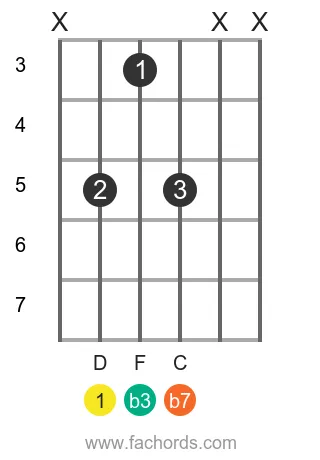
Position 2
Movable
Position 3
Movable
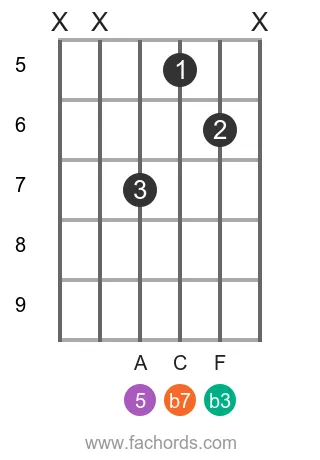
Position 4
Open
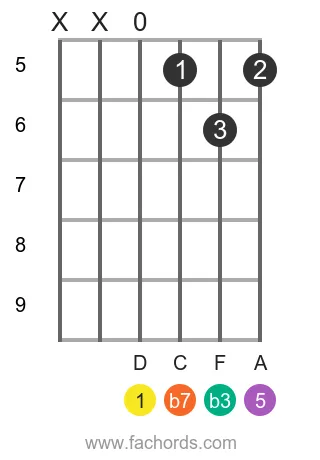
Position 5
Movable
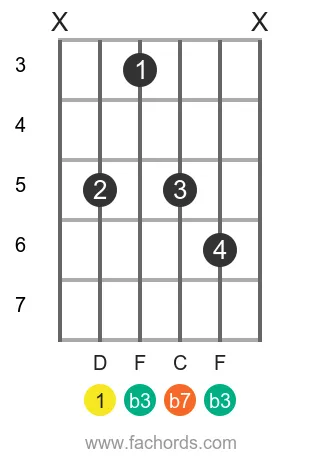
Position 6
Barre
Movable

Position 7
Barre
Open

Position 8
Barre
Open
Position 9
Barre
Movable
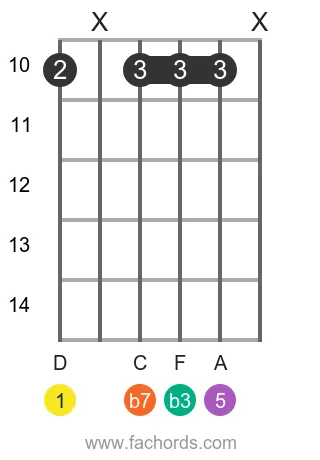
Position 10
Barre
Movable
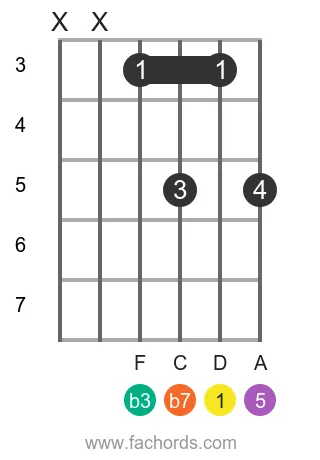
Position 11
Barre
Movable
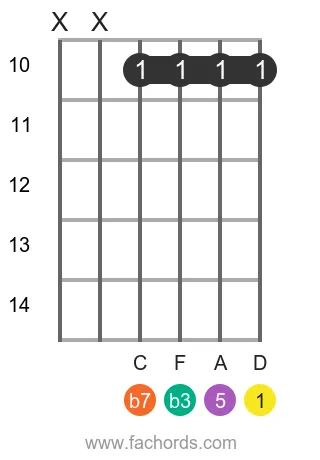
Position 12
Barre
Movable

Position 13
Barre
Movable
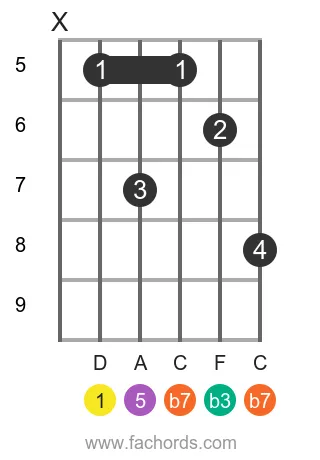
Position 14
Barre
Movable
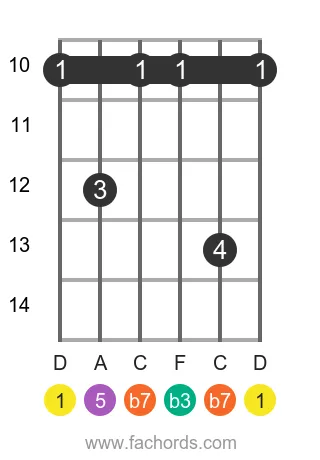
 Find more shapes in our all guitar chords online library. If you
prefer a printable pdf, download
the Free Guitar Chords Chart Pdf
Find more shapes in our all guitar chords online library. If you
prefer a printable pdf, download
the Free Guitar Chords Chart Pdf
You can also use this accessible Dm7 chord page, with written diagram instructions and screen-reader support for blind users.
FAQ
What are the essential notes and intervals that define a Dm7 chord?
A Dm7 chord is fundamentally defined by its root note D, along with specific intervals: the 1 (root), b3 (minor third), 5 (perfect fifth), and b7 (minor seventh). These intervals translate to the notes D, F, A, and C, which together give the Dm7 chord its distinctive minor sound with added depth.
In what musical contexts or genres is the Dm7 chord commonly used?
The Dm7 chord is highly versatile and frequently appears in a wide array of musical genres. It is a staple in jazz, where its rich, complex sound is often utilized, particularly in ii-V-I progressions. Beyond jazz, you'll also find the Dm7 chord adding depth and character in pop, funk, and blues music.
What is the benefit of learning movable Dm7 chord shapes compared to an open string voicing?
Movable Dm7 chord shapes offer significant flexibility because they do not rely on open strings. This means you can transpose the entire chord shape up or down the fretboard to play other minor seventh chords, making them invaluable for navigating different keys and creating varied chord progressions across the guitar neck.
What is a 'shell chord' Dm7 voicing and why is it useful in jazz?
A Dm7 'shell chord' is a minimalist voicing that focuses on the most harmonically essential notes of the chord, typically the root, third (or minor third), and seventh (or minor seventh). These concise voicings are often used in jazz to provide harmonic clarity while allowing other instruments or the guitarist's improvisation to fill out the sound, offering greater rhythmic and melodic freedom.
How does the Dm7 chord function within different musical keys and common chord progressions?
The Dm7 chord plays distinct roles depending on the musical key. In C Major, it functions as the 'ii' (two minor) chord, also known as the supertonic, and is a key component of the ii-V-I jazz progression (Dm7 - G7 - Cmaj7). In F Major, Dm7 serves as the 'vi' (six minor) chord, or the submediant, representing the relative minor. Understanding these functions helps integrate Dm7 naturally into various progressions like I-iii7-ii7 in Bb Major or I-ii-IV-vi7 in F Major.