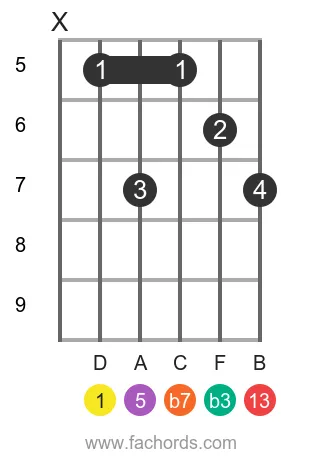
D m13 Guitar Chord
Chord Diagrams, Interactive Fretboard and Chord Theory
D minor 13th guitar chord is also written as Dm13, Dmin13 or D-13.
Position 1
Barre
Movable
 Find more shapes in our all guitar chords online library. If you
prefer a printable pdf, download
the Free Guitar Chords Chart Pdf
Find more shapes in our all guitar chords online library. If you
prefer a printable pdf, download
the Free Guitar Chords Chart Pdf
You can also use this accessible Dm13 chord page, with written diagram instructions and screen-reader support for blind users.
Explore D m13 Chord Shapes on Guitar
Want a structured chord roadmap instead of jumping between pages?
Go to the full guitar chords tutorial.
Dive into the intricate fretboard geometry of the D m13 chord, a rich member of the Minor Chords family. This complex voicing features the notes D, F, A, C, E, G, and B, built from the intervals 1, b3, 5, b7, 9, 11, and 13. Visualize these shapes across the strings using our interactive virtual fretboard, and confirm your finger placement and sound production in real-time with precise mic feedback. Our tool provides instant validation as you experiment with different voicings and arpeggios.
Understanding the specific intervals-Root, Minor Third, Perfect Fifth, Minor Seventh, Major Ninth, Perfect Eleventh, and Major Thirteenth-is key to grasping the unique character of this extended minor chord. Its rich, colorful sound adds depth to compositions, often found in jazz and neo-soul. For a deeper dive into how these notes are stacked, explore our Chord Construction guide. You can also expand your understanding of similar voicings with our Ninth Chords tutorial, which explores how extensions are built upon foundational harmonies.
Below, you'll find various chord diagrams, organized from simpler voicings to more challenging shapes, ready for you to experiment with. Each diagram highlights the theoretical components of the D m13 chord, revealing how it can be applied across different keys and incorporated into your song repertoire. Begin by exploring these shapes visually on the interactive fretboard above; truly understand their spatial relationships before committing them to memory.
D m13 chord Notes:
Chord Formula:
Play This Chord With Other Roots
C m13 | D m13 | E m13 | F m13 | G m13 | A m13 | B m13 | C#m13 | D#m13 | F#m13 | G#m13 | A#m13 | Abm13 | Bbm13 | Dbm13 | Ebm13 | Gbm13

Created by
Giancarlo is a musician (teaching guitar since 2000), software engineer, AI consultant and published researcher
FAQ
What specific notes and intervals define the D m13 chord?
The D m13 chord is comprised of the notes D, F, A, C, E, G, and B. These notes correspond to the intervals of Root (1), Minor Third (b3), Perfect Fifth (5), Minor Seventh (b7), Major Ninth (9), Perfect Eleventh (11), and Major Thirteenth (13) respectively.
What makes the D m13 chord an 'intermediate' level chord compared to simpler guitar chords?
The D m13 chord is considered intermediate because it is significantly more complex than basic beginner chords. It incorporates several extended intervals – the 9th, 11th, and 13th – in addition to the root, third, fifth, and seventh. This requires a deeper understanding of music theory and more intricate fingerings on the guitar.
In what musical genres or contexts is the D m13 chord most commonly used?
The D m13 chord is frequently used in genres like jazz, where its rich, complex sound adds sophistication and harmonic depth to chord progressions. Learning this chord can open up new musical possibilities, particularly in styles that utilize advanced harmonies.
How do the 9th, 11th, and 13th intervals contribute to the sound of a D m13 chord?
The 9th, 11th, and 13th intervals are known as extensions, and they are what elevate a basic minor chord to a D m13. These added notes contribute to the chord's characteristic rich, 'open,' and sometimes 'airy' sound, providing a more complex and colorful harmonic texture than simpler minor chords or minor 7th chords.