Explore and Play the Dm11 Guitar Chord
Want a structured chord roadmap instead of jumping between pages?
Go to the full guitar chords tutorial.
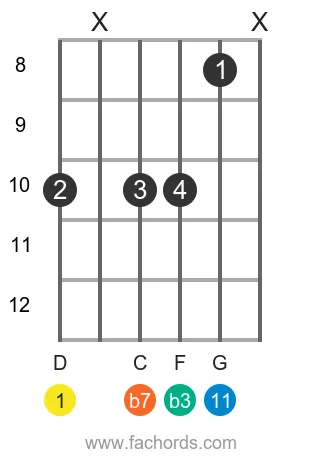
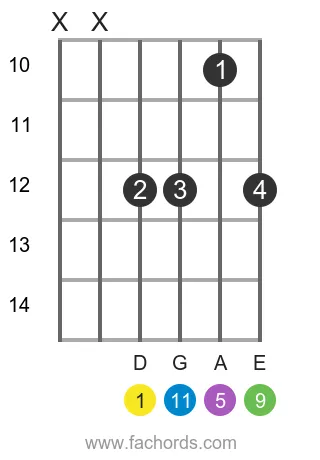
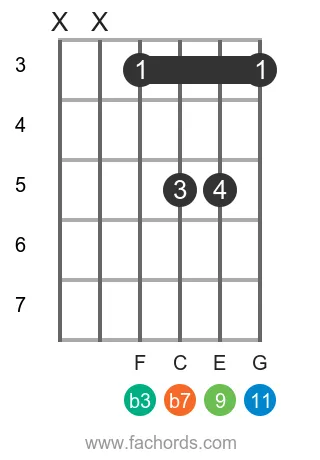
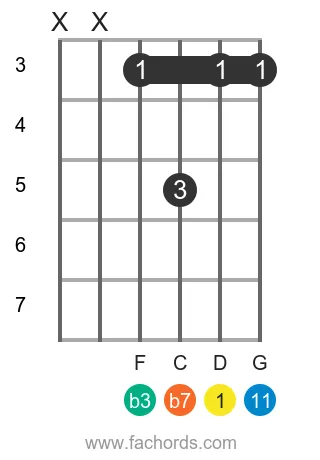
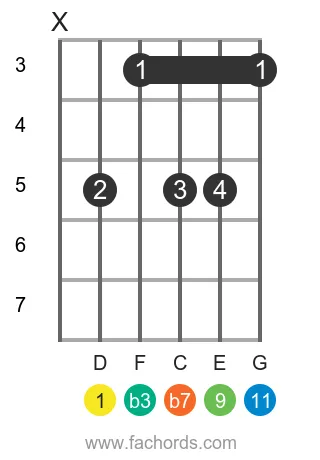
Often found enriching jazz and fusion compositions, the Dm11 chord adds a complex, sophisticated flavor to your playing. This intriguing member of the Minor Chords family is constructed from the notes D, F, A, C, E, and G, representing the intervals 1, b3, 5, b7, 9, and 11. Our interactive fretboard acts as your personal exploration lab, allowing you to instantly hear this chord's unique sound with chord and arpeggio playback, and instantly check your accuracy with real-time mic feedback.
As an extended chord, the Dm11 moves beyond basic triads to introduce rich color tones, characteristic of advanced harmony. Understanding its unique interval structure – featuring the minor third, minor seventh, ninth, and eleventh – is key to unlocking its full potential and application in modern music. If you're keen to deepen your understanding of how chords are built, explore our tutorial on Chord Construction. For those integrating more advanced harmonies into their playing, learning about Ninth Chords can provide further insight, building on the foundation of 7th chords often seen in Dominant Chords and jazz progressions. These concepts help you not just play, but truly understand the sonic richness you're adding to your compositions.
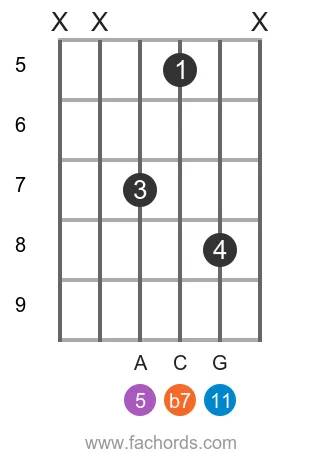
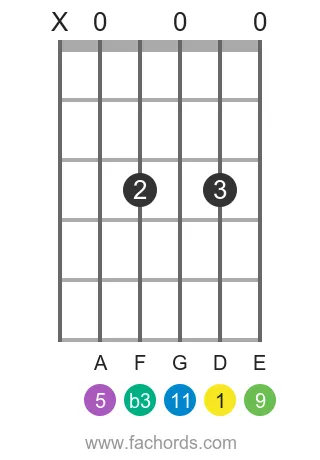
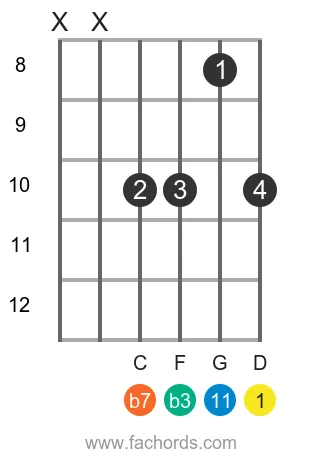
Before diving into the detailed diagrams, which present the Dm11 chord from easiest to hardest voicings, we encourage you to first experiment with the interactive fretboard above. Use the playback and mic feedback to internalize its distinct sound. This hands-on approach will make exploring the underlying theory and practical applications in various songs and keys much more intuitive and rewarding. Start playing, then delve into the analysis!
D minor 11th guitar chord is also written as Dm11, Dmin11 or D-11.
Notes in the D m11 chord:
Tones of the Minor Eleventh chord:
D M11 Guitar Chord Diagrams
Position 1
Movable
Position 2
Open
Position 3
Movable
Position 4
Movable
Position 5
Movable
Position 6
Barre
Movable
Position 7
Barre
Movable
Position 8
Barre
Movable
Position 9
Barre
Movable
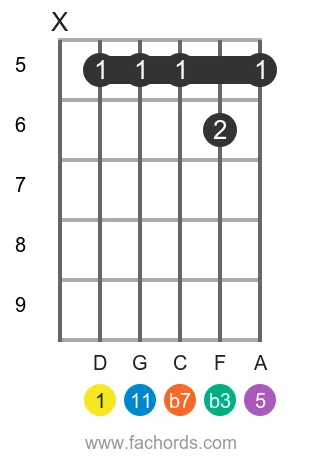
Position 10
Barre
Movable
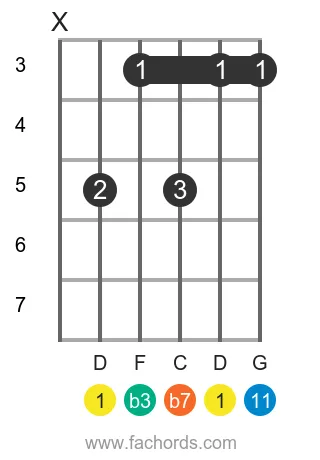
Position 11
Barre
Movable
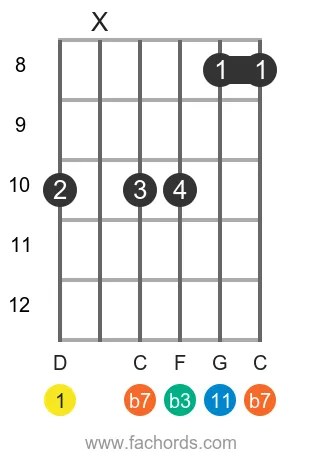
 Find more shapes in our all guitar chords online library. If you
prefer a printable pdf, download
the Free Guitar Chords Chart Pdf
Find more shapes in our all guitar chords online library. If you
prefer a printable pdf, download
the Free Guitar Chords Chart Pdf
You can also use this accessible Dm11 chord page, with written diagram instructions and screen-reader support for blind users.


Created by
Giancarlo is a musician (teaching guitar since 2000), software engineer, AI consultant and published researcher
FAQ
What notes and intervals make up the Dm11 chord?
The Dm11 chord is composed of six distinct notes: D, F, A, C, E, and G. These notes represent the intervals of the Root (D), Minor Third (F), Perfect Fifth (A), Minor Seventh (C), Major Ninth (E), and Perfect Eleventh (G) respectively.
Why is the Dm11 considered a complex or advanced chord?
The Dm11 chord is considered complex and advanced because it includes six notes, making it harmonically dense. It expands beyond basic triads and seventh chords by incorporating the Major Ninth and Perfect Eleventh intervals, requiring a deeper understanding of music theory and often more finger dexterity to play on the guitar.
How does the Dm11 chord differ from a simpler minor chord like a Dm7?
A Dm7 chord consists of the Root, Minor Third, Perfect Fifth, and Minor Seventh (D, F, A, C). The Dm11 chord builds upon this by adding two more intervals: the Major Ninth (E) and the Perfect Eleventh (G). These additional notes contribute to its fuller, richer, and often more open or suspended sound.
When is the Dm11 chord typically used in music?
The Dm11 chord is primarily used in jazz and fusion music to add sophisticated harmonic depth and complexity. It’s effective in chord progressions where other extended chords like major seventh, minor seventh, and dominant seventh types are common, providing a nuanced and often mellow sound.
What is the significance of the '9' and '11' in the Dm11 chord name?
The '9' and '11' in the Dm11 chord name refer to the Major Ninth (E) and Perfect Eleventh (G) intervals, which are added to a D minor seventh chord. These are known as chord extensions and are crucial for creating the characteristic rich and extended harmony of the Dm11, distinguishing it from simpler minor chords.
