Explore and Master the Dmmaj7 Guitar Chord on the Fretboard
Want a structured chord roadmap instead of jumping between pages?
Go to the full guitar chords tutorial.
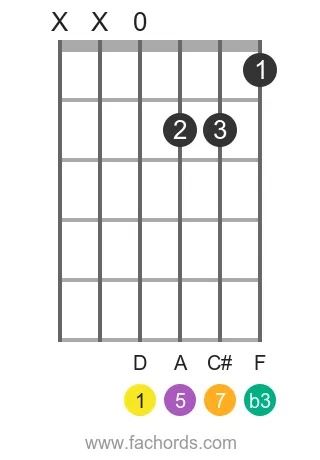
Unlock the unique sound of the D m(maj7) chord by visualizing its fretboard geometry and movable shapes. Our interactive virtual fretboard allows you to see how this distinctive chord, part of the Minor Chords family, lays out across the strings. Composed of the notes D, F, A, and C#, and built with the intervals 1, b3, 5, and 7, you can immediately test your accuracy using our real-time mic feedback feature to verify your playing technique.
Understanding the intervals (Root (1), Minor Third (b3), Perfect Fifth (5), and Major Seventh (7)) that form the D m(maj7) is key to appreciating its rich, often jazz-influenced color. This chord's sophisticated quality makes it a staple in advanced harmony. If you're interested in how chords are constructed from intervals, our dedicated resource on Chord Construction provides a comprehensive guide. For those looking to integrate such complex voicings smoothly into their playing, tips on Improve Chords Change can be invaluable.
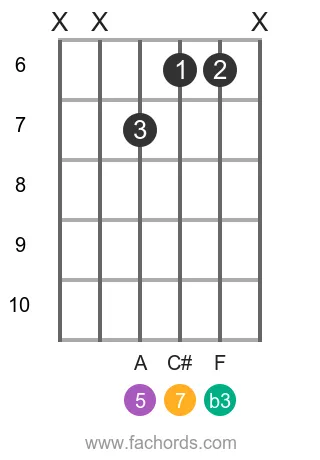
Before attempting to memorize shapes, explore the various fingering diagrams below, ranked from easiest to hardest, on our virtual fretboard. You'll also find comprehensive theory explanations and suggestions for integrating the D m(maj7) chord into songs across different keys. Use the interactive tool to visually grasp the fretboard geometry, solidifying your understanding before committing shapes to memory. This hands-on exploration will accelerate your progress and help you truly internalize this chord's character.
D m(maj7) chord Notes:
Chord Structure:
Dm(maj7) Guitar Chord Voicings
Position 1
Movable
Position 2
Open
 Find more shapes in our all guitar chords online library. If you
prefer a printable pdf, download
the Free Guitar Chords Chart Pdf
Find more shapes in our all guitar chords online library. If you
prefer a printable pdf, download
the Free Guitar Chords Chart Pdf
You can also use this accessible Dm(maj7) chord page, with written diagram instructions and screen-reader support for blind users.


Created by
Giancarlo is a musician (teaching guitar since 2000), software engineer, AI consultant and published researcher
FAQ
What notes make up the D m(maj7) chord?
The D m(maj7) chord is composed of four specific notes: D, F, A, and C#. These correspond to the root, minor third, perfect fifth, and major seventh intervals, respectively, when starting from the root note D.
What is the difference between a D m(maj7) chord and other D minor chords?
The key difference lies in the seventh interval. A standard D minor 7 chord includes a minor seventh (C), while the D m(maj7) chord features a major seventh (C#). This combination of a minor triad (D, F, A) with a major seventh (C#) gives it its distinctive sound and notation.
Why is this chord named D m(maj7)? What does 'm(maj7)' signify?
The 'D' indicates the root note of the chord. The 'm' stands for minor, specifically referring to the minor third interval (F) above the root. The '(maj7)' or sometimes 'M7' specifies that the seventh interval (C#) is a major seventh, distinguishing it from a chord with a minor seventh.
When should I use the D m(maj7) chord in my guitar playing?
The D m(maj7) chord offers a rich, complex, and often melancholic sound that is frequently employed in jazz music and other genres that benefit from sophisticated harmony. It can add color and tension to chord progressions, making it suitable for moments where a more nuanced emotional quality is desired.
