D 7-sharp-9 Guitar Chord
Chord Diagrams, Interactive Fretboard and Chord Theory
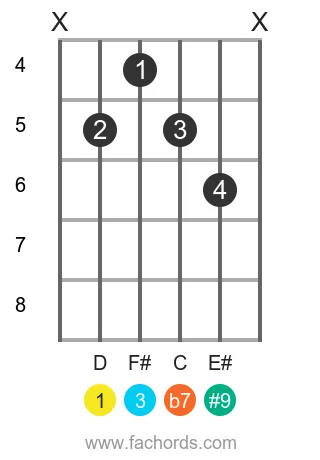
D 7th with sharp 9th guitar chord is also written as D7(#9), D7#9 or D7+9. It is also known as the Hendrix chord.
Position 1
Movable
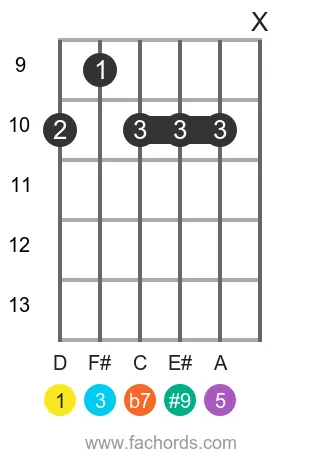
Position 2
Barre
Movable
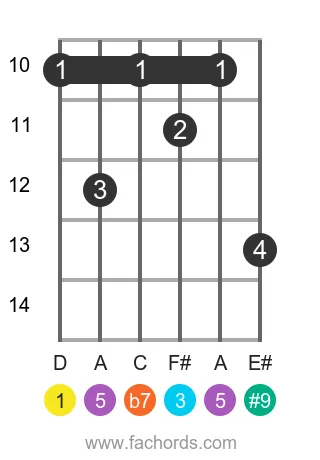
Position 3
Barre
Movable
 Find more shapes in our all guitar chords online library. If you
prefer a printable pdf, download
the Free Guitar Chords Chart Pdf
Find more shapes in our all guitar chords online library. If you
prefer a printable pdf, download
the Free Guitar Chords Chart Pdf
You can also use this accessible D7(#9) chord page, with written diagram instructions and screen-reader support for blind users.
Explore D7(#9) Guitar Chord Shapes on Our Interactive Fretboard
Want a structured chord roadmap instead of jumping between pages?
Go to the full guitar chords tutorial.
Start by visualizing the unique fingerings and movable shapes of the D 7(#9) chord across your guitar fretboard. Our interactive virtual fretboard allows you to see the exact positions for each note, offering a clear visual guide. As you play, get instant, real-time mic feedback to confirm your accuracy, ensuring each note resonates perfectly. This Dominant Chord is composed of the notes D, F#, A, C, and E#, corresponding to the intervals 1, 3, 5, b7, and #9, creating its rich, complex sound.
As a pivotal member of the Dominant Chords family, the D 7(#9) chord excels at building musical tension that demands resolution, a characteristic highly valued in blues and jazz. This augmented ninth extension adds a distinct color, making it a powerful tool for expressive playing. Understanding its construction, which involves a specific blend of music intervals like the Root, Major Third, Perfect Fifth, Minor Seventh, and Augmented Ninth, is crucial. If you're interested in the theory behind these rich harmonies, our guide on Chord Construction can help demystify how chords are built. You can also explore Dominant Chord principles further or delve into the world of Ninth Chords to grasp the full potential of this unique voicing.
Scroll down to find detailed chord diagrams, meticulously ranked from the easiest to the most challenging, each showcasing various fingerings for the D 7(#9) chord. Beyond just playing, you'll uncover the underlying theory and discover how this chord fits into various songs and musical keys. But before memorizing, we encourage you to use our interactive tool above to truly explore these shapes and understand their feel on the fretboard. Happy playing!
Notes that compose the D 7(#9) chord:
Tones of the Dominant Seventh Sharp Ninth Added chord:
Play This Chord With Other Roots
C 7(#9) | D 7(#9) | E 7(#9) | F 7(#9) | G 7(#9) | A 7(#9) | B 7(#9) | C#7(#9) | D#7(#9) | F#7(#9) | G#7(#9) | A#7(#9) | Ab7(#9) | Bb7(#9) | Db7(#9) | Eb7(#9) | Gb7(#9)

Created by
Giancarlo is a musician (teaching guitar since 2000), software engineer, AI consultant and published researcher
FAQ
What are the notes and intervals that make up the D7(#9) guitar chord?
The D7(#9) chord is composed of the notes D, F#, A, C, and E#. These notes correspond to specific musical intervals relative to the root D: the Root (D), Major Third (F#), Perfect Fifth (A), Minor Seventh (C), and Augmented Ninth (E#).
Why is the D7(#9) chord considered a Dominant Chord?
The D7(#9) chord belongs to the Dominant Chord family because it includes the root, major third, perfect fifth, and a minor seventh interval. The presence of the minor seventh (C in this case) inherently creates a sense of tension that typically seeks resolution, which is a defining characteristic of dominant chords. The added #9 further amplifies this tension.
What is the musical role of the D7(#9) chord in genres like blues and jazz?
The D7(#9) chord plays a crucial role in music, especially in blues and jazz, by creating significant tension and a strong pull towards resolution. Its complex sound adds a rich, distinctive flavor and emotional depth, driving the musical progression forward.
What does the '#9' in D7(#9) signify?
The '#9' in D7(#9) indicates an augmented ninth interval. This means the ninth degree of the scale (E in the key of D) is raised by a half-step. For the D7(#9) chord, this results in the note E#, adding a characteristic 'sharp ninth' sound to the dominant chord.
Why is the note E# used in the D7(#9) chord instead of F?
While E# and F are enharmonically the same pitch, E# is used in the D7(#9) chord to accurately represent its theoretical interval from the root (D). It is an augmented ninth above D (D-E is a major second, D-E# is an augmented second, extended to the ninth). Calling it F would incorrectly imply an altered eleventh or another interval, disrupting the clear understanding of the chord's construction from its root.