D 7-sharp-5 Guitar Chord
Chord Diagrams, Interactive Fretboard and Chord Theory
D dominant 7th with sharp 5th guitar chord is also written as D7(#5), D7#5, D7+5 or Daug7.
Position 1
Movable
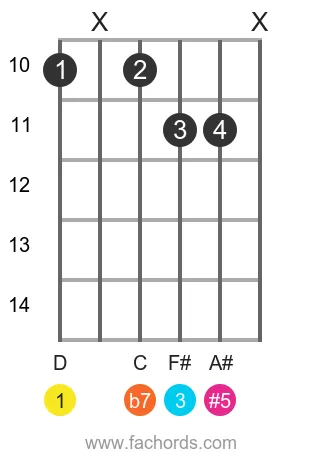
Position 2
Barre
Movable
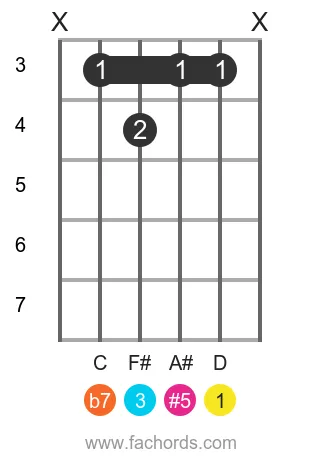
Position 3
Barre
Movable
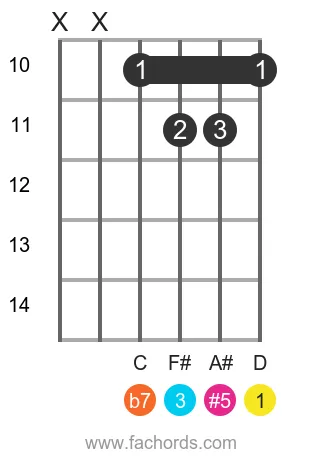
Position 4
Barre
Movable
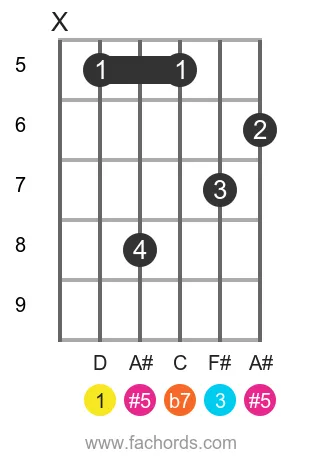
Position 5
Barre
Movable
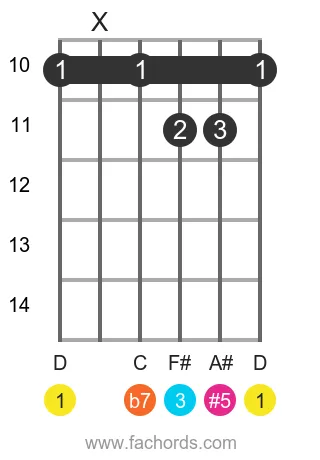
 Find more shapes in our all guitar chords online library. If you
prefer a printable pdf, download
the Free Guitar Chords Chart Pdf
Find more shapes in our all guitar chords online library. If you
prefer a printable pdf, download
the Free Guitar Chords Chart Pdf
You can also use this accessible D7(#5) chord page, with written diagram instructions and screen-reader support for blind users.
Practice D 7#5 Guitar Chord with Real-time Accuracy Feedback
Want a structured chord roadmap instead of jumping between pages?
Go to the full guitar chords tutorial.
Ready to tackle the D 7(#5) chord? Test your playing instantly with our interactive fretboard, providing real-time mic feedback on your accuracy. This powerful chord, a member of the Augmented Chords family, is built from the notes D, F#, A#, and C, representing the 1 (Root), 3 (Major Third), #5 (Augmented Fifth), and b7 (Minor Seventh) intervals. Use the integrated drum machine to practice your timing.
The D 7(#5) chord combines a root, major third, augmented fifth, and minor seventh, creating a distinct sound that often finds its place in more advanced musical contexts. Understanding the unique interval structure is key to mastering such chords, and our comprehensive guide on Chord Construction can illuminate how these elements come together. As part of the extended family of Dominant Chords, the D 7(#5) can add sophisticated tension to your progressions, making it a valuable addition to your harmonic vocabulary.
Before diving into the detailed diagrams, theory explanations, or exploring the chord in different musical keys and songs, we encourage you to use the interactive fretboard to internalize the sound and feel of the D 7(#5) chord. Our diagrams, arranged from easiest to hardest, will help you visualize various fingerings. Practice consistently and you'll find yourself incorporating this unique chord into your playing with confidence.
D 7(#5) chord Notes:
Formula of the Dominant Seventh Sharp Fifth chord:
Play This Chord With Other Roots
C 7(#5) | D 7(#5) | E 7(#5) | F 7(#5) | G 7(#5) | A 7(#5) | B 7(#5) | C#7(#5) | D#7(#5) | F#7(#5) | G#7(#5) | A#7(#5) | Ab7(#5) | Bb7(#5) | Db7(#5) | Eb7(#5) | Gb7(#5)

Created by
Giancarlo is a musician (teaching guitar since 2000), software engineer, AI consultant and published researcher
FAQ
What notes make up the D 7(#5) chord on guitar?
The D 7(#5) chord is composed of four specific notes: D, F#, A#, and C. These notes correspond to the chord's root, major third, augmented fifth, and minor seventh intervals, respectively.
What are the essential intervals that define the D 7(#5) chord's structure?
The D 7(#5) chord is uniquely defined by its specific intervals: the Root (1), a Major Third (3), an Augmented Fifth (#5), and a Minor Seventh (b7). These intervals are fundamental to understanding its construction and sound.
Why is the D 7(#5) chord classified as both an Augmented and a Dominant chord?
This chord is considered part of the Dominant (7) chord family because it contains the root, major third, and minor seventh (1, 3, b7) intervals. It's simultaneously part of the Augmented Chords family due to the presence of its augmented fifth (#5) interval, which significantly alters its characteristic sound.
How does the augmented fifth (#5) interval impact the sound of the D 7(#5) chord?
The augmented fifth (#5) interval replaces the perfect fifth typically found in a standard dominant 7th chord. This alteration creates a distinctively tense, 'unique' sound. This added tension makes the D 7(#5) chord particularly effective for creating harmonic interest and leading to specific resolutions in musical phrases.
When and where is the D 7(#5) chord commonly used in music?
The D 7(#5) chord is often employed in more advanced musical contexts, especially within jazz chord progressions. Its unique and complex sound makes it a valuable tool for adding color, building tension, and facilitating sophisticated harmonic movements.