Master the D7b9 Guitar Chord: Understand and Play with Precision
Want a structured chord roadmap instead of jumping between pages?
Go to the full guitar chords tutorial.
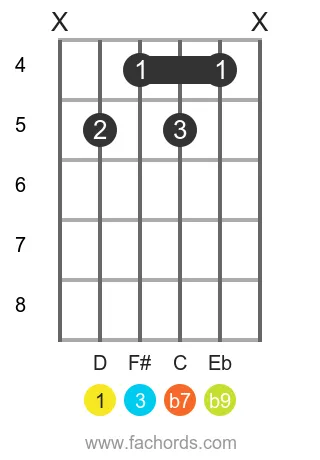
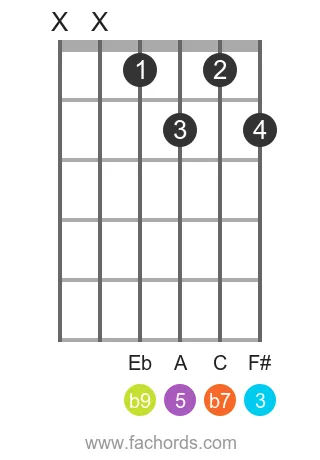
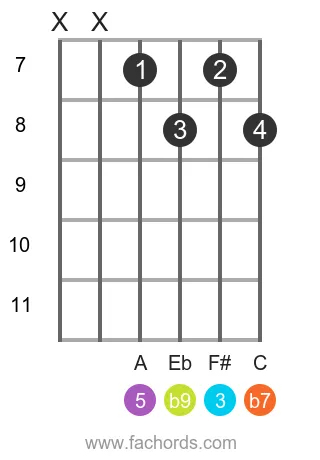
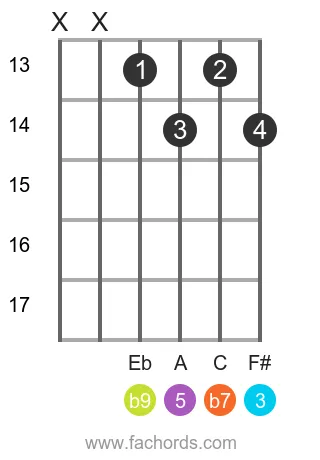
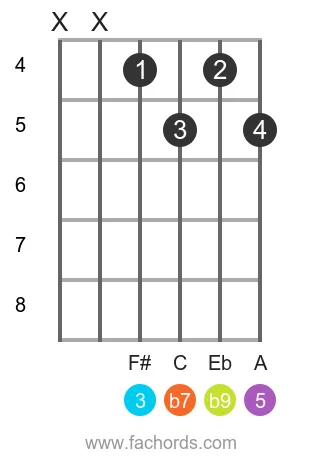
The D 7(b9) chord is fundamentally built upon the intervals 1, 3, 5, b7, and b9, corresponding to the Root, Major Third, Perfect Fifth, Minor Seventh, and Minor Ninth. This intricate structure defines its place within the Dominant Chords family, comprising the notes D, F#, A, C, and Eb. To truly grasp its construction and sound, utilize our interactive fretboard tool, allowing you to both visualize and hear the chord's playback. Moreover, our integrated mic feedback system provides instant verification of your playing accuracy, fostering disciplined practice.
Grasping the precise interval structure is vital for mastering chords beyond basic triads. This specific chord, as an extended dominant, introduces tension and color often employed in jazz and blues. For a deeper understanding of how intervals combine to form complex harmonies, explore our guide on Chord Construction. Furthermore, as a member of the Dominant Chords family, the D 7(b9) often functions as a crucial harmonic pivot; delve into its broader context with our dedicated tutorial on Dominant Chords. Given the inclusion of a flat ninth, understanding Ninth Chords can further enhance your theoretical and practical application of this voicing.
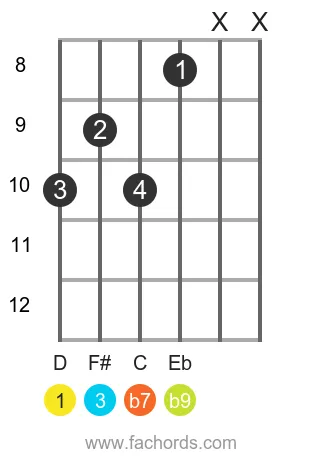
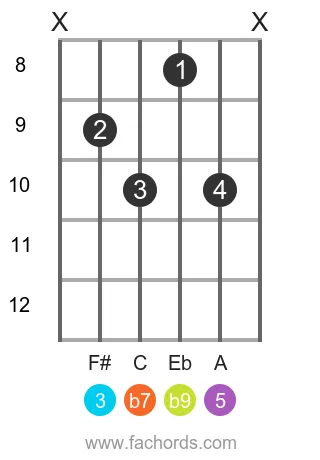
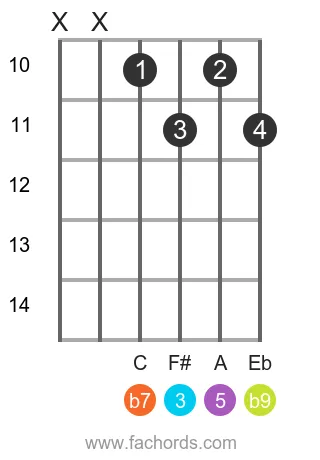
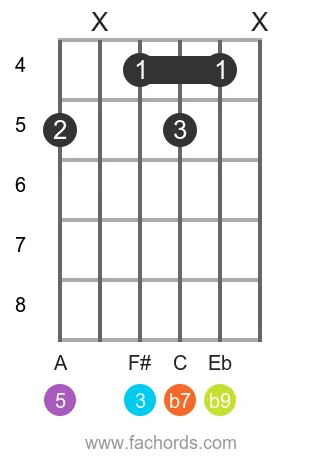
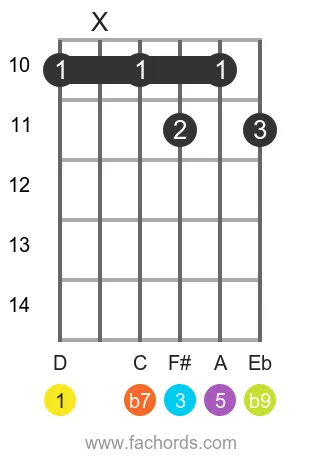
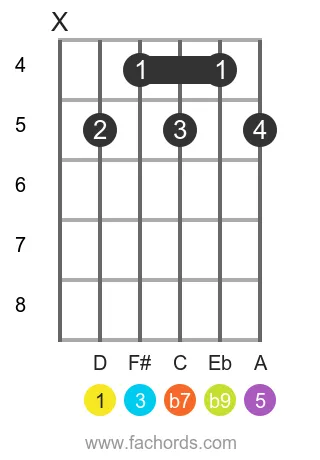
Below, you'll discover comprehensive diagrams for the D 7(b9) chord, ranging from simpler voicings to more challenging fingerings, all applicable across different keys. These visual aids, combined with foundational theory, will aid your comprehension. However, for truly effective and disciplined practice, begin by actively engaging with our interactive tool. Use it to internalize the sound, perfect your technique, and integrate this powerful chord into various musical contexts and songs.
Notes that compose the D 7(b9) chord:
Chord formula for the Dominant Seventh Flat Nine Added chord:
D7(b9) Guitar Chord Fingers Positions
Position 1
Movable
Position 2
Movable
Position 3
Movable
Position 4
Movable
Position 5
Movable
Position 6
Movable
Position 7
Movable
Position 8
Barre
Movable
Position 9
Barre
Movable
Position 10
Barre
Movable
Position 11
Barre
Movable
 Find more shapes in our all guitar chords online library. If you
prefer a printable pdf, download
the Free Guitar Chords Chart Pdf
Find more shapes in our all guitar chords online library. If you
prefer a printable pdf, download
the Free Guitar Chords Chart Pdf
You can also use this accessible D7(b9) chord page, with written diagram instructions and screen-reader support for blind users.
FAQ
What are the specific notes that make up a D7b9 guitar chord?
The D7b9 chord is composed of five distinct notes: D, F#, A, C, and Eb. These notes are derived from the chord's foundational intervals.
What do the '7' and 'b9' in the D7b9 chord name refer to?
In the D7b9 chord, 'D' is the root note. The '7' indicates the presence of a minor seventh interval, and the 'b9' signifies a minor ninth interval. Together, these intervals are the Root, Major Third, Perfect Fifth, Minor Seventh, and Minor Ninth, respectively.
Is the D7b9 chord considered a beginner-friendly chord for guitarists?
No, the D7b9 chord is not a beginner's chord. It is considered an advanced chord, offering a challenge for guitarists who are looking to explore more complex harmonies and expand their skills beyond basic chords.
What musical genres commonly use the D7b9 chord?
The D7b9 chord is a commonly used chord in a variety of music genres, but it holds particular prominence and frequent application in jazz music.
What chord family does the D7b9 belong to, and how is it typically utilized?
The D7b9 chord belongs to the Dominant Chords family. As a dominant chord, it is frequently used in conjunction with other dominant chords, often within advanced chord progressions, particularly in genres like jazz.
