Explore the D 13b9 Guitar Chord with Interactive Tools
Want a structured chord roadmap instead of jumping between pages?
Go to the full guitar chords tutorial.
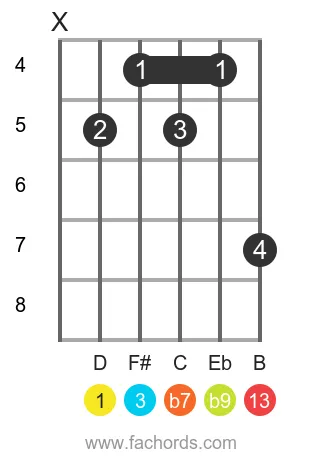
Visually grasp the intricate voicings of the D 13(b9) guitar chord by exploring its various shapes directly on our interactive virtual fretboard. This tool allows you to see how the notes D, F#, A, C, Eb, G, and B, which represent the 1, 3, 5, b7, b9, 11, and 13 intervals, are laid out across the strings. Verify your playing accuracy in real-time with mic feedback, ensuring you hit every note correctly as you learn this complex member of the Dominant Chords family.
Understanding the intricate interval structure of the D 13(b9), composed of the Root, Major Third, Perfect Fifth, Minor Seventh, Minor Ninth, Perfect Eleventh, and Major Thirteenth, is crucial for mastering its unique sound. As a sophisticated extension within the Dominant Chord family, this chord adds a rich, complex flavor often found in jazz contexts. While it's an intermediate to advanced chord, focusing on its chord construction will clarify its distinctive harmonic character and help you integrate it smoothly into your playing.
Dive deeper into the D 13(b9) by exploring its diagrams, arranged from simplest to most complex, along with detailed theory and applications in various songs and keys. Before committing shapes to memory, we encourage you to spend time interacting with the virtual fretboard to internalize the visual logic and sound of this advanced chord.
Notes that compose the D 13(b9) chord:
Tones in the Dominant Thirteen Flat Nine chord:
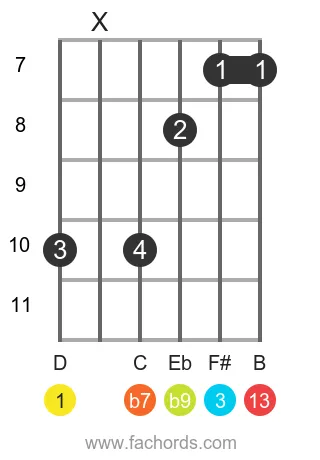
D13(b9) Guitar Chord Fingers Positions
Position 1
Barre
Movable
Position 2
Barre
Movable
 Find more shapes in our all guitar chords online library. If you
prefer a printable pdf, download
the Free Guitar Chords Chart Pdf
Find more shapes in our all guitar chords online library. If you
prefer a printable pdf, download
the Free Guitar Chords Chart Pdf
You can also use this accessible D13(b9) chord page, with written diagram instructions and screen-reader support for blind users.
FAQ
What notes are included in the D 13(b9) guitar chord?
The D 13(b9) chord is composed of seven distinct notes: D, F#, A, C, Eb, G, and B. These specific notes give the chord its characteristic complex and rich sound.
What do the interval numbers 1, 3, 5, b7, b9, 11, and 13 signify in the D 13(b9) chord?
These numbers represent specific musical intervals built from the root note D. They correspond to the Root, Major Third, Perfect Fifth, Minor Seventh, Minor Ninth, Perfect Eleventh, and Major Thirteenth, respectively.
Why is the D 13(b9) chord classified as a 'Dominant Chord'?
The D 13(b9) chord is a member of the Dominant Chords family because its specific intervallic structure, including the minor seventh and altered extensions, gives it a dominant harmonic quality.
What musical quality or sound can I expect from the D 13(b9) chord?
The D 13(b9) chord is recognized for its distinctly complex and rich sound. This quality arises from the combination of its root, third, fifth, minor seventh, and the extended altered intervals of the minor ninth, perfect eleventh, and major thirteenth.
Is the D 13(b9) chord suitable for beginner guitarists?
No, the D 13(b9) chord is considered an intermediate or advanced chord. Its complexity, due to the number of notes and extended intervals, makes it challenging for those new to guitar or complex harmonies.
In what musical genres or situations is the D 13(b9) chord commonly used?
The D 13(b9) chord is frequently utilized in jazz music, particularly within jazz chord progressions. Its complex and rich sound makes it a valuable harmonic tool in this genre.