Explore D 11 Chord Shapes & Positions on Your Guitar
Want a structured chord roadmap instead of jumping between pages?
Download the step-by-step Guitar Chord Ebook
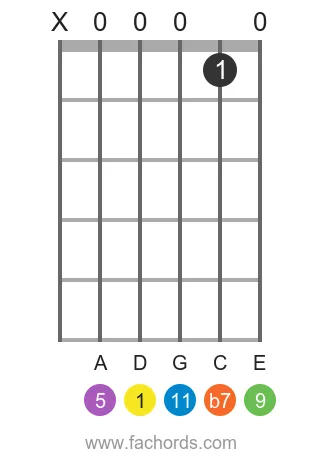
Start by visualizing the D 11 chord across your guitar fretboard, exploring its unique shapes and positions. Our interactive virtual fretboard allows you to see how this complex Dominant Chord, built from the notes D, F#, A, C, E, and G, lays out spatially on the strings. You can also instantly hear the chord's rich sound and verify your playing accuracy in real-time with our innovative mic feedback feature. This chord's distinctive character comes from its intervals: Root, Major Third, Perfect Fifth, Minor Seventh, Major Ninth, and Perfect Eleventh (1, 3, 5, b7, 9, 11).
As an extended chord, the D 11 chord adds rich color and harmonic depth, building upon the foundational dominant seventh and ninth structures. Understanding its construction, by stacking intervals, is key to unlocking these advanced sounds. You can delve deeper into this concept with our guide on Chord Construction. For those exploring the broader family of dominant sounds, our Dominant Chord tutorial provides valuable insights. Also, considering that eleventh chords are extensions of ninth chords, you might find our Ninth Chords lesson particularly helpful in understanding this advanced harmony.
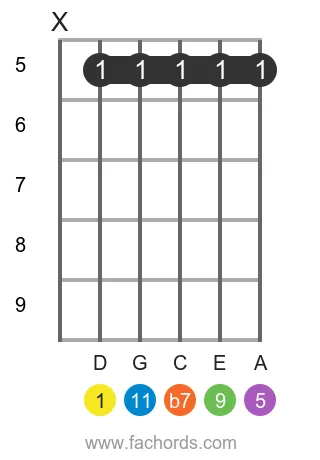
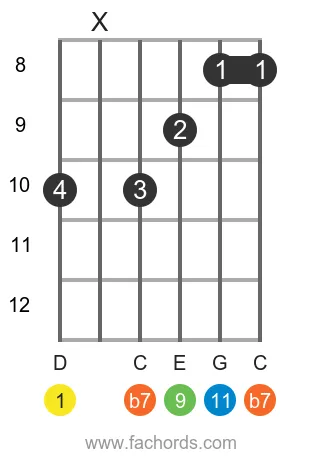
Below, you'll find various chord diagrams for the D 11 chord, organized from simpler voicings to more complex shapes. Before you commit them to memory, we encourage you to use the interactive virtual fretboard to actively explore these shapes. Experiment with their visual layout, practice the theory behind them, and imagine how they could fit into your favorite songs. This hands-on approach will deepen your understanding far beyond just looking at static charts.
Notes of the D 11 chord:
Tones in the Dominant Eleventh chord:
D11 Guitar Chord Shapes
Position 1
Open
Position 2
Barre
Movable
Position 3
Barre
Movable
 Find more shapes in our all guitar chords online library. If you
prefer a printable pdf, download
the Free Guitar Chords Chart Pdf
Find more shapes in our all guitar chords online library. If you
prefer a printable pdf, download
the Free Guitar Chords Chart Pdf
You can also use this accessible D11 chord page, with written diagram instructions and screen-reader support for blind users.
FAQ
What notes are included in a D 11 chord?
The D 11 chord is composed of six distinct notes: D, F#, A, C, E, and G. These notes are arranged to create its characteristic sound.
What intervals construct the D 11 chord?
The D 11 chord is built using a specific set of intervals relative to its root (D). These are the Root (1), Major Third (3), Perfect Fifth (5), Minor Seventh (b7), Major Ninth (9), and Perfect Eleventh (11).
What does it mean for the D 11 to be a 'Dominant Chord'?
The D 11 chord is classified as a member of the Dominant Chords family. This categorization places it within a group of chords known for their particular harmonic function and tension in music.
How is the D 11 chord generally constructed?
The D 11 chord is constructed by stacking its specific intervals (Root, Major Third, Perfect Fifth, Minor Seventh, Major Ninth, and Perfect Eleventh) on top of the root note. This layering of intervals forms the complete chord.
What gives the D 11 chord its 'rich and complex' sound?
The D 11 chord derives its rich and complex sound from the specific combination of its six notes (D, F#, A, C, E, G) and the advanced intervals, Minor Seventh, Major Ninth, and Perfect Eleventh, that are added beyond a basic triad.
Is the D 11 chord difficult for guitarists to learn?
Understanding the D 11 chord and its construction can initially seem complex, especially without familiarity with fretboard intervals and chord notation. However, mastering it is a valuable skill that opens up new possibilities for guitarists.
