D# sus4 Guitar Chord
Chord Diagrams, Interactive Fretboard and Chord Theory
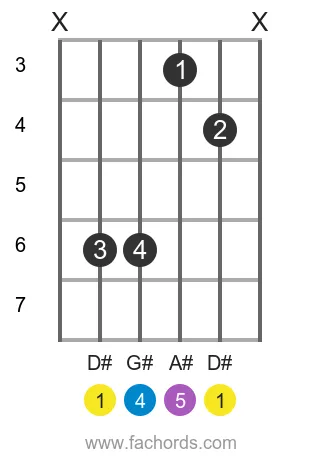
D# suspended 4th guitar chord is also written as D#sus4, D#sus or D#4.
Position 1
Movable
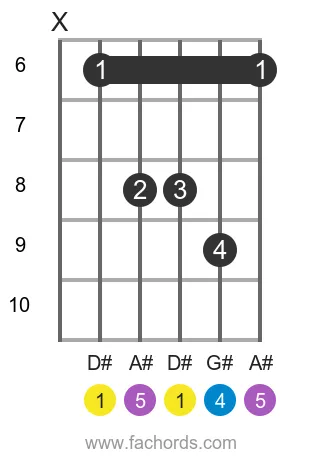
Position 2
Barre
Movable
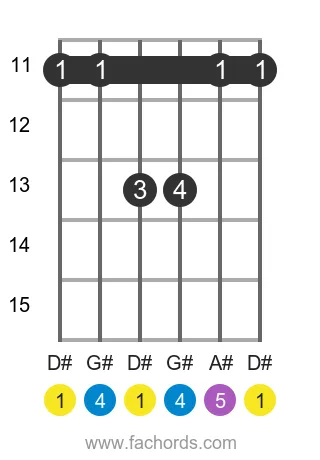
Position 3
Barre
Movable
 Find more shapes in our all guitar chords online library. If you
prefer a printable pdf, download
the Free Guitar Chords Chart Pdf
Find more shapes in our all guitar chords online library. If you
prefer a printable pdf, download
the Free Guitar Chords Chart Pdf
You can also use this accessible D#sus4 chord page, with written diagram instructions and screen-reader support for blind users.
Practice D#sus4: Instant Feedback with Our Interactive Tool
Want a structured chord roadmap instead of jumping between pages?
Go to the full guitar chords tutorial.
Feeling stuck with new guitar chords? Our interactive fretboard is designed to accelerate your learning. Immediately verify your hand positioning and strumming accuracy for the D#sus4 chord using our real-time mic feedback feature. This vibrant suspended chord, known for its unresolved tension, is built from the notes D#, G#, and A#, representing the Root (1), Perfect Fourth (4), and Perfect Fifth (5) intervals. Explore every fingering and hear the chord played as a strum with ease.
Suspended chords like the D#sus4 intentionally omit the third, creating a distinctive, open sound that craves resolution. This unique characteristic is what makes them so versatile in songwriting. To deepen your understanding of how such chords are put together, explore our comprehensive guide on Chord Construction. You can also dive into the world of Suspended Chords for more insights into this chord family. Many common D#sus4 fingerings utilize barre shapes; master them with our Guitar Bar Chords tutorial. Once you're comfortable with the shape, focus on improving your chord changes for fluid playing.
Below, you'll discover a collection of D#sus4 chord diagrams, presented from the simplest open positions to more challenging barre shapes, alongside detailed music theory, popular songs that feature this chord, and the key contexts where it frequently appears. Before you scroll, take a moment to engage with the interactive tool above. Set a comfortable tempo with the drum machine, strum the chord, and use the mic feedback to fine-tune your hand position. This hands-on practice is the most effective way to internalize new chords and truly make them your own.
Notes that compose the D# sus4 chord:
Tones in the Suspended Fourth chord:
Play This Chord With Other Roots
C sus4 | D sus4 | E sus4 | F sus4 | G sus4 | A sus4 | B sus4 | C#sus4 | D#sus4 | F#sus4 | G#sus4 | A#sus4 | Absus4 | Bbsus4 | Dbsus4 | Ebsus4 | Gbsus4

Created by
Giancarlo is a musician (teaching guitar since 2000), software engineer, AI consultant and published researcher
FAQ
What are the specific notes that form a D# sus4 chord?
The D# sus4 chord is composed of three distinct notes: D#, G#, and A#. These notes correspond to the root, a perfect fourth above the root, and a perfect fifth above the root, respectively.
How are the 1, 4, and 5 intervals used to build a D# sus4 chord?
The D# sus4 chord is built by starting with the root note, D#. From there, you add the note that is a perfect fourth interval above D# (which is G#), and finally, the note that is a perfect fifth interval above D# (which is A#). This combination of root, perfect fourth, and perfect fifth creates the chord's unique sound.
Why is the D# sus4 called a 'suspended' chord?
The D# sus4 is called a 'suspended' chord because it creates a sense of suspension or unresolved tension. This is achieved by omitting the traditional third interval, which usually defines a chord as major or minor, and replacing it with a perfect fourth interval instead.
How does a D# sus4 chord's sound differ from a standard D# major or minor chord?
A D# sus4 chord sounds different from a standard major or minor chord because it lacks the defining major or minor third. By replacing the third with a perfect fourth, the chord loses its definitive happy or sad quality and instead presents a feeling of 'unresolved tension' that often implies a desire to resolve to a major or minor chord.