Explore D#m6 Guitar Chord: Interactive Fretboard Guide
Want a structured chord roadmap instead of jumping between pages?
Go to the full guitar chords tutorial.
The D#m6 is a rich, complex minor chord that adds a touch of vintage sweetness and sophistication to your playing, building on a minor triad with a distinct major sixth. This expressive chord, the D#m6, belongs to the Minor Chords family and is constructed from four key notes: D#, F#, A#, and B#, representing the intervals Root (1), Minor Third (b3), Perfect Fifth (5), and Major Sixth (6). To truly grasp its sound and feel, dive into our interactive fretboard tool at the top of this page. You can visualize every possible fingering, hear the chord as a strum or arpeggio, and immediately verify your finger placement with real-time microphone feedback, ensuring you hit every note accurately.
The major sixth interval is what gives the D#m6 chord its characteristic vintage and jazz-like sweetness, distinct from a standard minor triad. Understanding how this extra interval enriches the minor harmony is key. For a deeper dive into these unique voicings, explore our guide on 6th Chords. Building such chords from their fundamental intervals is a core skill; our Chord Construction tutorial offers comprehensive insights. Once you've mastered the shapes, integrating them smoothly into your playing is the next step, which you can refine with tips from our Improve Chords Change page.
As you scroll further down, you'll find comprehensive chord diagrams for D#m6, progressing from accessible open positions to more advanced barre shapes. We also explore the intricate music theory underpinning this chord, provide examples of songs where it shines, and detail the musical keys in which it most naturally appears. But before you delve into the theory and static charts, we highly encourage you to spend some time experimenting with the interactive tool above. Set your desired tempo with the built-in drum tool, play the chord, and truly hear how the D#m6 sounds in different contexts.
D# minor 6th guitar chord is also written as D#m6, D#min6 or D#-6.
Notes that compose the D# m6 chord:
Chord Formula:
D# M6 Guitar Chord Diagrams
Position 1 Movable
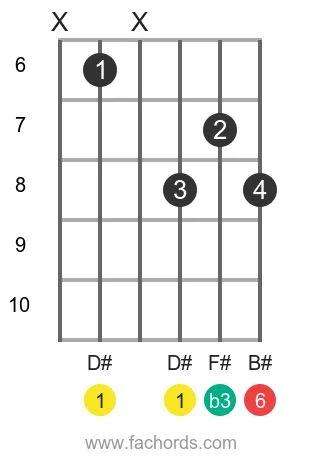
Finger Positions
- Mute the low E string
- Mute the D string
- Place your index finger (1) on the fret 6 of the A string
- Place your middle finger (2) on the fret 7 of the B string
- Place your ring finger (3) on the fret 8 of the G string
- Place your pinky finger (4) on the fret 8 of the high E string
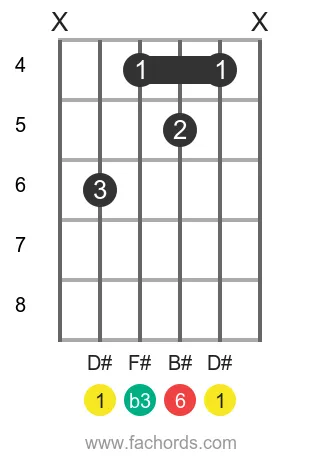
Position 2 Barre Movable
Finger Positions
- Mute the low E string
- Mute the high E string
- Place your index finger (1) on the fret 4 of the D and B strings at the same time
- Place your middle finger (2) on the fret 5 of the G string
- Place your ring finger (3) on the fret 6 of the A string
Position 3 Barre Movable
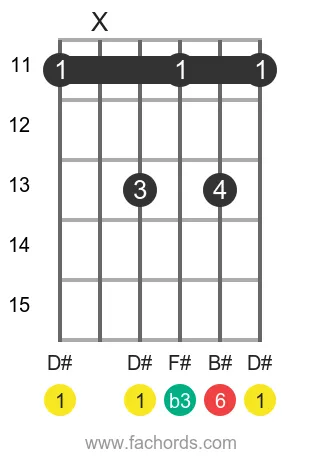
Finger Positions
- Mute the A string
- Place your index finger (1) on the fret 11 of the low E, G and high E strings at the same time
- Place your ring finger (3) on the fret 13 of the D string
- Place your pinky finger (4) on the fret 13 of the B string
 Find more shapes in our all guitar chords online library. If you
prefer a printable pdf, download
the Free Guitar Chords Chart Pdf
Find more shapes in our all guitar chords online library. If you
prefer a printable pdf, download
the Free Guitar Chords Chart Pdf


Created by
Giancarlo is a musician (teaching guitar since 2000), software engineer, AI consultant and published researcher
FAQ
What specific notes make up the D# m6 chord?
The D# m6 chord is built from four specific notes: D#, F#, A#, and B#. These notes correspond to the Root, Minor Third, Perfect Fifth, and Major Sixth intervals, respectively.
How does the '6' in 'D# m6' modify a standard D# minor chord?
The '6' in D# m6 indicates the addition of a Major Sixth interval to a standard D# minor triad. A D# minor chord consists of D#, F#, and A#. Adding the Major Sixth, which is B#, creates the D# m6 chord, giving it its distinct 'rich, complex sound'.
Why is B# used as a note in the D# m6 chord instead of C?
The B# in the D# m6 chord correctly represents the Major Sixth interval when starting from D#. While C is enharmonically equivalent to B# in some contexts, using B# maintains the proper intervallic spelling and relationship within the D# scale structure, following the pattern of 1, b3, 5, and 6.
What kind of musical character does the D# m6 chord offer?
The D# m6 chord is known for its rich and complex sound. This characteristic comes from the specific combination of a minor triad (D#, F#, A#) with the added Major Sixth interval (B#), which introduces a unique color and sophistication compared to a simple minor chord.
