Explore the D#m11 Guitar Chord with Interactive Tools
Want a structured chord roadmap instead of jumping between pages?
Go to the full guitar chords tutorial.
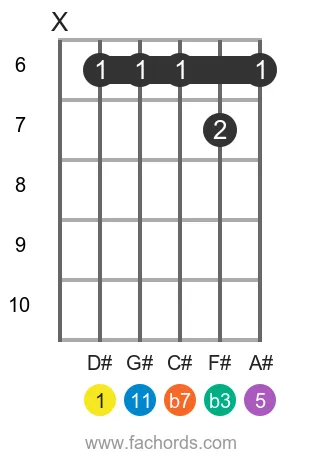
The D#m11 chord delivers a rich, complex minor sound with jazzy extensions, often found in jazz, R&B, and neo-soul. This expressive chord belongs to the Minor Chords family and is built from the notes D#, F#, A#, C#, E#, and G#, corresponding to the intervals 1, b3, 5, b7, 9, and 11. Use the interactive fretboard tool above as your exploration lab to visualize every possible fingering, hear the chord played as a strum or arpeggio, and get immediate feedback on your accuracy with its real-time microphone feature.
Understanding how these intervals create the D#m11 chord's unique character is key to harnessing its extended harmony. Dive into our Chord Construction tutorial to uncover the theoretical foundations. Many fingerings for this advanced chord involve barre shapes, so mastering them will unlock many voicings; our guide on Guitar Bar Chords can provide essential techniques. Since an eleventh chord builds upon a ninth, exploring Ninth Chords offers further insight into its sophisticated sound. Consistent practice with smooth chord changes is also crucial for seamlessly integrating this expressive chord into your playing.
Below, you'll find a comprehensive collection of D#m11 chord diagrams, ranging from open positions to more challenging movable shapes, alongside detailed music theory, example songs that feature this chord, and the keys where it commonly appears. But before you scroll, take a moment to engage with the interactive tool above. Experiment with different voicings, listen carefully to its distinctive sound, and use the microphone feedback to refine your finger placement and ensure every note rings clear. Play with the chord first, letting its sound guide your hands, and then delve into the analysis.
D# m11 chord Notes:
Chord Formula:
D# Minor Eleventh Guitar Chord Fingers Positions
Position 1
Barre
Movable
 Find more shapes in our all guitar chords online library. If you
prefer a printable pdf, download
the Free Guitar Chords Chart Pdf
Find more shapes in our all guitar chords online library. If you
prefer a printable pdf, download
the Free Guitar Chords Chart Pdf
You can also use this accessible D#m11 chord page, with written diagram instructions and screen-reader support for blind users.

Created by
Giancarlo is a musician (teaching guitar since 2000), software engineer, AI consultant and published researcher
FAQ
What notes make up the D# m11 chord?
The D# m11 chord is constructed from the notes D#, F#, A#, C#, E#, and G#. These notes are derived from a specific stacking of intervals starting from the root note D#.
What do the intervals 1, b3, 5, b7, 9, and 11 represent for the D# m11 chord?
These intervals correspond to specific scale degrees relative to the root note D#. They are the Root (1), Minor Third (b3), Perfect Fifth (5), Minor Seventh (b7), Major Ninth (9), and Perfect Eleventh (11).
Why is the D# m11 chord classified as a 'minor' chord?
The D# m11 chord is considered a 'minor' chord because it contains both a minor third (b3) and a minor seventh (b7) relative to its root (D#). These specific intervals define its overall minor quality.
If D# m11 is a minor chord, why does it have a Major Ninth and Perfect Eleventh rather than minor or diminished versions?
In chord nomenclature, the 'minor' designation in 'm11' primarily applies to the third (b3) and seventh (b7) intervals. Unless explicitly stated otherwise (e.g., b9 or b11), the ninth and eleventh intervals in such chords are typically assumed to be major (9) and perfect (11), as is the case here for the D# m11.
How challenging is it to learn and play the D# m11 chord on guitar?
The D# m11 chord can be somewhat challenging for beginners due to its complex nature and the number of notes involved. However, with focused practice and understanding of its construction, it can be mastered over time.
