Explore D# 7b5 Guitar Chord: Interactive Fretboard & Ear Training
Want a structured chord roadmap instead of jumping between pages?
Go to the full guitar chords tutorial.
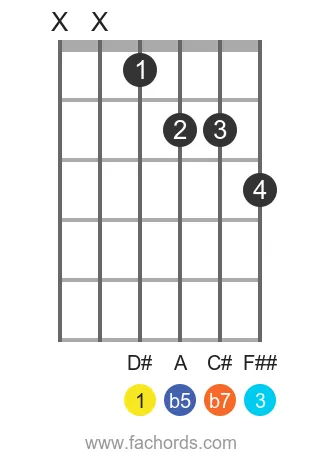
The D# 7b5 chord injects a rich, dissonant tension perfect for blues, jazz, and fusion. This captivating sound is built from the notes D#, F##, A, and C#, defining its unique character through the intervals Root (1), Major Third (3), Diminished Fifth (b5), and Minor Seventh (b7), a distinctive member of the Dominant Seventh family. Dive into this chord's sonic possibilities directly on our interactive fretboard tool, where you can instantly hear it played as a strum or arpeggio. Get precise real-time mic feedback to confirm your finger placement, ensuring you truly master this powerful chord by playing it yourself.
The D# 7b5 chord's unique combination of a major third, diminished fifth, and minor seventh creates its signature tension and release potential, making it a powerful tool for harmonic movement. Understanding the intricacies of its construction is vital; deepen your knowledge with our comprehensive guide on Chord Construction. For those navigating the shapes on the fretboard, especially with its common barre forms, our Guitar Bar Chords lesson provides essential techniques. Since the D# 7b5 is a potent example of a modified dominant chord, exploring the broader context of Dominant Chord theory will further unlock its musical applications. Ultimately, making this chord a fluent part of your playing demands smooth transitions, which you can perfect with our Improve Chords Change tutorial.
Below, you'll find comprehensive chord diagrams for the D# 7b5, from open positions to challenging barre shapes, alongside detailed music theory, popular songs featuring this chord, and its key musical contexts. But before you scroll, immerse yourself in the interactive tool above. Set your desired BPM with the drum tool, try strumming the chord, and let the real-time mic feedback guide your practice. There's no better way to internalize the D# 7b5 than by playing it yourself.
D# 7th with flat 5th guitar chord is also written as D#7b5, D#7(b5) or D#7-5.
Notes of the D# 7b5 chord:
Chord Structure:
D# 7b5 Guitar Chord Diagrams
Position 1
Movable
Position 2
Movable
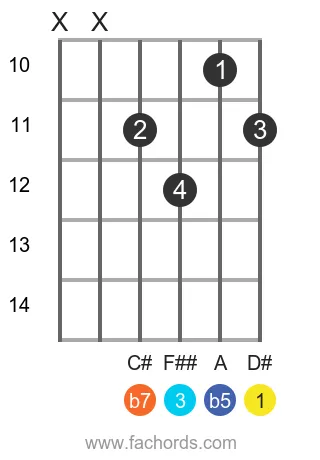
Position 3
Barre
Movable
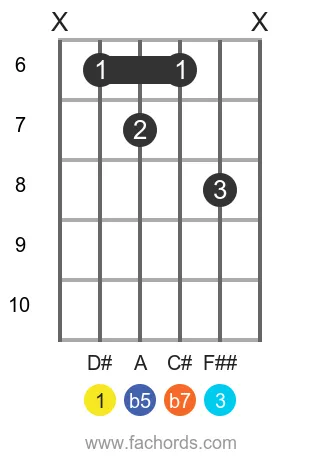
 Find more shapes in our all guitar chords online library. If you
prefer a printable pdf, download
the Free Guitar Chords Chart Pdf
Find more shapes in our all guitar chords online library. If you
prefer a printable pdf, download
the Free Guitar Chords Chart Pdf
You can also use this accessible D#7b5 chord page, with written diagram instructions and screen-reader support for blind users.

Created by
Giancarlo is a musician (teaching guitar since 2000), software engineer, AI consultant and published researcher
FAQ
What are the specific notes and intervals that form the D# 7b5 chord?
The D# 7b5 chord is built from the notes D#, F##, A, and C#. These notes correspond to the intervals of the root (1), major third (3), diminished fifth (b5), and minor seventh (b7).
Why is the D# 7b5 chord described as having a 'rich and dissonant' sound?
Its distinctive sound comes from the combination of its intervals, particularly the diminished fifth (b5). This interval creates a unique tension that, when blended with the major third and minor seventh, produces a complex yet harmonically interesting quality, contributing to its rich and dissonant character.
What does the '7b5' part of the D# 7b5 chord name signify?
The '7' in D# 7b5 indicates that the chord includes a minor seventh interval (b7) above the root. The 'b5' specifically means that the fifth interval of the chord is diminished, or a half-step lower than a perfect fifth. This notation precisely defines the chord's unique interval structure.
In what musical contexts or genres is the D# 7b5 chord commonly used?
As a member of the dominant chord family, the D# 7b5 is primarily used to create harmonic tension that resolves to another chord. It is particularly valued in genres like blues and jazz for its distinctive, colorful dissonance, which adds depth and interest to chord progressions.
Why is the note F## (F double sharp) used in the D# 7b5 chord instead of a simpler enharmonic equivalent?
The use of F## helps maintain the correct theoretical spelling of the major third interval (3) in relation to the root D#. Music theory dictates that intervals like thirds are spelled using specific letter names. Using F## clearly identifies it as a third derived from D, preserving the chord's theoretical structure rather than simply its sound.