Understand and Play the D#7(#5) Guitar Chord with Our Tool
Want a structured chord roadmap instead of jumping between pages?
Download the step-by-step Guitar Chord Ebook
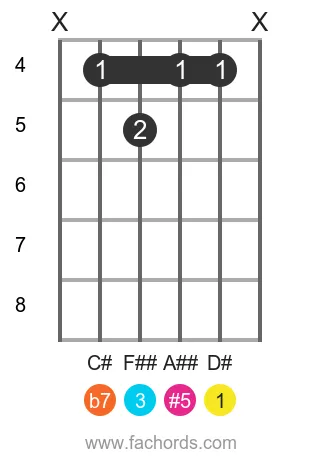
The D#7(#5) chord, an intriguing member of the Augmented Chords family, is constructed from the notes D#, F##, A##, and C#. These intervals correspond to the 1, 3, #5, and b7, creating a rich and complex harmonic structure. To truly grasp this unique sound, utilize our interactive fretboard tool above. It allows you to explore fingerings, listen to the chord played as a strum or arpeggio, and receive instant verification of your accuracy through its real-time microphone feedback.
This chord represents a fascinating variant of the dominant seventh, where the augmented fifth introduces a distinct tension and harmonic pull, crucial for understanding its role in musical resolutions. To deepen your understanding of such foundational elements, explore our guide to the Dominant Chord family. For those interested in the fundamental principles, our Chord Construction tutorial breaks down how complex chords like the D#7(#5) are assembled. Many advanced chords benefit from fluid changes, so consider our tips to Improve Chords Change. Should you encounter barre shapes for this chord, our Guitar Bar Chords guide offers valuable insights.
Below, you will find more than 20 chord diagrams for the D#7(#5), systematically arranged from accessible open positions to more demanding movable shapes. We also provide relevant music theory insights, popular songs featuring this chord, and the common keys where it appears. Before analyzing the diagrams, commit to a disciplined practice session with the interactive tool above. Set your tempo with the drum machine, play the chord, and allow the mic feedback to meticulously confirm your accuracy. Consistent hands-on engagement is key to effectively integrating this rich chord into your playing repertoire.
D# 7(#5) chord Notes:
Formula of the Dominant Seventh Sharp Fifth chord:
Guitar Patterns for the D#7(#5) chord
Position 1
Barre
Movable
Position 2
Barre
Movable
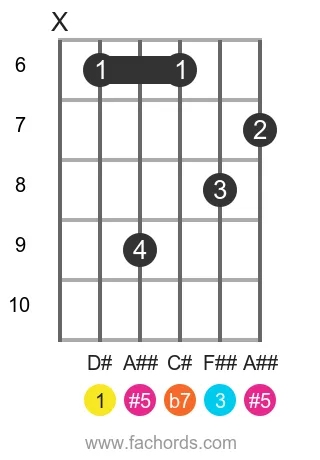
Position 3
Barre
Movable
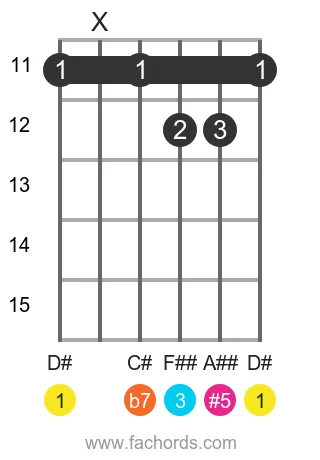
 Find more shapes in our all guitar chords online library. If you
prefer a printable pdf, download
the Free Guitar Chords Chart Pdf
Find more shapes in our all guitar chords online library. If you
prefer a printable pdf, download
the Free Guitar Chords Chart Pdf
You can also use this accessible D#7(#5) chord page, with written diagram instructions and screen-reader support for blind users.

FAQ
What notes are included in the D# 7(#5) chord?
The D# 7(#5) chord is made up of four specific notes: D# (the root), F## (F double sharp), A## (A double sharp), and C# (C sharp).
What intervals define the construction of the D# 7(#5) chord?
The D# 7(#5) chord is constructed using a specific series of intervals from its root: the 1 (root), 3 (major third), #5 (augmented fifth), and b7 (minor seventh).
Which chord families does the D# 7(#5) chord belong to?
The D# 7(#5) chord is identified as a member of both the Augmented Chords family and the dominant (7) guitar chords family.
What kind of sound does the D# 7(#5) chord produce?
The D# 7(#5) chord is characterized by a rich and complex sound, making it a distinctive harmony for guitarists looking to expand into more advanced chord voicings.
How does the '#5' interval differentiate the D# 7(#5) from a regular dominant 7 chord?
The '#5' interval indicates an augmented fifth. This means the fifth degree of the chord is raised by a half step compared to a standard dominant 7 chord, which typically has a perfect fifth. This augmented fifth is what gives the D# 7(#5) its unique and complex character.
Why does the D# 7(#5) chord use F## and A## instead of their enharmonic equivalents?
The notes F## and A## are used to maintain the theoretical integrity of the chord's intervals. From the root D#, F## correctly represents a major third, and A## correctly represents an augmented fifth, preserving the stacked-third structure typical in chord construction.
