D# 6-9 Guitar Chord
Chord Diagrams, Interactive Fretboard and Chord Theory
D# 6/9 guitar chord is also written as D#6/9, D#6add9, D#69 or D#maj6/9.
Position 1
Open
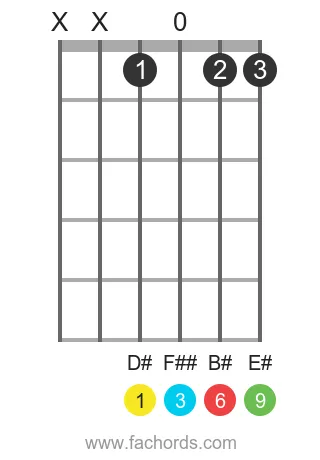
Position 2
Barre
Movable
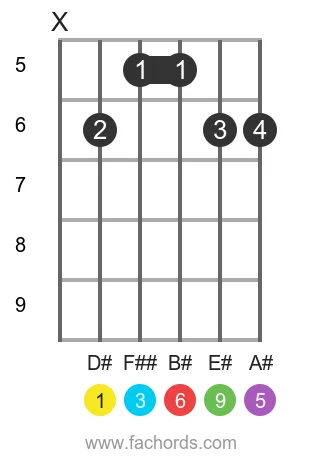
Position 3
Barre
Movable
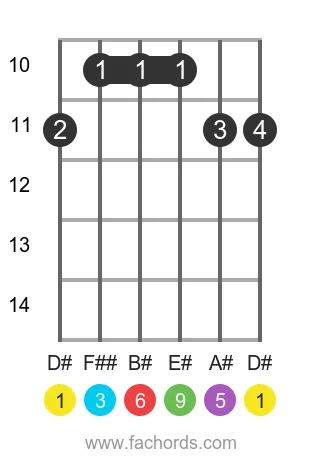
 Find more shapes in our all guitar chords online library. If you
prefer a printable pdf, download
the Free Guitar Chords Chart Pdf
Find more shapes in our all guitar chords online library. If you
prefer a printable pdf, download
the Free Guitar Chords Chart Pdf
You can also use this accessible D#6/9 chord page, with written diagram instructions and screen-reader support for blind users.
Practice D#6/9 Guitar Chord with Real-Time Feedback
Want a structured chord roadmap instead of jumping between pages?
Go to the full guitar chords tutorial.
Ready to internalize the sophisticated sound of the D#6/9 chord? Jump straight into practice with our interactive fretboard tool at the top of this page. Immediately test your finger placement and accuracy with real-time microphone feedback – the tool actively tells you if you're hitting the right notes. This rich, complex member of the Major Chord family is built from the notes D#, F##, A#, B#, and E#, corresponding to the intervals Root (1), Major Third (3), Perfect Fifth (5), Major Sixth (6), and Major Ninth (9). You can also visualize every fingering and listen to the chord played as a strum or arpeggio.
The D#6/9 chord's extended intervals give it a sophisticated, jazz-influenced sound, adding depth and complexity to your harmony. Its combination of a Major Sixth and Major Ninth contributes to a vintage, sweet texture often found in jazz and R&B. To fully grasp how these notes combine, explore our guide on Chord Construction. As a member of both 6th Chords and Ninth Chords families, mastering it will significantly broaden your harmonic vocabulary. Once you understand the theory, focus on improving your chord changes to integrate this rich sound smoothly into your playing.
Below, you'll find over 20 chord diagrams, ranging from easily accessible open positions to advanced movable shapes, alongside detailed music theory, popular songs that feature the D#6/9 chord, and the keys where it commonly appears. We highly recommend you first spend a few minutes with the interactive tool above – set a comfortable tempo with the drum tool, play the chord, and let the mic feedback confirm your finger placement. This hands-on approach is the quickest way to internalize new chords and make them part of your musical vocabulary. Test yourself and see how quickly you can master the D#6/9!
Notes of the D# 6/9 chord:
How to create the Major Sixth Nine Added chord:
Play This Chord With Other Roots
C 6/9 | D 6/9 | E 6/9 | F 6/9 | G 6/9 | A 6/9 | B 6/9 | C#6/9 | D#6/9 | F#6/9 | G#6/9 | A#6/9 | Ab6/9 | Bb6/9 | Db6/9 | Eb6/9 | Gb6/9


Created by
Giancarlo is a musician (teaching guitar since 2000), software engineer, AI consultant and published researcher
FAQ
What notes are included in the D#6/9 chord?
The D#6/9 chord is composed of five distinct notes: D# (the root), F##, A#, B#, and E#. These notes combine to create its unique and rich sound.
What specific intervals define the D#6/9 chord?
The D#6/9 chord is constructed using five intervals relative to its root (D#). These are the Root (1), Major Third (3), Perfect Fifth (5), Major Sixth (6), and Major Ninth (9).
Why is the D#6/9 chord described as 'richly textured' and 'complex'?
The D#6/9 chord is considered richly textured and complex because it expands upon a basic major chord by adding both a Major Sixth and a Major Ninth interval. These additional notes create a fuller, more sophisticated harmonic quality that adds depth to your playing.
What musical families does the D#6/9 chord belong to?
The D#6/9 chord is a member of the Major Chords family due to its foundational major triad structure. It also belongs to both the Sixth Guitar Chords and Ninth Guitar Chords families because it explicitly includes a Major Sixth and a Major Ninth interval in its composition.
Is the D#6/9 chord considered an advanced chord for guitarists?
Yes, the D#6/9 chord is typically seen as more advanced than fundamental beginner chords. Its advanced nature comes from its intricate composition, requiring a good understanding of intervals and often more complex fingerings on the fretboard.
