Explore D#13 Guitar Chord Shapes with Our Interactive Fretboard
Want a structured chord roadmap instead of jumping between pages?
Go to the full guitar chords tutorial.
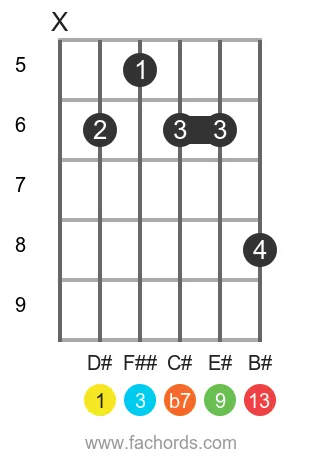
Discovering the D#13 chord often begins by visualizing its complex geometry across the fretboard. Our interactive virtual fretboard allows you to map out and explore various fingerings for this extended Dominant Chord, understanding how its notes align visually. You can instantly verify your accuracy with our real-time mic feature, ensuring perfect finger placement as you play. Hear the chord as a strum or arpeggio, then delve into its construction: a fascinating blend of D#, F##, A#, C#, E#, G#, and B#, corresponding to the intervals Root (1), Major Third (3), Perfect Fifth (5), Minor Seventh (b7), Major Ninth (9), Perfect Eleventh (11), and Major Thirteenth (13).
As a highly extended dominant chord, the D#13 adds rich harmonic color and strong tension, pushing towards resolution. Understanding how these many intervals combine is key; our Chord Construction tutorial can help demystify the process. Since it's a dominant chord, delve deeper into its function and role with our guide to Dominant Chords, and explore its close relatives in our Ninth Chords lesson. Many common D#13 shapes are barre chords, so if you're working on those, our tips on Guitar Bar Chords might be useful for mastering these challenging voicings.
Below, you'll find comprehensive content including detailed chord diagrams, ranked from easiest to more advanced voicings, deeper music theory insights, song examples featuring the D#13 chord, and a breakdown of the keys where it commonly appears. Before diving into memorization, we highly recommend you first explore the shapes with the interactive tool above. Use the built-in drum machine and BPM tool to practice playing the chord along to a beat, letting the mic feedback refine your finger placement and technique. Exploring interactively is the most effective way to truly internalize this chord's many voicings.
D# dominant 13th guitar chord is also written as D#13, D#dom13 or D#7(13).
Notes of the D# 13 chord:
Tones in the Dominant Thirteen chord:
D# 13 Guitar Chord Diagrams
Position 1 Barre Movable
Finger Positions
- Mute the low E string
- Place your index finger (1) on the fret 5 of the D string
- Place your middle finger (2) on the fret 6 of the A string
- Place your ring finger (3) on the fret 6 of the G and B strings at the same time
- Place your pinky finger (4) on the fret 8 of the high E string
Position 2 Barre Movable
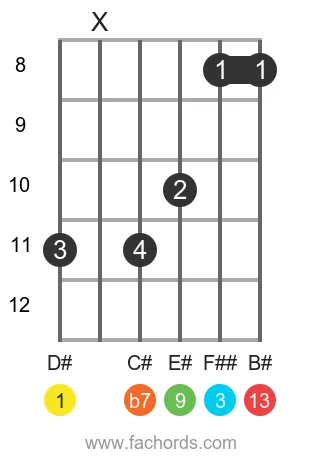
Finger Positions
- Mute the A string
- Place your index finger (1) on the fret 8 of the B and high E strings at the same time
- Place your middle finger (2) on the fret 10 of the G string
- Place your ring finger (3) on the fret 11 of the low E string
- Place your pinky finger (4) on the fret 11 of the D string
Position 3 Barre Movable
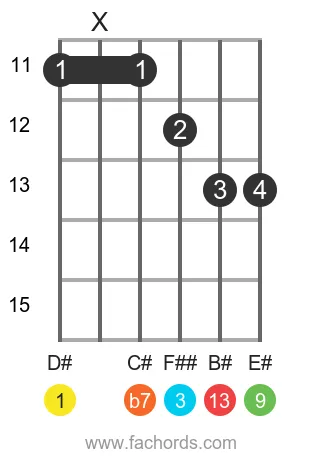
Finger Positions
- Mute the A string
- Place your index finger (1) on the fret 11 of the low E and D strings at the same time
- Place your middle finger (2) on the fret 12 of the G string
- Place your ring finger (3) on the fret 13 of the B string
- Place your pinky finger (4) on the fret 13 of the high E string
 Find more shapes in our all guitar chords online library. If you
prefer a printable pdf, download
the Free Guitar Chords Chart Pdf
Find more shapes in our all guitar chords online library. If you
prefer a printable pdf, download
the Free Guitar Chords Chart Pdf

Created by
Giancarlo is a musician (teaching guitar since 2000), software engineer, AI consultant and published researcher
FAQ
What makes the D# 13 chord part of the Dominant Chords family?
The D# 13 chord is classified as dominant primarily because it contains a minor seventh (b7) interval, which in this specific chord is C#. This interval creates a characteristic harmonic tension that typically seeks to resolve to a tonic chord, driving the musical progression forward.
How are the specific notes D#, F##, A#, C#, E#, G#, and B# derived from the 13th chord intervals?
Starting from the root D#, each note corresponds to its respective interval: D# (Root), F## (Major Third), A# (Perfect Fifth), C# (Minor Seventh), E# (Major Ninth, which is a major second an octave up), G# (Perfect Eleventh, a perfect fourth an octave up), and B# (Major Thirteenth, a major sixth an octave up). These intervals are stacked to form the complete chord.
Do I need to play all seven notes of the D# 13 chord on the guitar?
On guitar, it's often impractical to play all seven notes of a 13th chord simultaneously due to the instrument's string limitations. Guitarists commonly omit certain notes, such as the perfect fifth (A#) and sometimes the perfect eleventh (G#), while ensuring the root, third, minor seventh, and the 9th and 13th extensions are present to maintain the chord's characteristic sound and color.
When would I typically use a D# 13 chord in music?
As a dominant chord, the D# 13 typically functions to create harmonic tension that leads to resolution. It most often appears as the V (five) chord in a progression, resolving to the I (one) chord of a key. For instance, a D# 13 might resolve to a G# Major or G# minor chord, adding a rich and sophisticated flavor to the harmony.
Why is the D# 13 chord considered an 'intermediate-level' chord for guitarists?
The D# 13 chord is categorized as intermediate due to its extensive number of notes and complex intervals, which go beyond basic triads and seventh chords. It requires a more developed understanding of music theory, including extended intervals like 9ths, 11ths, and 13ths, and often involves more challenging fingerings and a precise knowledge of note placement across the fretboard.
