Db m7 Guitar Chord | Play, Hear and Practice Interactively
Want a structured chord roadmap instead of jumping between pages?
Go to the full guitar chords tutorial.
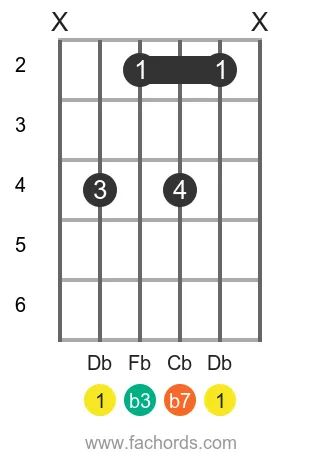
The Db m7 chord belongs to the Minor Chords family and is built from four notes: Db, Fb, Ab, and Cb-corresponding to the intervals Root (1), Minor Third (b3), Perfect Fifth (5), and Minor Seventh (b7). Use the interactive fretboard tool at the top of this page to visualize every fingering, listen to the chord played as a strum or arpeggio, and check your own playing with the real-time microphone feedback-the tool will tell you if you're nailing it.
Understanding these intervals is crucial to understanding how chords are built and how they function within a musical context. The Db m7 is a staple in many genres, including jazz. To dive deeper into how chords are built, check out our guide on Chord Construction. You can also explore Learn 3-Note 7th Chords for a more streamlined approach or Understanding Chord Inversions to unlock new voicings. Once you've got the shape down, focus on Improve Chords Change to integrate it smoothly into your playing.
Scrolling down, you'll find detailed chord diagrams, organized from the simplest open positions to more advanced movable shapes. We'll also cover the music theory behind the Db m7, suggest songs where it shines, and explore the keys where it commonly appears. But before you explore the diagrams, spend some time with the interactive tool above. Set a comfortable tempo with the drum/BPM tool, play the chord, and let the mic feedback guide your hand placement. This active learning approach is the most effective way to truly master the Db m7 chord.
Notes that compose the Db m7 chord:
Tones of the Minor Seventh chord:
Dbm7 Guitar Chord Shapes
Position 1
Movable
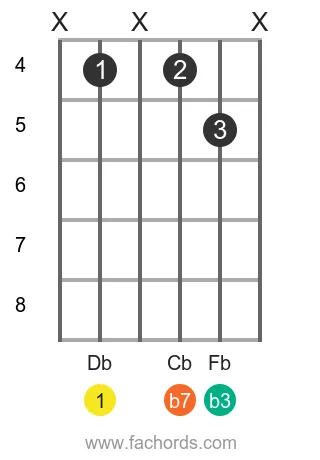
Position 2
Barre
Movable
Position 3
Barre
Movable
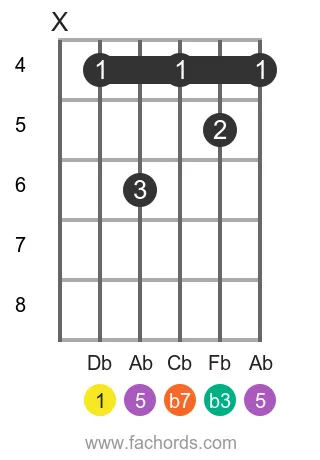
Position 4
Barre
Movable
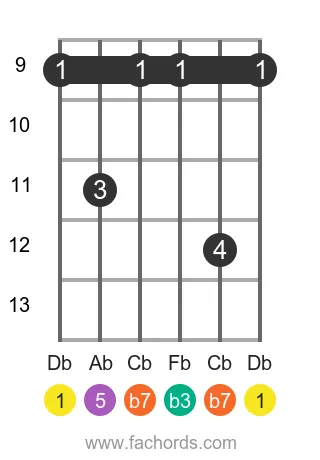
 Find more shapes in our all guitar chords online library. If you
prefer a printable pdf, download
the Free Guitar Chords Chart Pdf
Find more shapes in our all guitar chords online library. If you
prefer a printable pdf, download
the Free Guitar Chords Chart Pdf
You can also use this accessible Dbm7 chord page, with written diagram instructions and screen-reader support for blind users.


Created by
Giancarlo is a musician (teaching guitar since 2000), software engineer, AI consultant and published researcher
FAQ
What are the specific notes that form the Db m7 chord?
The Db m7 chord is built using four distinct notes: Db, Fb, Ab, and Cb. These notes are derived from specific intervals above the root note, Db.
What do the interval numbers '1, b3, 5, and b7' represent for the Db m7 chord?
These numbers define the chord's structure relative to its root, Db. '1' is the Root (Db), 'b3' is the Minor Third (Fb), '5' is the Perfect Fifth (Ab), and 'b7' is the Minor Seventh (Cb). These intervals characterize the unique sound of a minor seventh chord.
Why are Fb and Cb used in the Db m7 chord instead of E and B?
In music theory, note names are chosen to reflect their specific interval relationship and avoid skipping scale degrees. Fb is the correct minor third above Db, and Cb is the correct minor seventh, even though they are enharmonically equivalent to E natural and B natural. This naming maintains theoretical consistency for the intervals.
In what musical genres or contexts is the Db m7 chord commonly found?
The Db m7 chord is a versatile chord frequently used across various music genres. It is particularly common in jazz chord progressions, where its rich and complex sound adds depth. It’s also a valuable addition for intermediate players looking to expand their harmonic vocabulary.
What does it mean to 'invert the intervals' of the Db m7 chord on the guitar?
Inverting the intervals of the Db m7 chord means rearranging its component notes (Db, Fb, Ab, Cb) so that a note other than the root (Db) is played as the lowest pitch. This creates different voicings and fretboard shapes for the same chord, offering new sonic textures and melodic options.
