Dbdim7 Guitar Chord | Play, Hear and Practice Interactively
Want a structured chord roadmap instead of jumping between pages?
Download the step-by-step Guitar Chord Ebook
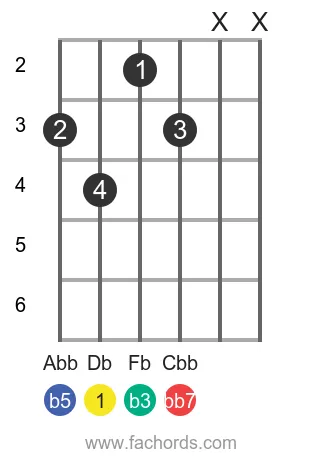
The Db dim7 chord, a member of the Diminished Chords family, is built from the notes Db, Fb, Abb, and Cbb. These correspond to the intervals Root (1), Minor Third (b3), Diminished Fifth (b5), and Diminished Seventh (bb7). Utilize the interactive fretboard tool on this page to visualize every fingering, listen to the chord played as a strum or arpeggio, and instantly check your accuracy using the real-time microphone feedback.
The Db dim7 chord offers a unique, tension-filled sound that adds sophistication to your playing, often used to create suspense or lead into other chords. To truly master the unique qualities of these complex voicings, explore our comprehensive guide on Diminished Guitar Chords. Understanding how chords are put together will deepen your insight; check out our Chord Construction tutorial. Once you grasp the theory, focus on improving your chord changes to integrate this chord smoothly into your music.
Below, you'll discover a variety of Db dim7 chord diagrams, presented from the easiest open positions to more challenging movable shapes, alongside detailed music theory, example songs where this chord shines, and the musical keys where you'll most often encounter it. Before you explore the diagrams, take a moment to engage with the interactive tool above. Use it to hear the chord's distinctive sound, try out fingerings, and let the mic feedback guide your practice. This hands-on approach is the most effective way to internalize new chords and make them part of your repertoire.
Notes in the Db dim7 chord:
Tones in the Diminished Seventh chord:
Guitar Patterns for the Dbdim7 chord
Position 1
Movable
Position 2
Movable
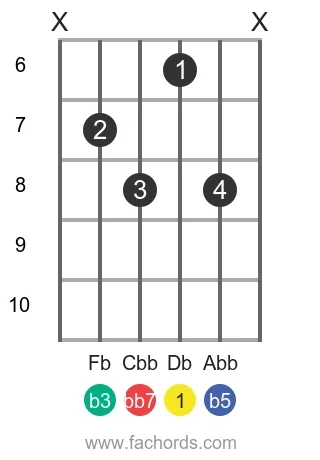
Position 3
Movable
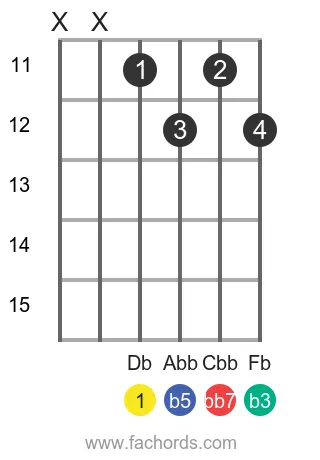
Position 4
Movable
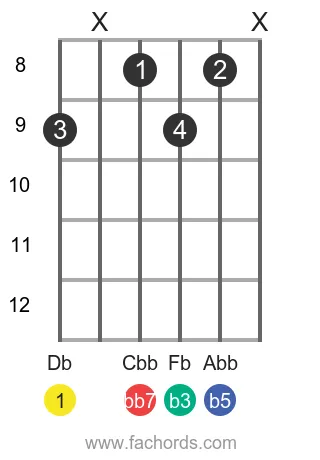
 Find more shapes in our all guitar chords online library. If you
prefer a printable pdf, download
the Free Guitar Chords Chart Pdf
Find more shapes in our all guitar chords online library. If you
prefer a printable pdf, download
the Free Guitar Chords Chart Pdf
You can also use this accessible Dbdim7 chord page, with written diagram instructions and screen-reader support for blind users.
FAQ
What specific notes make up the Db dim7 chord?
The Db dim7 chord is composed of four distinct notes: Db, Fb, Abb, and Cbb. These notes are essential to understanding and playing this chord accurately.
What intervals define the structure of a Db dim7 chord?
The Db dim7 chord is defined by its specific intervals from the root: the 1st (Root), b3 (Minor Third), b5 (Diminished Fifth), and bb7 (Diminished Seventh). These intervals create its unique harmonic sound.
Why is the Db dim7 chord considered more complex than other chords?
The Db dim7 chord is considered more complex due to the presence of diminished intervals, especially the double-flat seventh (bb7). These intervals can be less familiar and require a deeper understanding of music theory to grasp and apply on the fretboard compared to more common major or minor chords.
Can you explain what the 'bb7' interval means in the Db dim7 chord?
The 'bb7' interval, or double-flat seventh, means that the natural seventh degree above the root (Db) is flattened twice. For Db, the natural seventh is C, so a bb7 results in Cbb. This specific interval is a defining characteristic of a diminished seventh chord.
What is the benefit of learning to play the Db dim7 chord?
Learning the Db dim7 chord allows guitarists to significantly broaden their chord knowledge and introduce unique, sophisticated sounds into their music. It's a valuable chord for adding tension, color, and more complex harmonic movement to your playing, moving beyond standard major and minor tonalities.
