Db9b5 Guitar Chord | Play, Hear and Practice Interactively
Want a structured chord roadmap instead of jumping between pages?
Go to the full guitar chords tutorial.
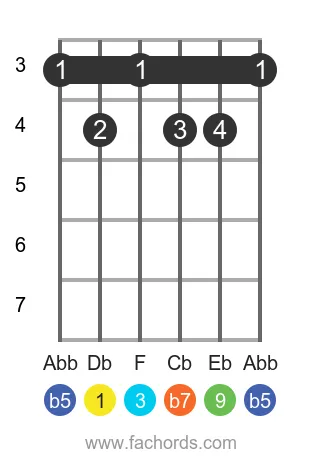
The Db 9b5 chord, a member of the Dominant Chords family, is built from the notes Db, F, Abb, Cb, and Eb, corresponding to the intervals Root (1), Major Third (3), Diminished Fifth (b5), Minor Seventh (b7), and Major Ninth (9). Use the interactive fretboard tool on this page to visualize countless fingerings, hear the chord played as a strum or arpeggio, and check your accuracy with real-time microphone feedback – it will tell you if you're hitting every note cleanly.
The unique diminished fifth (b5) and major ninth (9) give the Db9b5 its distinctive, jazzy sound. To understand the theory behind such complex structures, explore our in-depth guide on Chord Construction. As a dominant chord, it creates tension seeking resolution; learn more about its role in harmony with our Dominant Chord tutorial. For a deeper dive into extended harmonies, check out our guide on Ninth Chords.
Below, you'll discover over 20 chord diagrams, presented from the simplest open positions to more advanced movable shapes, alongside relevant music theory, popular songs that feature the Db9b5, and the common keys where it appears. Before you dig into the diagrams, take a moment to interact with the tool above – use the drum and BPM tool to set your tempo, play the chord, and let the mic feedback guide you. This hands-on approach is the quickest way to internalize new chords and build muscle memory.
Db 9th with flat 5th guitar chord is also written as Db9b5, Db9(b5) or Db9-5.
Db 9b5 chord Notes:
Chord structure of the Dominant Ninth Flat five chord:
Db 9b5 Guitar Chord Diagrams
Position 1 Barre Movable
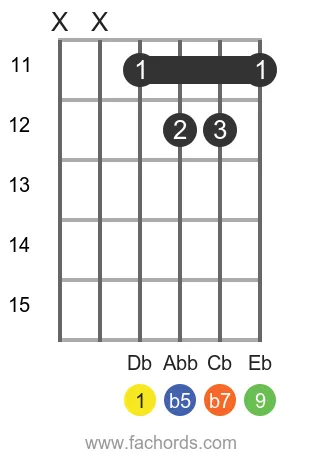
Finger Positions
- Mute the low E string
- Mute the A string
- Place your index finger (1) on the fret 11 of the D and high E strings at the same time
- Place your middle finger (2) on the fret 12 of the G string
- Place your ring finger (3) on the fret 12 of the B string
Position 2 Barre Movable
Finger Positions
- Place your index finger (1) on the fret 3 of the low E, D and high E strings at the same time
- Place your middle finger (2) on the fret 4 of the A string
- Place your ring finger (3) on the fret 4 of the G string
- Place your pinky finger (4) on the fret 4 of the B string
Position 3 Barre Movable
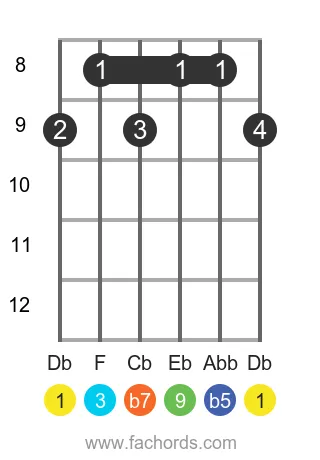
Finger Positions
- Place your index finger (1) on the fret 8 of the A, G and B strings at the same time
- Place your middle finger (2) on the fret 9 of the low E string
- Place your ring finger (3) on the fret 9 of the D string
- Place your pinky finger (4) on the fret 9 of the high E string
 Find more shapes in our all guitar chords online library. If you
prefer a printable pdf, download
the Free Guitar Chords Chart Pdf
Find more shapes in our all guitar chords online library. If you
prefer a printable pdf, download
the Free Guitar Chords Chart Pdf

Created by
Giancarlo is a musician (teaching guitar since 2000), software engineer, AI consultant and published researcher
FAQ
What defines the Db 9b5 as a 'Dominant Chord' even with a flattened fifth?
The Db 9b5 chord is classified as a dominant chord because it fundamentally contains the root (Db), a major third (F), and a minor seventh (Cb). These three intervals are the core components that establish a chord's dominant function. The 'b5' (diminished fifth) and '9' (major ninth) are extensions or alterations that add color and tension, but they do not change the chord's underlying dominant quality.
How do the notes Db, F, Abb, Cb, and Eb correspond to the intervals 1, 3, b5, b7, and 9?
The notes of the Db 9b5 chord directly map to its intervals as follows: Db is the Root (1), F is the Major Third (3), Abb is the Diminished Fifth (b5), Cb is the Minor Seventh (b7), and Eb is the Major Ninth (9). The Abb might be enharmonically thought of as G, and Cb as B, but their correct theoretical spelling within the Db dominant context is crucial for understanding the chord's construction.
What is the specific musical effect or role of the diminished fifth (b5) and major ninth (9) in the Db 9b5 chord?
The diminished fifth (b5) creates a unique, often unsettling or highly dissonant tension that seeks resolution, making the chord sound more 'outside' or bluesy. The major ninth (9) adds richness and a 'sweet' upper extension to the dominant sound, increasing its harmonic complexity. Together, these intervals give the Db 9b5 a distinctive, complex, and highly colorful sound often used in jazz and fusion music to create sophisticated harmonic movement.
Why is the Db 9b5 chord considered complex compared to other dominant chords?
The Db 9b5 chord is deemed complex because it features two alterations beyond a basic dominant seventh chord: a diminished fifth (b5) and a major ninth (9). These intervals are less common in simpler harmonies and require a deeper understanding of music theory, especially how to locate and voice these specific intervals on the fretboard. It moves beyond standard dominant 7 or 9 voicings, demanding more precision in note selection and finger placement.