Db 6-9 Guitar Chord
Chord Diagrams, Interactive Fretboard and Chord Theory
Db 6/9 guitar chord is also written as Db6/9, Db6add9, Db69 or Dbmaj6/9.
Position 1
Movable
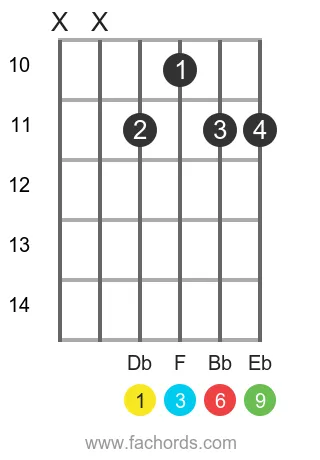
Position 2
Barre
Movable
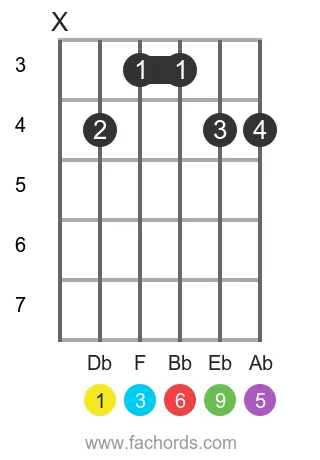
Position 3
Barre
Movable
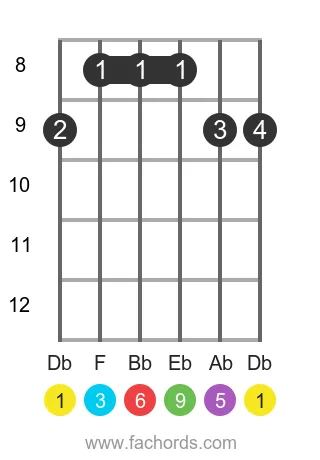
 Find more shapes in our all guitar chords online library. If you
prefer a printable pdf, download
the Free Guitar Chords Chart Pdf
Find more shapes in our all guitar chords online library. If you
prefer a printable pdf, download
the Free Guitar Chords Chart Pdf
You can also use this accessible Db6/9 chord page, with written diagram instructions and screen-reader support for blind users.
Db6/9 Guitar Chord | Play, Hear and Practice Interactively
Want a structured chord roadmap instead of jumping between pages?
Go to the full guitar chords tutorial.
The Db 6/9 chord, a rich and complex member of the Major Chords family, is built from the notes Db, F, Ab, Bb, and Eb. These correspond to the intervals 1 (Root), 3 (Major Third), 5 (Perfect Fifth), 6 (Major Sixth), and 9 (Major Ninth). Use the interactive fretboard tool at the top of this page to visualize every possible fingering, listen to the chord played as a strum or arpeggio, and instantly verify your playing with real-time microphone feedback.
The Db 6/9 chord is more advanced than basic major/minor chords, offering a richer, more sophisticated sound often heard in jazz. To understand how these extra notes shape the chord's unique voice, explore our tutorials on Ninth Chords and 6th Chords. You can also delve deeper into the fundamental principles with our guide on Chord Construction. Once you're comfortable with the shape, practice improving your chord changes for seamless playing.
Scroll down to discover multiple chord diagrams, arranged from the simplest to more advanced voicings, along with music theory explanations, popular songs featuring the Db 6/9, and the keys where this chord is commonly found. Before you dive into the diagrams, make sure to utilize the interactive tool above: set a tempo with the drum and BPM practice tool, play the chord, and let the mic feedback guide your fingers to perfection. This direct, interactive practice accelerates your learning like nothing else.
Db 6/9 chord Notes:
Tones of the Major Sixth Nine Added chord:
Play This Chord With Other Roots
C 6/9 | D 6/9 | E 6/9 | F 6/9 | G 6/9 | A 6/9 | B 6/9 | C#6/9 | D#6/9 | F#6/9 | G#6/9 | A#6/9 | Ab6/9 | Bb6/9 | Db6/9 | Eb6/9 | Gb6/9


Created by
Giancarlo is a musician (teaching guitar since 2000), software engineer, AI consultant and published researcher
FAQ
What makes the Db 6/9 chord considered a "Major Chord" despite its additional notes?
The fundamental major quality of the Db 6/9 chord comes from its core triad: the root (Db), major third (F), and perfect fifth (Ab). These three intervals establish it as a major chord. The added 6th (Bb) and 9th (Eb) intervals are extensions that enrich its sound and complexity without changing its underlying major characteristic.
What is the function of the 6th and 9th intervals in the Db 6/9 chord?
The Major Sixth (Bb) and Major Ninth (Eb) intervals are what give the Db 6/9 chord its distinctive, richer, and more complex sound. These extensions add harmonic color and depth, contributing to its sophisticated quality and making it particularly favored in styles like jazz music.
Do I always need to play all five notes (Db, F, Ab, Bb, Eb) to voice a Db 6/9 chord on guitar?
While the theoretical composition of the Db 6/9 chord includes all five notes (Db, F, Ab, Bb, Eb), practical guitar voicings often omit certain notes for playability or to achieve a specific sonic texture. For example, the perfect fifth (Ab) is commonly omitted as its harmonic contribution is often less critical than the root, third, sixth, and ninth in defining the chord's unique character.
When is the Db 6/9 chord typically used in music?
The Db 6/9 chord is especially popular in jazz music due to its full, complex sound. It is used to add unique flavor to chord progressions, creating more sophisticated and nuanced harmonies. It often functions as a stable, yet harmonically interesting, major chord, expanding a guitarist's musical vocabulary.
How does the Db 6/9 chord differ from a basic Db Major chord?
A basic Db Major chord consists only of the root (Db), major third (F), and perfect fifth (Ab). The Db 6/9 chord expands upon this basic structure by adding two specific intervals: the Major Sixth (Bb) and the Major Ninth (Eb). These added notes give the 6/9 chord a fuller, more complex, and often jazzier sound compared to the simpler Db Major triad, making it a more advanced chord.
