C m11 Guitar Chord
Chord Diagrams, Interactive Fretboard and Chord Theory
C minor 11th guitar chord is also written as Cm11, Cmin11 or C-11.
Position 1
Movable
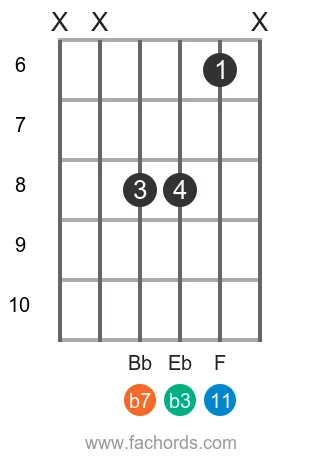
Position 2
Movable
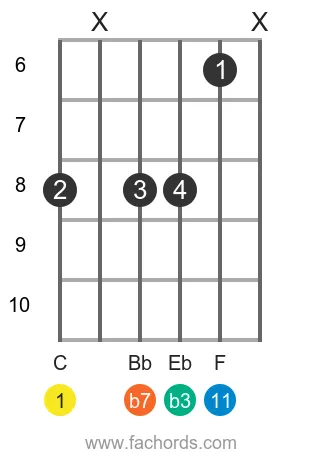
Position 3
Barre
Movable
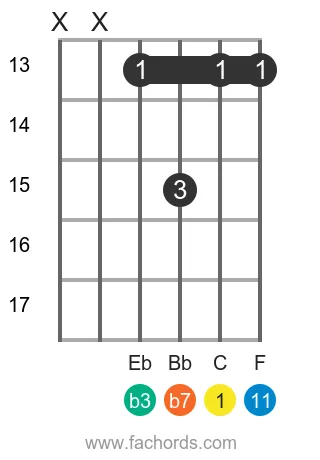
Position 4
Barre
Movable
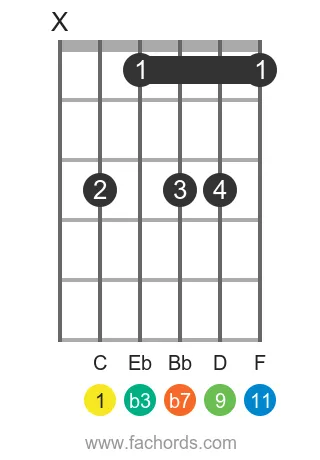
Position 5
Barre
Movable
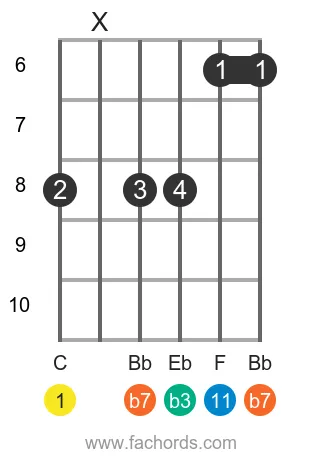
Position 6
Barre
Movable
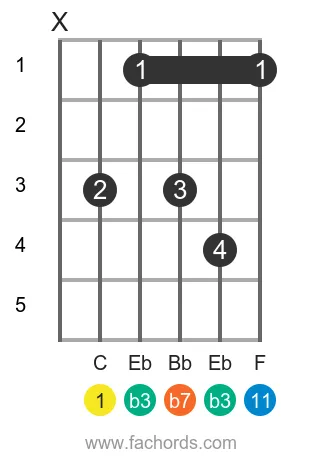
Position 7
Barre
Movable
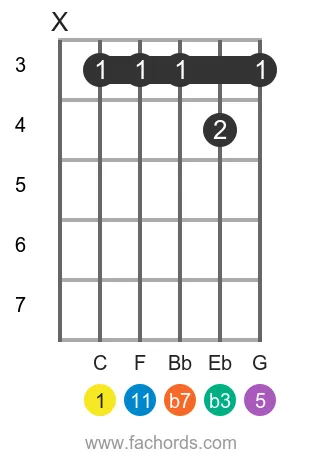
Position 8
Barre
Movable
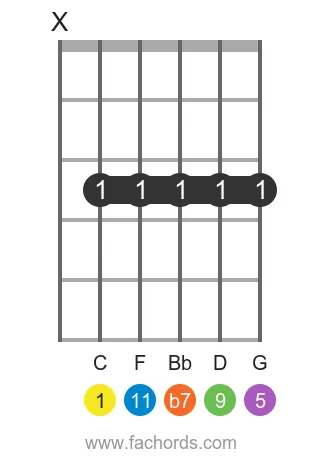
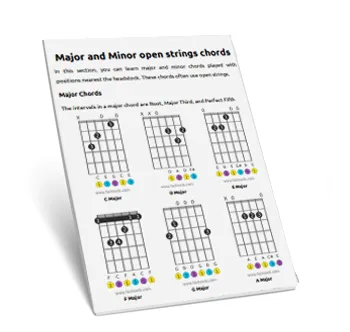
 Find more shapes in our all guitar chords online library. If you
prefer a printable pdf, download
the Free Guitar Chords Chart Pdf
Find more shapes in our all guitar chords online library. If you
prefer a printable pdf, download
the Free Guitar Chords Chart Pdf
You can also use this accessible Cm11 chord page, with written diagram instructions and screen-reader support for blind users.
Master the C m11 Guitar Chord: Theory and Application
Want a structured chord roadmap instead of jumping between pages?
Go to the full guitar chords tutorial.
Understanding the C m11 chord begins with its structure. This extended harmony belongs to the Minor Chords family, built from the notes C, Eb, G, Bb, D, and F. These correspond to the intervals 1, b3, 5, b7, 9, and 11 (Root, Minor Third, Perfect Fifth, Minor Seventh, Major Ninth, and Perfect Eleventh). Our interactive virtual fretboard provides clear chord diagrams and fretboard patterns, allowing you to visualize these tones. You can also hear the chord and arpeggio playback, and verify your playing technique instantly with real-time mic feedback.
As an extended harmony, the C m11 chord adds rich color to your musical palette. Understanding how these intricate structures are built from their foundational intervals is crucial for advanced guitarists; our guide on Chord Construction can provide deeper insights. Eleventh chords, like their Ninth Chords counterparts, often appear in jazz, fusion, and R&B, offering a sophisticated sound beyond basic triads and sevenths. Practicing smooth Chord Changes will help you integrate such complex voicings seamlessly into your playing.
Scroll down to find comprehensive chord diagrams, arranged from the simplest to the most complex voicings. These visual aids, combined with foundational theory and practical examples in various keys and songs, will solidify your understanding. Before diving into the diagrams, engage with our interactive tool above to practice and internalize the C m11 chord through disciplined repetition, ensuring accuracy before applying it in musical contexts.
Notes of the C m11 chord:
How the Minor Eleventh chord is built:
Play This Chord With Other Roots
C m11 | D m11 | E m11 | F m11 | G m11 | A m11 | B m11 | C#m11 | D#m11 | F#m11 | G#m11 | A#m11 | Abm11 | Bbm11 | Dbm11 | Ebm11 | Gbm11

Created by
Giancarlo is a musician (teaching guitar since 2000), software engineer, AI consultant and published researcher
FAQ
What notes and intervals make up the C m11 chord?
The C m11 chord is composed of six notes: C, Eb, G, Bb, D, and F. These notes correspond to the intervals of 1 (Root), b3 (Minor Third), 5 (Perfect Fifth), b7 (Minor Seventh), 9 (Major Ninth), and 11 (Perfect Eleventh) respectively.
How does the 'm11' in C m11 define its structure?
The 'm' in C m11 signifies that the chord is a minor type, specifically incorporating a minor third (Eb) and a minor seventh (Bb). The '11' indicates that the chord includes additional extensions, namely the major ninth (D) and the perfect eleventh (F), built upon its minor seventh foundation.
Which musical situations commonly feature the C m11 chord?
The C m11 chord is frequently found in jazz chord progressions. Its extended structure and rich sound make it a versatile addition that can bring greater depth and complexity to musical arrangements.
Is the C m11 chord considered part of the Minor Chords family?
Yes, the C m11 chord firmly belongs to the Minor Chords family. This classification is primarily due to its defining intervals, particularly the presence of the minor third (Eb) and minor seventh (Bb) within its construction.