Explore the C mmaj7 Guitar Chord with Interactive Diagrams
Want a structured chord roadmap instead of jumping between pages?
Go to the full guitar chords tutorial.
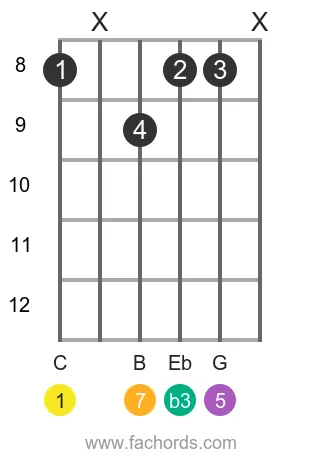
Dive into the smooth, sophisticated sound of the C m(maj7) chord, a captivating choice often heard in jazz and neo-soul for its unique blend of minor tonality and major seventh tension. This intriguing chord is composed of the notes C, Eb, G, and B, representing the intervals 1, b3, 5, and 7 respectively. Utilize our interactive fretboard as your personal exploration lab, complete with real-time mic feedback to instantly verify your accuracy as you play.
The C m(maj7) chord is celebrated for its distinctive 'smooth jazz color,' where the major seventh (B) adds an unexpected brightness and tension to the minor triad (C, Eb, G). Understanding how this unique interval structure is formed is key, and you can deepen your knowledge by exploring our comprehensive tutorial on chord construction. For those keen on mastering the nuances of seventh chords, learning to identify and play 3-note 7th chords can significantly improve your fretboard fluency and understanding of harmonic movement.
As you practice, remember that our platform provides detailed chord diagrams, from the easiest fingerings to more challenging voicings, all designed to help you internalize the theory and apply this chord effectively in various songs and keys. We encourage you to start by experimenting with the interactive fretboard; actively playing the C m(maj7) chord helps you truly grasp its sound and feel before diving deep into theoretical analysis.
Notes of the C m(maj7) chord:
Chord structure of the Minor Major Seventh chord:
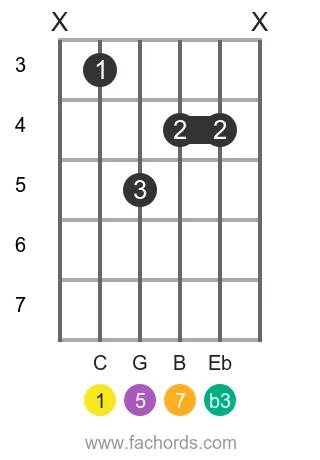
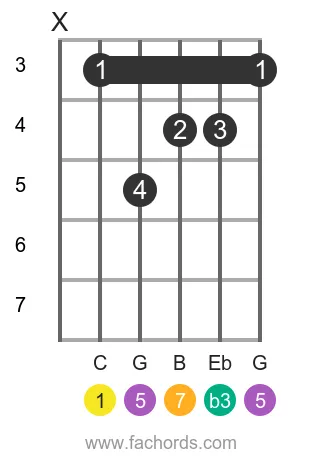
C Minor Major Seventh Guitar Chord Diagrams
Position 1
Movable
Position 2
Barre
Movable
Position 3
Barre
Movable
 Find more shapes in our all guitar chords online library. If you
prefer a printable pdf, download
the Free Guitar Chords Chart Pdf
Find more shapes in our all guitar chords online library. If you
prefer a printable pdf, download
the Free Guitar Chords Chart Pdf
You can also use this accessible Cm(maj7) chord page, with written diagram instructions and screen-reader support for blind users.

FAQ
What notes make up the C m(maj7) chord?
The C m(maj7) chord is composed of the notes C, Eb, G, and B. These correspond to the Root, Minor Third, Perfect Fifth, and Major Seventh intervals respectively, creating its distinct sound.
What is the difference between a C m(maj7) chord and a Cm7 chord?
The main difference lies in the seventh interval. A C m(maj7) chord uses a Major Seventh (B), giving it a unique, often melancholic or ethereal quality. A Cm7 chord, on the other hand, uses a Minor Seventh (Bb), which is more commonly found and has a softer, more traditional minor dominant sound.
Why is the C m(maj7) chord considered more advanced for guitarists?
The C m(maj7) chord is considered more advanced because it incorporates a Major Seventh interval on a minor chord, which can be less intuitive to understand and finger compared to basic major or minor triads. It often requires specific fingerings and a deeper understanding of music theory for its application.
What gives the C m(maj7) chord its 'rich and complex sound'?
The rich and complex sound of the C m(maj7) chord comes from the combination of a minor third (Eb) and a major seventh (B) over the root (C). This particular intervalic structure creates a tension and resolution within the chord that is both sophisticated and distinct, often described as melancholic or ethereal.
When would I typically use a C m(maj7) chord in music?
The C m(maj7) chord is frequently found in jazz and neo-soul music. It often functions as a 'tonic minor' chord, providing a rich, slightly dramatic flavor to a minor key. It can also be used as a passing chord or to create specific harmonic colors in progressions where a minor sound with a leading tone is desired.
