Understand and Play the C9 Guitar Chord
Want a structured chord roadmap instead of jumping between pages?
Go to the full guitar chords tutorial.
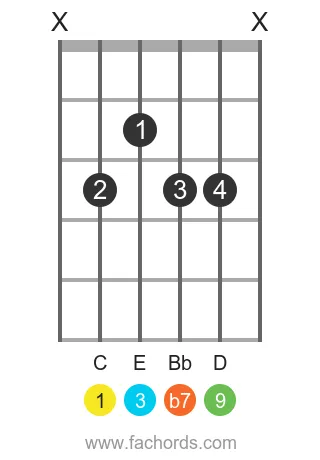
The C9 chord is a compelling extension within the family of Dominant Chords. Structurally, it is defined by the intervals 1 (Root), 3 (Major Third), 5 (Perfect Fifth), b7 (Minor Seventh), and 9 (Major Ninth), yielding the notes C, E, G, Bb, and D. To fully grasp this complex harmony, utilize our interactive virtual fretboard to visualize these intervals and hear the chord's playback. This powerful tool also offers real-time mic feedback, instantly verifying your accuracy as you play each note.
Understanding the intricate nature of ninth chords like the C9 is essential for expanding your harmonic palette. These chords introduce extended harmony and rich color tones, moving beyond basic triads and seventh chords. For a deeper dive into their structure and application, explore our dedicated guide on Ninth Chords. The C9 specifically functions as a Dominant Chord, creating a strong pull towards resolution. To truly master how these complex structures are built from fundamental principles, we recommend reviewing our comprehensive Chord Construction tutorial.
After thoroughly engaging with the interactive fretboard and its real-time feedback, continue your disciplined practice by exploring the provided diagrams, ranked from easiest to hardest, to solidify your fingerings across different keys. Deepen your theoretical understanding and integrate the C9 into various musical contexts by studying the accompanying song examples. Consistent application of these learning tools will ensure mastery.
C dominant 9th guitar chord is also written as C9, Cdom9, C7(9) or C7add9.
C 9 chord Notes:
Tones in the Dominant Ninth chord:
C 9 Guitar Chord Diagrams
Position 1 Movable
Finger Positions
- Mute the low E string
- Mute the high E string
- Place your index finger (1) on the fret 2 of the D string
- Place your middle finger (2) on the fret 3 of the A string
- Place your ring finger (3) on the fret 3 of the G string
- Place your pinky finger (4) on the fret 3 of the B string
Position 2 Movable
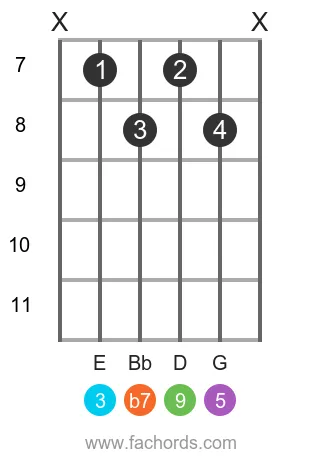
Finger Positions
- Mute the low E string
- Mute the high E string
- Place your index finger (1) on the fret 7 of the A string
- Place your middle finger (2) on the fret 7 of the G string
- Place your ring finger (3) on the fret 8 of the D string
- Place your pinky finger (4) on the fret 8 of the B string
Position 3 Movable
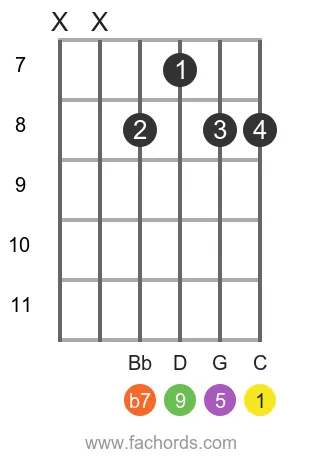
Finger Positions
- Mute the low E string
- Mute the A string
- Place your index finger (1) on the fret 7 of the G string
- Place your middle finger (2) on the fret 8 of the D string
- Place your ring finger (3) on the fret 8 of the B string
- Place your pinky finger (4) on the fret 8 of the high E string
Position 4 Movable
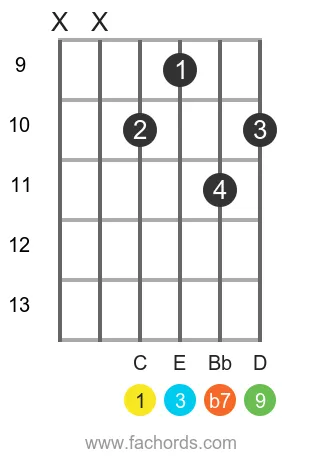
Finger Positions
- Mute the low E string
- Mute the A string
- Place your index finger (1) on the fret 9 of the G string
- Place your middle finger (2) on the fret 10 of the D string
- Place your ring finger (3) on the fret 10 of the high E string
- Place your pinky finger (4) on the fret 11 of the B string
Position 5 Barre Movable
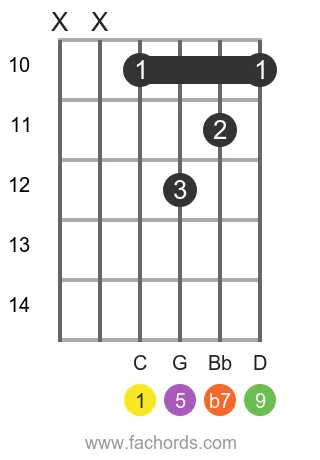
Finger Positions
- Mute the low E string
- Mute the A string
- Place your index finger (1) on the fret 10 of the D and high E strings at the same time
- Place your middle finger (2) on the fret 11 of the B string
- Place your ring finger (3) on the fret 12 of the G string
Position 6 Barre Movable
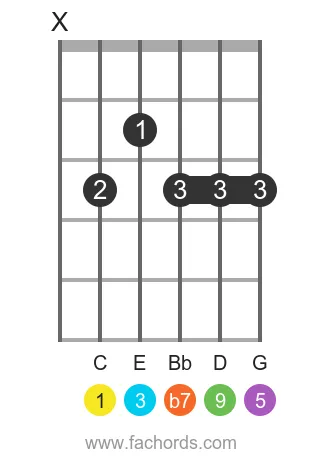
Finger Positions
- Mute the low E string
- Place your index finger (1) on the fret 2 of the D string
- Place your middle finger (2) on the fret 3 of the A string
- Place your ring finger (3) on the fret 3 of the G, B and high E strings at the same time
Position 7 Barre Movable
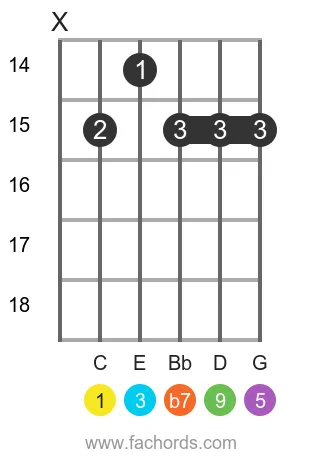
Finger Positions
- Mute the low E string
- Place your index finger (1) on the fret 14 of the D string
- Place your middle finger (2) on the fret 15 of the A string
- Place your ring finger (3) on the fret 15 of the G, B and high E strings at the same time
Position 8 Barre Movable
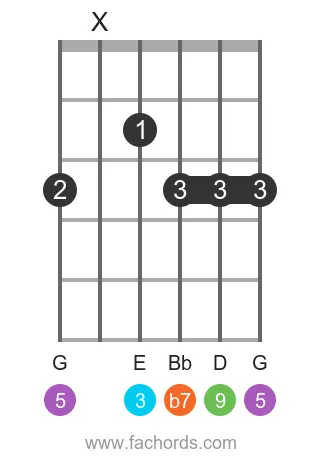
Finger Positions
- Mute the A string
- Place your index finger (1) on the fret 2 of the D string
- Place your middle finger (2) on the fret 3 of the low E string
- Place your ring finger (3) on the fret 3 of the G, B and high E strings at the same time
Position 9 Barre Movable
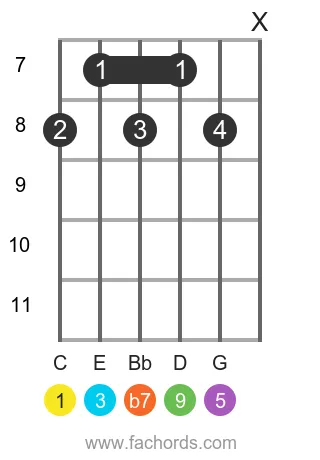
Finger Positions
- Mute the high E string
- Place your index finger (1) on the fret 7 of the A and G strings at the same time
- Place your middle finger (2) on the fret 8 of the low E string
- Place your ring finger (3) on the fret 8 of the D string
- Place your pinky finger (4) on the fret 8 of the B string
 Find more shapes in our all guitar chords online library. If you
prefer a printable pdf, download
the Free Guitar Chords Chart Pdf
Find more shapes in our all guitar chords online library. If you
prefer a printable pdf, download
the Free Guitar Chords Chart Pdf

Created by
Giancarlo is a musician (teaching guitar since 2000), software engineer, AI consultant and published researcher
FAQ
What are the specific notes that make up a C9 chord?
The C9 chord is composed of five distinct notes: C (the Root), E (Major Third), G (Perfect Fifth), Bb (Minor Seventh), and D (Major Ninth). These intervals are stacked to create its unique sound and define its harmonic structure.
What defines the C9 chord as a 'dominant chord'?
The C9 chord is classified as a dominant chord primarily because it contains a minor seventh interval (Bb in this case) above the root. This minor seventh, combined with the major third, creates the characteristic harmonic tension that is central to all dominant chords.
How is the '9' interval in the C9 chord derived?
The '9' in the C9 chord refers to the Major Ninth interval. This note is the major second of the root played an octave higher. For a C root, the major second is D, so the ninth interval is D. This added note contributes significantly to the chord's 'rich and complex' sound.
Why does the C9 chord sound 'rich and complex'?
The C9 chord sounds rich and complex because it includes five notes, featuring both the minor seventh (Bb) and the major ninth (D) in addition to the basic major triad. These added intervals introduce a sophisticated harmonic tension and color that gives the chord its distinctive full and intricate quality.
What is the main difference between a C7 and a C9 chord?
The main difference between a C7 and a C9 chord is the presence of the ninth interval. A C7 chord consists of the root, major third, perfect fifth, and minor seventh (C, E, G, Bb). The C9 chord builds upon this by adding the major ninth (D) to the existing C7 structure, making it a five-note chord.
In which musical genres is the C9 chord commonly used?
The C9 chord is a versatile and expressive chord that is commonly used across a variety of musical genres. It is particularly prevalent and highly characteristic in jazz, blues, and rock music, where its distinctive sound adds harmonic depth and flavor.
