C 7-sharp-5 Guitar Chord
Chord Diagrams, Interactive Fretboard and Chord Theory
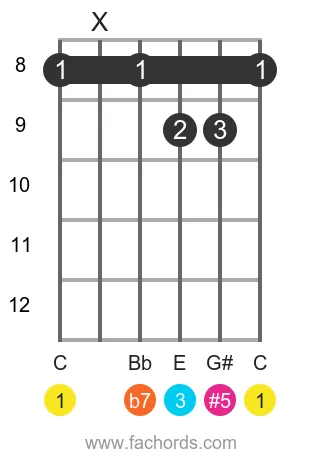
C dominant 7th with sharp 5th guitar chord is also written as C7(#5), C7#5, C7+5 or Caug7.
Position 1
Movable
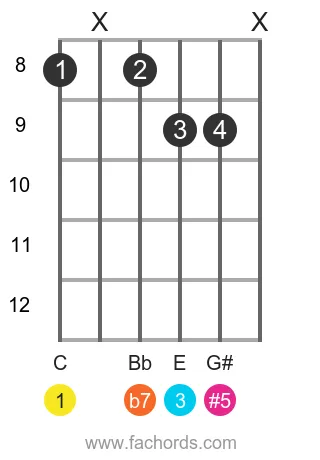
Position 2
Barre
Movable
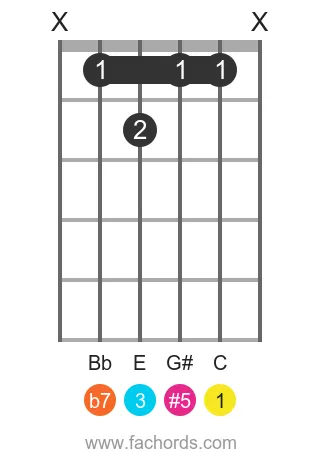
Position 3
Barre
Movable
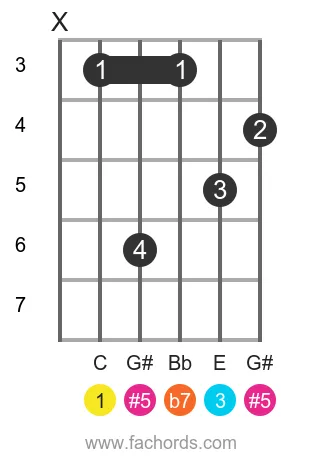
Position 4
Barre
Movable
 Find more shapes in our all guitar chords online library. If you
prefer a printable pdf, download
the Free Guitar Chords Chart Pdf
Find more shapes in our all guitar chords online library. If you
prefer a printable pdf, download
the Free Guitar Chords Chart Pdf
You can also use this accessible C7(#5) chord page, with written diagram instructions and screen-reader support for blind users.
Practice Your C7(#5) Guitar Chord with Our Interactive Tool
Want a structured chord roadmap instead of jumping between pages?
Go to the full guitar chords tutorial.
Ready to tackle the intriguing C7(#5) chord? Our interactive fretboard is your ideal training ground, offering instant mic feedback so you can verify your playing accuracy in real-time. You can also hear its distinct sound with our playback feature. This complex Augmented Seventh chord is composed of the notes C, E, G#, and Bb, corresponding to the 1 (Root), 3 (Major Third), #5 (Augmented Fifth), and b7 (Minor Seventh) intervals, placing it firmly within the Augmented Chords family.
The C7(#5) chord, as a member of the dominant family, inherently carries a unique tension that often resolves harmonically. Its augmented fifth creates a distinctive, rich sound frequently employed in jazz and blues for its expressive qualities. Understanding the construction of chords by their intervals is fundamental for expanding your fretboard knowledge. This particular chord's role in creating harmonic movement makes it a valuable addition to your dominant chord vocabulary. For those interested in simplifying such complex voicings, exploring 3-note 7th chords can offer a practical approach.
Further down this page, you’ll find comprehensive chord diagrams, arranged from the easiest to the most challenging, along with detailed theory on its application across various keys and within different songs. Before you delve into the diagrams and theoretical explanations, we encourage you to immediately test your understanding with our interactive tool. Get hands-on experience and confirm your fingerings and sound. Your guitar is waiting!
Notes that compose the C 7(#5) chord:
Formula of the Dominant Seventh Sharp Fifth chord:
Play This Chord With Other Roots
C 7(#5) | D 7(#5) | E 7(#5) | F 7(#5) | G 7(#5) | A 7(#5) | B 7(#5) | C#7(#5) | D#7(#5) | F#7(#5) | G#7(#5) | A#7(#5) | Ab7(#5) | Bb7(#5) | Db7(#5) | Eb7(#5) | Gb7(#5)

Created by
Giancarlo is a musician (teaching guitar since 2000), software engineer, AI consultant and published researcher
FAQ
What are the specific notes and intervals that make up a C7(#5) chord?
The C7(#5) chord is composed of the notes C, E, G#, and Bb. These notes correspond to the intervals of 1 (Root), 3 (Major Third), #5 (Augmented Fifth), and b7 (Minor Seventh) relative to the root C.
How does the C7(#5) chord relate to the 'Augmented Chords' family?
The C7(#5) chord is known as an Augmented Seventh chord because it contains an augmented fifth interval (G#). This augmented fifth is the characteristic element that places it within the family of Augmented Chords.
How is the C7(#5) chord different from a standard C7 (dominant seventh) chord?
A standard C7 chord contains a perfect fifth (G). The C7(#5) chord, however, features an *augmented* fifth (G# instead of G). This altered fifth is what gives the C7(#5) its distinct 'augmented' quality and unique, rich sound, while both chords include the root, major third, and minor seventh.
When is the C7(#5) chord typically used in music?
The C7(#5) chord, with its complex and rich sound, is often used in jazz and blues music. As a type of dominant (7) chord, it frequently functions to create tension that leads to resolution, adding harmonic color and sophistication to chord progressions.
Is the C7(#5) chord suitable for beginners?
While the C7(#5) chord might be a bit more advanced for beginners due to its altered fifth and distinct sound, it is an excellent addition to the repertoire of an intermediate player looking to expand their harmonic vocabulary and explore more complex musical genres like jazz and blues.