Explore C6/9 Chord for Guitar: Uncover Fretboard Patterns
Want a structured chord roadmap instead of jumping between pages?
Go to the full guitar chords tutorial.
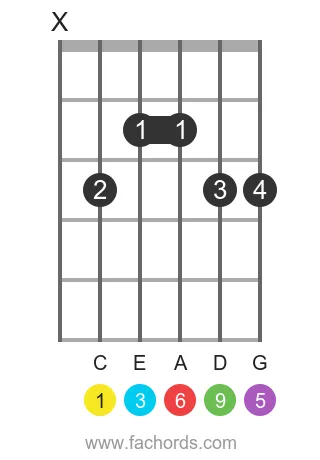
The C six nine chord, written C6/9, stacks root C, major third E, fifth G, major sixth A and ninth D. The ninth, D, is the second note of the C major scale placed an octave higher.
There are four voicings on this page, three of them barre shapes, and the lowest sits at the 2nd fret. For melody, use the C major pentatonic scale: it consists of the chord's own five notes. For a visual route to the same notes, see how intervals sit on the neck.
Press play on the fretboard player at the top to hear C6/9 strummed and as an arpeggio.
C 6/9 guitar chord is also written as C6/9, C6add9, C69 or Cmaj6/9.
Notes in the C 6/9 chord:
Tones of the Major Sixth Nine Added chord:
C 6/9 Guitar Chord Diagrams
Position 1 Barre Movable
Finger Positions
- Mute the low E string
- Place your index finger (1) on the fret 2 of the D and G strings at the same time
- Place your middle finger (2) on the fret 3 of the A string
- Place your ring finger (3) on the fret 3 of the B string
- Place your pinky finger (4) on the fret 3 of the high E string
Position 2 Barre Movable
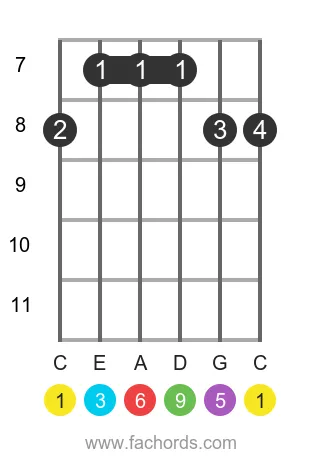
Finger Positions
- Place your index finger (1) on the fret 7 of the A, D and G strings at the same time
- Place your middle finger (2) on the fret 8 of the low E string
- Place your ring finger (3) on the fret 8 of the B string
- Place your pinky finger (4) on the fret 8 of the high E string
Position 3 Movable
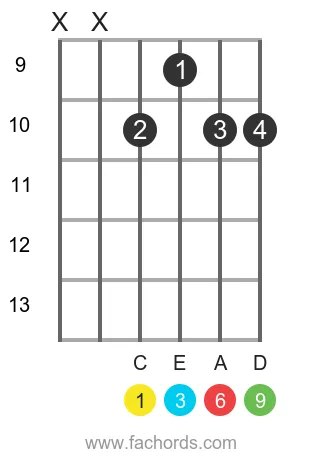
Finger Positions
- Mute the low E string
- Mute the A string
- Place your index finger (1) on the fret 9 of the G string
- Place your middle finger (2) on the fret 10 of the D string
- Place your ring finger (3) on the fret 10 of the B string
- Place your pinky finger (4) on the fret 10 of the high E string
Position 4 Barre Movable
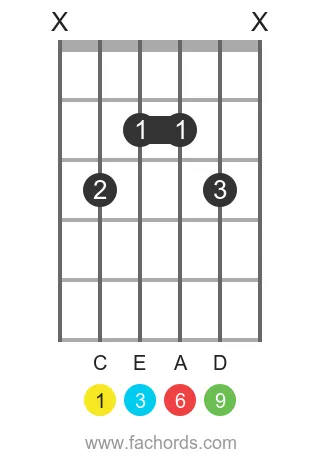
Finger Positions
- Mute the low E string
- Mute the high E string
- Place your index finger (1) on the fret 2 of the D and G strings at the same time
- Place your middle finger (2) on the fret 3 of the A string
- Place your ring finger (3) on the fret 3 of the B string
 Find more shapes in our all guitar chords online library. If you
prefer a printable pdf, download
the Free Guitar Chords Chart Pdf
Find more shapes in our all guitar chords online library. If you
prefer a printable pdf, download
the Free Guitar Chords Chart Pdf


Created by
Giancarlo is a musician (teaching guitar since 2000), software engineer, AI consultant and published researcher
FAQ
Which notes are in C six nine?
C six nine contains C, E, G, A and D. They are the root, major third, perfect fifth, major sixth and ninth.
How many voicings are there for C6/9?
C6/9 has 4 voicings: 3 use a barre and none use open strings. The highest one reaches the 10th fret.
Which scale goes with C6/9?
The C major pentatonic scale: C, D, E, G, A. It contains exactly the five notes of the chord.
How does C6/9 differ from C6?
C6 has C, E, G and A. C6/9 also includes D, the ninth, so it has five notes instead of four.
