Play and Master the C11 Guitar Chord
Want a structured chord roadmap instead of jumping between pages?
Go to the full guitar chords tutorial.
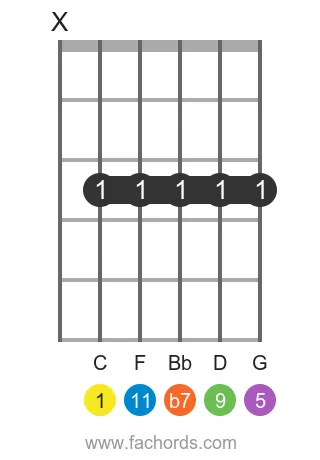
The C 11 chord adds a rich, sophisticated flavor often heard in jazz and contemporary music. This intricate chord, a member of the Dominant Chord family, is built from the notes C, E, G, Bb, D, and F, representing the 1, 3, 5, b7, 9, and 11 intervals respectively. Use the interactive fretboard above to explore its distinct sound, listen to its playback, and verify your accuracy as you play using real-time mic feedback.
The addition of the 9th and 11th intervals makes the C11 a truly expressive chord, expanding beyond the basic dominant seventh. Understanding how these extensions are stacked, as detailed in our Chord Construction tutorial, is key to unlocking its harmonic potential. If you're familiar with Ninth Chords, you'll find the C11 takes that concept a step further, offering even richer sonic textures in your progressions.
Dive into playing the C11 chord immediately by interacting with our visual diagrams, which range from easy voicings to more challenging shapes. Our comprehensive theory section, along with practical examples in various keys and musical contexts, will solidify your understanding. Don't just read about it – start playing and experimenting with this powerful chord today!
C 11 chord Notes:
Chord Formula:
Guitar Patterns for the C Dominant Eleventh chord
Position 1
Barre
Movable
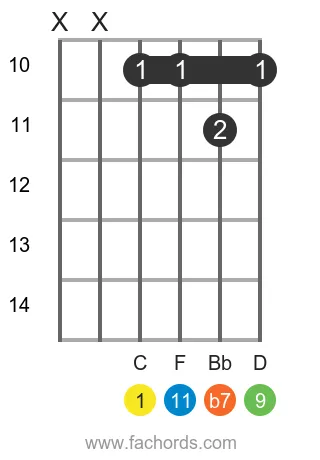
Position 2
Barre
Movable
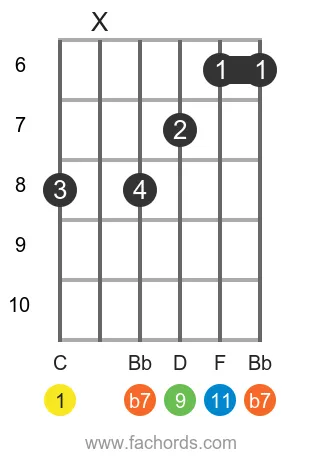
Position 3
Barre
Movable
 Find more shapes in our all guitar chords online library. If you
prefer a printable pdf, download
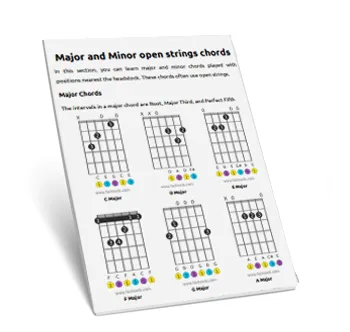
the Free Guitar Chords Chart Pdf
Find more shapes in our all guitar chords online library. If you
prefer a printable pdf, download
the Free Guitar Chords Chart Pdf
You can also use this accessible C11 chord page, with written diagram instructions and screen-reader support for blind users.
FAQ
What notes and intervals make up a C11 chord?
The C11 chord is composed of the notes C, E, G, Bb, D, and F. These correspond to the intervals of Root (1), Major Third (3), Perfect Fifth (5), Minor Seventh (b7), Major Ninth (9), and Perfect Eleventh (11) from the root note C.
Why is the C11 chord classified as a dominant chord?
The C11 chord is a dominant chord because its fundamental structure includes the Root, Major Third, Perfect Fifth, and crucially, the Minor Seventh (b7) interval. This characteristic minor seventh is what defines a dominant 7th chord, and the 9th and 11th are extensions built upon that dominant foundation.
What makes the C11 chord an intermediate level chord for guitarists?
The C11 chord is considered intermediate because it is more complex than basic chords, involving six distinct notes and intervals. Playing it accurately requires a deeper understanding of music theory and often more challenging fingerings or fretboard patterns compared to simpler three or four-note chords.
When are C11 chords typically used in music?
C11 chords are frequently used in jazz music, particularly within jazz chord progressions. They add a rich and complex harmonic flavor, often found in progressions that also utilize major 7th, minor 7th, and dominant 7th chord types.
What does the '11' signify in the C11 chord name?
The '11' in C11 signifies that the chord includes the Perfect Eleventh interval (F) in its structure, in addition to the Root (C), Major Third (E), Perfect Fifth (G), Minor Seventh (Bb), and Major Ninth (D). The number indicates the highest musical interval present from the root, beyond the basic dominant 7th and 9th.