C# m11 Guitar Chord
Chord Diagrams, Interactive Fretboard and Chord Theory
C# minor 11th guitar chord is also written as C#m11, C#min11 or C#-11.
Position 1
Movable
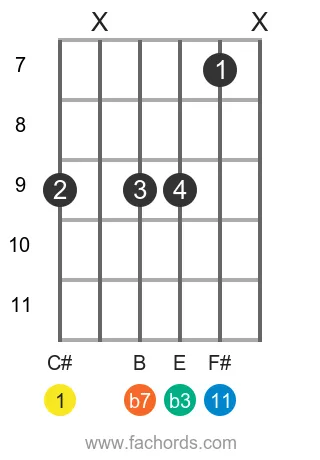
Position 2
Barre
Movable
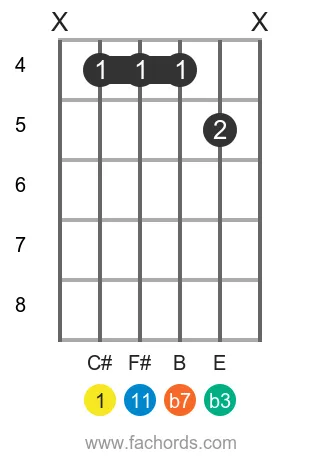
Position 3
Barre
Movable
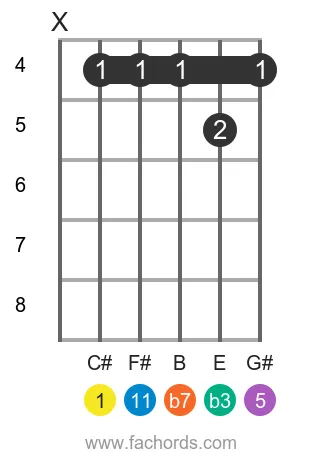
Position 4
Barre
Movable
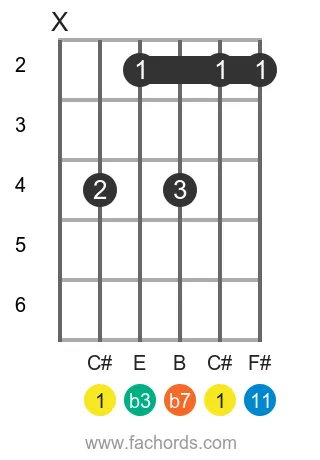
Position 5
Barre
Movable
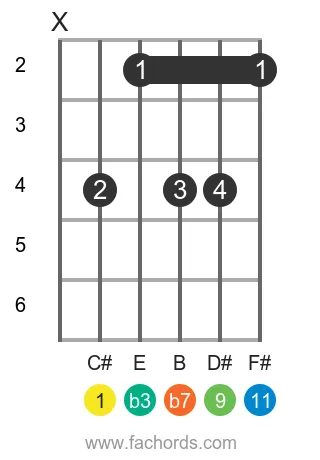
Position 6
Barre
Movable
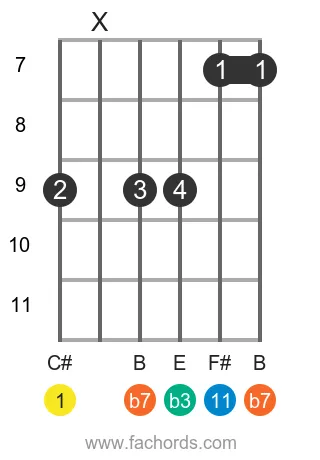
Position 7
Barre
Open
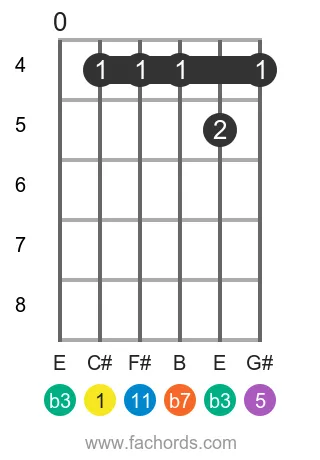
 Find more shapes in our all guitar chords online library. If you
prefer a printable pdf, download
the Free Guitar Chords Chart Pdf
Find more shapes in our all guitar chords online library. If you
prefer a printable pdf, download
the Free Guitar Chords Chart Pdf
You can also use this accessible C#m11 chord page, with written diagram instructions and screen-reader support for blind users.
Explore & Master the C#m11 Guitar Chord with Interactive Practice
Want a structured chord roadmap instead of jumping between pages?
Go to the full guitar chords tutorial.
The C#m11 chord brings a lush, often jazzy or soulful depth to compositions, acting as a rich extension in the Minor Chords family. It's constructed from the notes C#, E, G#, B, D#, and F#, which correspond to the intervals Root (1), Minor Third (b3), Perfect Fifth (5), Minor Seventh (b7), Major Ninth (9), and Perfect Eleventh (11). To truly grasp its sound and feel, our interactive fretboard tool provides an immersive exploration lab, allowing you to visualize voicings, hear them played as a strum or arpeggio, and immediately verify your accuracy with real-time microphone feedback.
Expanding on simpler minor and ninth chords, the C#m11 showcases the beauty of stacked intervals and advanced harmonies. Mastering such complex voicings is crucial for fretboard fluidity. Dive deeper into how these harmonies are built with our guide on Chord Construction, and further explore extended voicings in our Ninth Chords tutorial. Given that many complex chords utilize movable shapes, our insights on Guitar Bar Chords will be highly beneficial. And to ensure seamless transitions between these new shapes, be sure to consult our tips to Improve Chords Change.
Below, you'll find a wealth of resources including C#m11 chord diagrams, logically ranked from simple open positions to advanced movable shapes. Essential music theory, popular songs featuring this chord, and ideal keys for its use are also covered. However, we encourage you to play and experiment first with the interactive tool above. Set a groove with the drum and BPM tool, try various voicings, and let the mic feedback refine your technique. Immersing yourself in the sound is the most direct route to truly understanding the C#m11.
C# m11 chord Notes:
How the Minor Eleventh chord is built:
Play This Chord With Other Roots
C m11 | D m11 | E m11 | F m11 | G m11 | A m11 | B m11 | C#m11 | D#m11 | F#m11 | G#m11 | A#m11 | Abm11 | Bbm11 | Dbm11 | Ebm11 | Gbm11


Created by
Giancarlo is a musician (teaching guitar since 2000), software engineer, AI consultant and published researcher
FAQ
What specific notes and intervals define the C# m11 chord?
The C# m11 chord is comprised of the notes C#, E, G#, B, D#, and F#. These correspond to the intervals of Root (1), Minor Third (b3), Perfect Fifth (5), Minor Seventh (b7), Major Ninth (9), and Perfect Eleventh (11) when built from the root note C#.
How is the C# m11 chord typically constructed?
The C# m11 chord is built by a technique called 'stacking intervals'. This means adding specific intervals, the Minor Third, Perfect Fifth, Minor Seventh, Major Ninth, and Perfect Eleventh, sequentially on top of the C# root note to form the complete chord structure.
Why is the C# m11 chord described as having a 'rich and complex tonal texture'?
The C# m11 chord's rich and complex sound stems from its extended nature. It includes the Major Ninth (9) and Perfect Eleventh (11) intervals, which add sophisticated harmonic color and depth beyond a basic minor seventh chord, creating a fuller and more nuanced musical quality.
Is the C# m11 chord suitable for beginner guitarists?
No, the C# m11 chord is characterized as an 'intermediate to advanced' chord. Its extended nature, involving more notes and complex intervals than simpler chords, generally requires a solid foundation in basic chord theory and playing techniques, making it more challenging for absolute beginners.
