Explore C# 9b5 Guitar Chord Shapes on the Fretboard
Want a structured chord roadmap instead of jumping between pages?
Go to the full guitar chords tutorial.
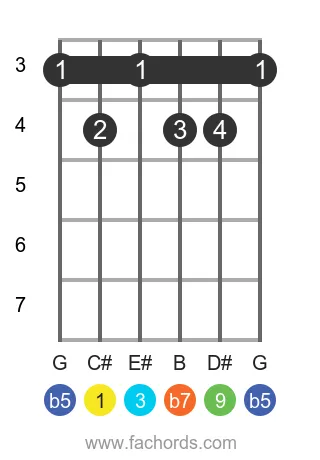
Unlocking the C# 9b5 chord begins with understanding its unique visual footprint on the fretboard. Our interactive fretboard tool provides an immediate canvas to explore every possible fingering, helping you grasp the spatial relationships across the strings. Verify your precision in real-time with mic feedback, confirming your finger placement instantly. This complex Dominant Chord is built from the notes C#, E#, G, B, and D#, structured with a Root (1), Major Third (3), flattened Fifth (b5), Minor Seventh (b7), and Ninth (9).
The distinct blend of the ninth and flattened fifth intervals gives the C# 9b5 its sophisticated harmonic color, creating tension that often resolves beautifully. Understanding how these extensions are constructed is key, so delve into our guide on Chord Construction. As a powerful member of the Dominant Chords family, its application is crucial for advanced harmony. Many common voicings for this chord involve barre shapes, making Guitar Bar Chords an essential skill to master for full command of the fretboard.
Below, you'll discover a comprehensive collection of chord diagrams for the C# 9b5, ranging from foundational open positions to more advanced movable shapes. We'll also delve into its music theory, list songs where it shines, and highlight common keys where this chord is frequently found. Before committing shapes to memory, take a moment with the interactive tool above to visually explore how the C# 9b5 lays out on the fretboard, using the drum tool to set a practice tempo and hear it played as a strum or arpeggio.
C# 9th with flat 5th guitar chord is also written as C#9b5, C#9(b5) or C#9-5.
Notes in the C# 9b5 chord:
Tones of the Dominant Ninth Flat five chord:
C# 9b5 Guitar Chord Diagrams
Position 1
Barre
Movable
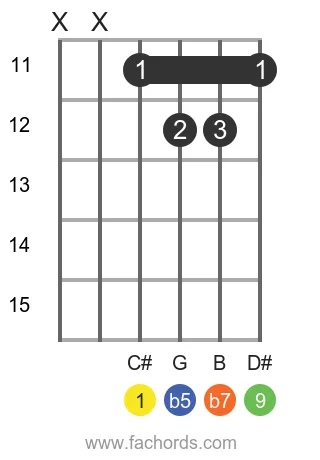
Position 2
Barre
Movable
Position 3
Barre
Movable
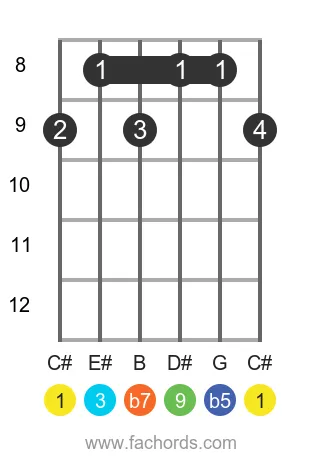
 Find more shapes in our all guitar chords online library. If you
prefer a printable pdf, download
the Free Guitar Chords Chart Pdf
Find more shapes in our all guitar chords online library. If you
prefer a printable pdf, download
the Free Guitar Chords Chart Pdf
You can also use this accessible C#9b5 chord page, with written diagram instructions and screen-reader support for blind users.

Created by
Giancarlo is a musician (teaching guitar since 2000), software engineer, AI consultant and published researcher
FAQ
What defines a C# 9b5 chord?
The C# 9b5 is a complex Dominant Chord defined by its specific notes: C#, E#, G, B, and D#. Its unique structure consists of the intervals 1 (root), 3 (major third), b5 (flattened fifth), b7 (minor seventh), and 9 (ninth).
Why is the C# 9b5 considered a Dominant Chord?
The C# 9b5 chord belongs to the Dominant Chords family, sharing fundamental characteristics and a specific interval structure with other dominant chords, notably including a major third and a minor seventh.
What do the '9' and 'b5' in the C# 9b5 chord name signify?
The '9' indicates the inclusion of a ninth interval above the root, which is an extension beyond a basic dominant chord. The 'b5' means the fifth degree of the scale is flattened (lowered by a semitone), contributing to the chord's unique altered sound.
How do the notes C#, E#, G, B, and D# correspond to the C# 9b5's interval structure?
For the C# 9b5 chord, C# is the root (1), E# is the major third (3), G is the flattened fifth (b5), B is the flattened seventh (b7), and D# is the ninth (9). These notes precisely form the chord according to its theoretical construction.
What level of guitarist is the C# 9b5 chord appropriate for?
The C# 9b5 chord is not recommended for beginners. It is considered an intermediate to advanced chord, requiring a solid understanding of music theory, chord construction, and general guitar playing experience.