C# 9 Guitar Chord
Chord Diagrams, Interactive Fretboard and Chord Theory
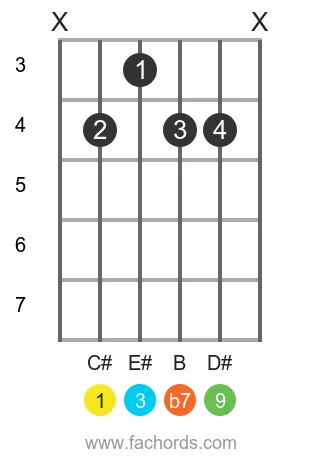
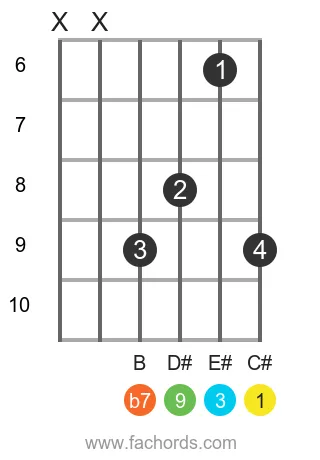
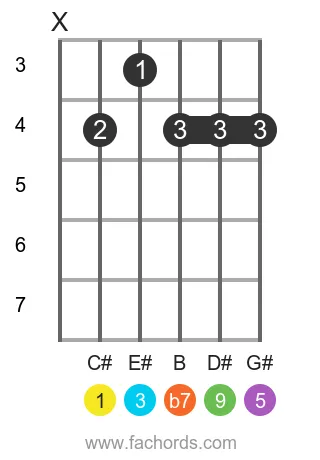
C# dominant 9th guitar chord is also written as C#9, C#dom9, C#7(9) or C#7add9.
Position 1
Movable
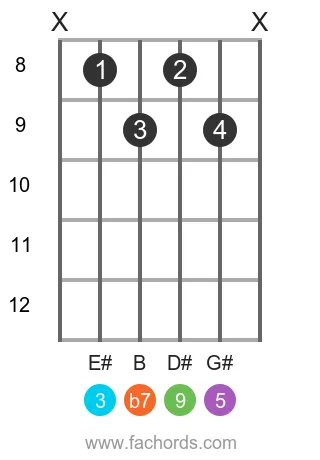
Position 2
Movable
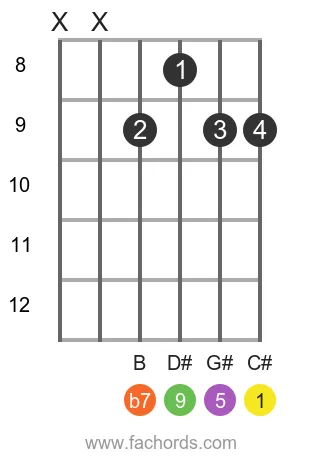
Position 3
Movable
Position 4
Movable
Position 5
Barre
Movable
 Find more shapes in our all guitar chords online library. If you
prefer a printable pdf, download
the Free Guitar Chords Chart Pdf
Find more shapes in our all guitar chords online library. If you
prefer a printable pdf, download
the Free Guitar Chords Chart Pdf
You can also use this accessible C#9 chord page, with written diagram instructions and screen-reader support for blind users.
Explore C#9 Guitar Chord Shapes with Interactive Feedback
Want a structured chord roadmap instead of jumping between pages?
Go to the full guitar chords tutorial.
Discover the spatial possibilities of the C#9 chord on your guitar. The interactive fretboard tool at the top of this page lets you visualize various fingerings across the neck, emphasizing the geometry of this rich, complex sound. As you explore these shapes, our virtual fretboard can play the chord as a strum or arpeggio, and you can verify your accuracy instantly with real-time microphone feedback. This C#9 chord belongs to the Dominant Chords family, constructed from the notes C#, E#, G#, B, and D#, using the intervals 1 (Root), 3 (Major Third), 5 (Perfect Fifth), b7 (Minor Seventh), and 9 (Major Ninth).
Ninth chords, like the C#9, introduce extended harmony and vibrant color tones to your music, moving beyond basic triads to create richer textures. To fully grasp how these complex structures are built, dive into our comprehensive guide on Chord Construction. For a deeper understanding of their foundational role, particularly in blues and jazz, explore our Dominant Chord tutorial. You can further expand your knowledge of the entire family of extended chords with our dedicated Ninth Chords resource, and discover how to apply these sophisticated shapes across the fretboard, including common Guitar Bar Chords.
Below this section, you'll find a curated collection of C#9 chord diagrams, presented from accessible open positions to more advanced movable shapes. These are complemented by detailed music theory explanations, popular songs utilizing this chord, and insights into the key contexts where it shines. Before committing these shapes to memory, we encourage you to fully engage with the interactive tool above: set your preferred rhythm with the BPM/drum tool, actively play the C#9 chord, and allow the integrated mic feedback to refine your physical understanding. Exploring the visual layout first with the tool is key to mastering these shapes effectively.
Notes of the C# 9 chord:
Tones in the Dominant Ninth chord:
Play This Chord With Other Roots
C 9 | D 9 | E 9 | F 9 | G 9 | A 9 | B 9 | C#9 | D#9 | F#9 | G#9 | A#9 | Ab9 | Bb9 | Db9 | Eb9 | Gb9

Created by
Giancarlo is a musician (teaching guitar since 2000), software engineer, AI consultant and published researcher
FAQ
What are the specific notes that make up a C#9 chord?
The C#9 chord is composed of five distinct notes: C#, E#, G#, B, and D#. These notes, when played together, create the chord's characteristic rich and complex sound.
How are the intervals 1, 3, 5, b7, and 9 used to build the C#9 chord?
The C#9 chord is constructed by stacking specific intervals from its root note, C#. The intervals are the root (1st), major third (3rd), perfect fifth (5th), minor seventh (b7th), and major ninth (9th). Each interval corresponds to one of the chord's notes: C# (1), E# (3), G# (5), B (b7), and D# (9).
Why is the C#9 classified as a 'dominant chord'?
The C#9 chord belongs to the dominant chord family because it inherently contains a minor seventh interval (b7) along with the root, major third, and perfect fifth. This combination gives dominant chords a specific harmonic function, often creating tension that leads to a resolution.
What is the significance of the '9' in the C#9 chord?
The '9' in the C#9 chord indicates the inclusion of a major ninth interval, which is D# in this case. This interval extends the basic dominant seventh chord, adding a layer of harmonic sophistication and a distinctive, often colorful or jazzy, quality to the chord's overall sound.
Why is E# used as a note in the C#9 chord instead of F?
In music theory, intervals are named systematically based on their scale degree relative to the root. For a C# major third, the third note in the theoretical C# major scale is E. To make it a major third from C#, it must be written as E#, not F, even though F is enharmonically equivalent to E#. This ensures correct interval notation and consistent chord spelling.
What makes the C#9 chord's sound 'rich and complex'?
The C#9 chord achieves its rich and complex sound primarily due to the addition of the minor seventh (b7) and especially the major ninth (9) intervals beyond the basic triad. These extended notes introduce harmonic tension and color, providing a more sophisticated and nuanced tonal quality compared to simpler chords.