C# 7b5 Guitar Chord
Chord Diagrams, Interactive Fretboard and Chord Theory
C# 7th with flat 5th guitar chord is also written as C#7b5, C#7(b5) or C#7-5.
Position 1
Movable
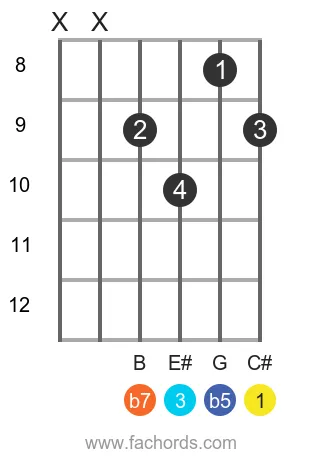
Position 2
Movable
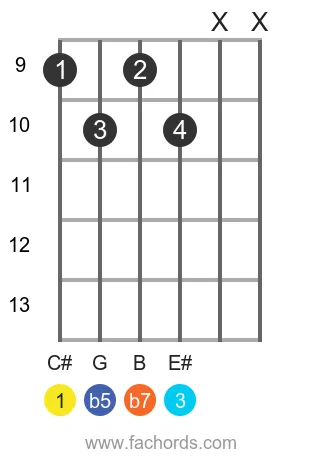
Position 3
Barre
Movable
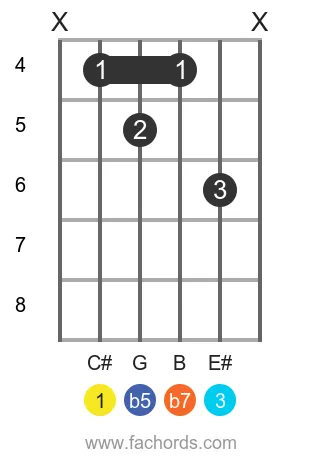
 Find more shapes in our all guitar chords online library. If you
prefer a printable pdf, download
the Free Guitar Chords Chart Pdf
Find more shapes in our all guitar chords online library. If you
prefer a printable pdf, download
the Free Guitar Chords Chart Pdf
You can also use this accessible C#7b5 chord page, with written diagram instructions and screen-reader support for blind users.
Explore C#7b5 Guitar Chord Shapes & Master the Fretboard
Want a structured chord roadmap instead of jumping between pages?
Go to the full guitar chords tutorial.
To truly grasp the C#7b5 chord, begin by visualizing its unique fretboard geometry. Our interactive fretboard tool allows you to explore various fingerings and see how this captivating Dominant Chord family member lays out across the strings. Verify your accuracy instantly with our real-time microphone feature, ensuring every note is perfectly placed. The C#7b5 is built from the notes C#, E#, G, and B, comprising the intervals Root (1), Major Third (3), Diminished Fifth (b5), and Minor Seventh (b7).
The unique combination of a major third and a diminished fifth gives the C#7b5 its distinct, often dissonant yet intriguing quality, frequently used in jazz, funk, and blues to create tension and lead to resolution. To understand the underlying principles of why this Dominant Chord sounds the way it does, explore our comprehensive guide on Dominant Chords. You can also deepen your theoretical knowledge with our Chord Construction tutorial, or discover how essential 7th chord voicings are formed in our Learn 3-Note 7th Chords lesson.
Below, you'll find a curated selection of C#7b5 chord diagrams, ranging from the simplest open positions to more advanced movable shapes, alongside valuable music theory insights, popular songs featuring this chord, and the keys where it commonly appears. Before you delve into memorizing these patterns, we strongly recommend spending quality time with the interactive tool above. Use the drum & BPM tool to set your rhythm, strum or arpeggiate the chord, and let the mic feedback fine-tune your playing. Actively exploring these shapes with the tool is key to internalizing the C#7b5.
Notes of the C# 7b5 chord:
Tones in the Dominant Seventh Flat five chord:
Play This Chord With Other Roots
C 7b5 | D 7b5 | E 7b5 | F 7b5 | G 7b5 | A 7b5 | B 7b5 | C#7b5 | D#7b5 | F#7b5 | G#7b5 | A#7b5 | Ab7b5 | Bb7b5 | Db7b5 | Eb7b5 | Gb7b5

Created by
Giancarlo is a musician (teaching guitar since 2000), software engineer, AI consultant and published researcher
FAQ
What are the specific notes and intervals that form the C#7b5 chord?
The C#7b5 chord is comprised of the notes C#, E#, G, and B. These notes correspond to the intervals of a Root, Major Third, Diminished Fifth, and Minor Seventh from the root note C#.
What type of chord is C#7b5, and what kind of sound does it produce?
The C#7b5 belongs to the dominant chords family. It creates a unique and complex sound, described as both dissonant and harmonious, which can add depth and richness to your music.
How do the numerical intervals 1, 3, b5, and b7 relate to building the C#7b5 chord?
These numerical intervals define the precise structure of the C#7b5 chord. '1' represents the Root, '3' is the Major Third, 'b5' signifies the Diminished Fifth, and 'b7' indicates the Minor Seventh, all stacked from the C# root.
In what musical genres or contexts might I typically encounter the C#7b5 chord?
As a dominant chord, the C#7b5 is often utilized in genres such as jazz and blues music, where dominant chords play a significant role in creating harmonic interest.
Why is E# listed as a note in the C#7b5 chord instead of F?
Within music theory, E# is the correct name for the Major Third interval when building from the root note C#. This specific naming maintains the consistent intervallic structure of the chord, which includes a Root, Major Third, Diminished Fifth, and Minor Seventh.
