Practice C#7(b9) Guitar Chord: Master Your Technique
Want a structured chord roadmap instead of jumping between pages?
Go to the full guitar chords tutorial.
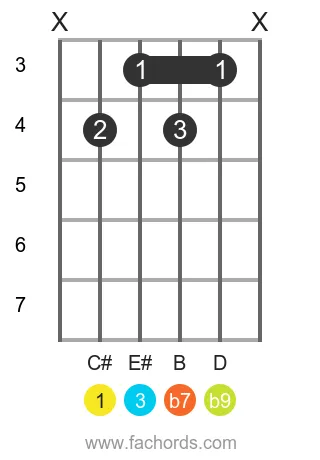
Are you ready to truly master the C#7(b9) chord? Dive straight into our interactive tool where you can immediately strum this complex voicing and verify your accuracy with real-time mic feedback. This compelling member of the Dominant Chords family is constructed from the notes C#, E#, G#, B, and D, corresponding to the intervals Root (1), Major Third (3), Perfect Fifth (5), Minor Seventh (b7), and Minor Ninth (b9). Use the virtual fretboard to visualize fingerings and hear the chord through chord or arpeggio playback.
Known for its rich, often tense sound, the C#7(b9) chord brings extended harmony and unique color tones to genres like jazz and neo-soul. Mastering its application requires understanding its role within the broader concept of Dominant Chords and their natural resolution. As an extended voicing, a firm grasp of Ninth Chords is essential to truly harness its power. For a comprehensive look at how these complex harmonies are built, our Chord Construction guide offers invaluable insights into the underlying principles.
Further down, you'll find comprehensive C#7(b9) chord diagrams, ranging from the simplest open positions to more advanced movable shapes, complete with relevant music theory, songs that feature this chord, and key contexts where it truly shines. But before you scroll, test yourself first with the interactive tool above: set your desired BPM with the integrated drum tool, strum the chord, and let the mic feedback guide your technique. This immediate, hands-on approach is the most efficient way to internalize new chords.
C# 7(b9) chord Notes:
How the Dominant Seventh Flat Nine Added chord is built:
C#7(b9) Guitar Chord Diagrams
Position 1
Movable
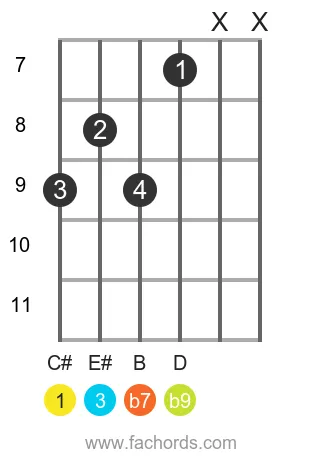
Position 2
Barre
Movable
Position 3
Barre
Movable
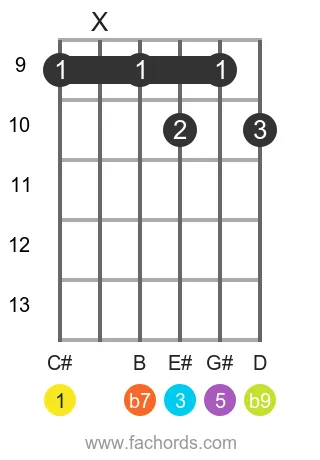
 Find more shapes in our all guitar chords online library. If you
prefer a printable pdf, download
the Free Guitar Chords Chart Pdf
Find more shapes in our all guitar chords online library. If you
prefer a printable pdf, download
the Free Guitar Chords Chart Pdf
You can also use this accessible C#7(b9) chord page, with written diagram instructions and screen-reader support for blind users.
FAQ
What notes make up the C#7(b9) chord?
The C#7(b9) chord is composed of five distinct notes: C# (Root), E# (Major Third), G# (Perfect Fifth), B (Minor Seventh), and D (Minor Ninth). These notes are derived from its specific interval structure.
What does the 'b9' signify in the C#7(b9) chord?
The 'b9' in C#7(b9) stands for a 'minor ninth' interval. This means the ninth degree of the scale is flattened by a half-step. For a C# chord, the natural ninth would be D#, so the b9 becomes D, adding a characteristic tension and color often utilized in jazz.
Why is the C#7(b9) chord classified as a dominant chord?
The C#7(b9) chord is part of the dominant chords family because it contains a minor seventh interval (b7) along with its root, major third, and perfect fifth. The presence of the minor seventh is the defining characteristic of a dominant 7th chord, upon which the b9 is then added.
What level of guitarist should attempt to learn the C#7(b9) chord?
The C#7(b9) is considered a more complex chord. It is generally recommended for intermediate to advanced guitarists who have a solid understanding of basic chords, fretboard intervals, and fundamental music theory concepts before attempting to master it.
How do intervals like 1, 3, 5, b7, and b9 translate to the notes of the C#7(b9) chord?
Starting from the root note C#: the 1 (Root) is C#, the 3 (Major Third) is E#, the 5 (Perfect Fifth) is G#, the b7 (Minor Seventh) is B, and the b9 (Minor Ninth) is D. Understanding these interval-to-note relationships is key to building and identifying the chord.
