Learn and Master the C#13 Guitar Chord Interactively
Want a structured chord roadmap instead of jumping between pages?
Download the step-by-step Guitar Chord Ebook
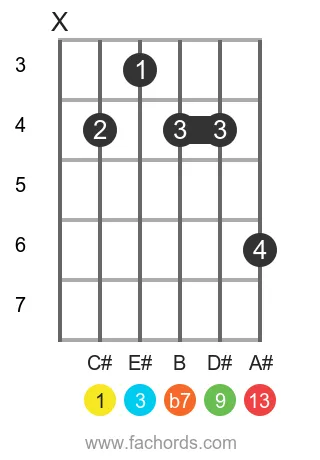
The C#13 chord is constructed as an extended dominant harmony, derived from its core intervals. As a member of the Dominant Chords family, it comprises the notes C#, E#, G#, B, D#, F#, and A#. These notes correspond to the intervals Root (1), Major Third (3), Perfect Fifth (5), Minor Seventh (b7), Major Ninth (9), Perfect Eleventh (11), and Major Thirteenth (13). To thoroughly understand and apply this rich sound, utilize our interactive fretboard tool. It allows you to visualize every possible fingering, hear the chord played as a strum or arpeggio, and receive crucial real-time microphone feedback to verify your accuracy and execution.
This sophisticated extended dominant chord is a hallmark in jazz and blues, enriching compositions with its complex harmony. To deepen your understanding of how such chords are built and function harmonically, explore our comprehensive guide on Dominant Chord theory. Further expand your knowledge of advanced voicings and color tones with our Ninth Chords tutorial, which lays the groundwork for extensions like the 13th. For a general overview of fundamental principles, consult our Chord Construction lesson. Mastering the C#13 requires smooth changes, so review our tips to Improve Chords Change.
Below, you will find comprehensive C#13 chord diagrams, organized from foundational fingerings to more advanced voicings, along with deeper music theory insights, popular songs showcasing this chord, and common keys where it beautifully fits. Before proceeding, make it a disciplined practice to fully engage with the interactive tool above. Utilize the built-in drum and BPM tool for rhythmic precision, listen carefully to the chord's sound, and leverage the mic feedback to meticulously refine your technique. Consistent, interactive practice is key to truly integrating complex chords like the C#13 into your repertoire.
C# 13 chord Notes:
How the Dominant Thirteen chord is built:
Guitar Patterns for the C#13 chord
Position 1
Barre
Movable
Position 2
Barre
Movable
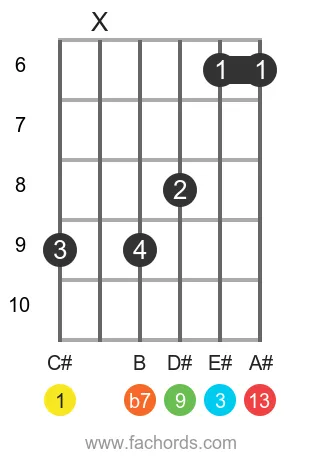
Position 3
Barre
Movable
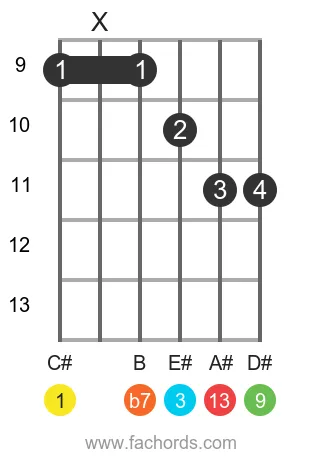
 Find more shapes in our all guitar chords online library. If you
prefer a printable pdf, download
the Free Guitar Chords Chart Pdf
Find more shapes in our all guitar chords online library. If you
prefer a printable pdf, download
the Free Guitar Chords Chart Pdf
You can also use this accessible C#13 chord page, with written diagram instructions and screen-reader support for blind users.

FAQ
What notes make up the C#13 chord?
The C#13 chord is composed of seven distinct notes: C# (root), E# (major third), G# (perfect fifth), B (minor seventh), D# (major ninth), F# (perfect eleventh), and A# (major thirteenth). These notes are built by stacking specific intervals from the C# root.
Why is the C#13 considered a 'dominant' chord?
The C#13 chord is categorized as a dominant chord because it contains the crucial minor seventh interval (B in this case), along with the root (C#) and major third (E#). This specific combination of intervals, even with added extensions like the 9th, 11th, and 13th, gives it the characteristic harmonic tension and pull associated with dominant chords.
How do the intervals 1, 3, 5, b7, 9, 11, and 13 relate to the C#13 chord?
These numbers represent the specific intervals built from the root note C# that form the C#13 chord. '1' is the root (C#), '3' is the major third (E#), '5' is the perfect fifth (G#), 'b7' is the minor seventh (B), '9' is the major ninth (D#), '11' is the perfect eleventh (F#), and '13' is the major thirteenth (A#). Each interval adds a layer to the chord's overall sound.
Why does a C#13 chord have so many notes compared to simpler chords?
The C#13 chord is a highly extended chord, meaning it builds upon a basic dominant seventh chord by adding further intervals. It includes the major ninth, perfect eleventh, and major thirteenth intervals stacked on top of the root, third, fifth, and minor seventh, resulting in a chord with up to seven distinct notes that contribute to its rich and complex sound.
In which musical genres is the C#13 chord typically used?
The C#13 chord, being a sophisticated dominant chord, is often used in jazz and blues music. Its rich and complex sound adds harmonic depth and color, making it a valuable addition to chord progressions in these genres.
Do I need to play all seven notes of the C#13 chord on the guitar?
While the C#13 chord technically consists of seven notes, it's often impractical or impossible to play all of them simultaneously on a standard six-string guitar. Guitarists typically choose specific voicings that emphasize the most characteristic intervals (like the root, 3rd, b7, and 13th) to capture the chord's essential sound, sometimes omitting the 5th or 11th to create clear and playable shapes.
