Practice C#11 Guitar Chord with Real-Time Feedback
Want a structured chord roadmap instead of jumping between pages?
Go to the full guitar chords tutorial.
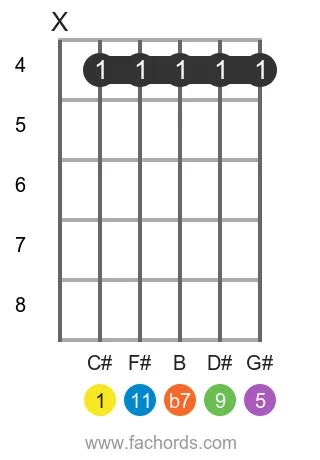
Struggling to play the C#11 chord accurately? Put your playing to the test instantly with the interactive fretboard tool at the top of this page, featuring real-time mic feedback on your strumming or arpeggio. This hands-on approach helps you internalize that the C#11 chord is a rich, complex sound from the Dominant Chords family, built from the notes C#, E#, G#, B, D#, and F#, corresponding to the intervals 1, 3, 5, b7, 9, and 11.
As an extended harmony, the 9th and 11th intervals add a sophisticated color to this chord. Delve deeper into the theoretical underpinnings with our Chord Construction tutorial, or explore the wider world of Ninth Chords. Understanding how these extensions function within the broader context of Dominant Chords will significantly enhance your playing. Don't forget to check our tips on Improve Chords Change to integrate it smoothly.
Below this interactive tool, you'll discover comprehensive chord diagrams (organized from easiest to hardest fingerings), in-depth music theory, examples of songs where the C#11 is used, and the musical keys in which it naturally appears. Before you dive into the static content, take a moment to engage with the interactive tool above; use the drum & BPM tool to find a comfortable tempo, play the chord, and let the mic feedback guide your fingers. Test yourself first for the most effective learning experience!
C# dominant 11th guitar chord is also written as C#11, C#dom11 or C#7(11).
Notes of the C# 11 chord:
Tones of the Dominant Eleventh chord:
C# 11 Guitar Chord Diagrams
Position 1
Barre
Movable
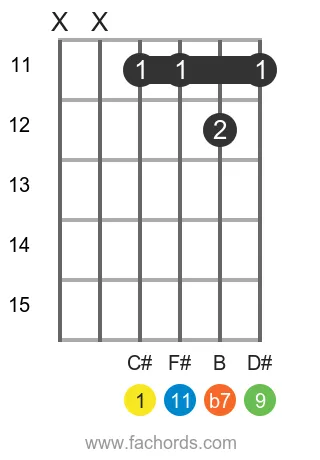
Position 2
Barre
Movable
Position 3
Barre
Movable
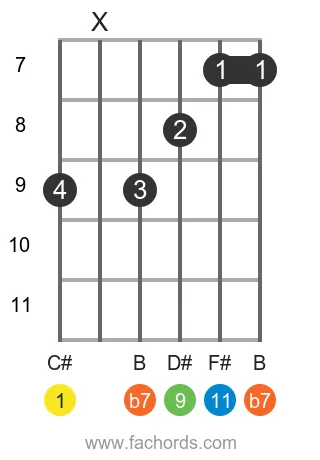
 Find more shapes in our all guitar chords online library. If you
prefer a printable pdf, download
the Free Guitar Chords Chart Pdf
Find more shapes in our all guitar chords online library. If you
prefer a printable pdf, download
the Free Guitar Chords Chart Pdf
You can also use this accessible C#11 chord page, with written diagram instructions and screen-reader support for blind users.


Created by
Giancarlo is a musician (teaching guitar since 2000), software engineer, AI consultant and published researcher
FAQ
What specifically makes the C#11 a 'dominant' chord?
The C#11 chord is classified as a dominant chord primarily because it contains a minor seventh interval (b7) relative to its root. This characteristic interval creates a natural tension that typically wants to resolve to another chord, a defining feature of the dominant chord family.
What are the individual notes that make up the C#11 chord?
The C#11 chord is constructed from six distinct notes: C#, E#, G#, B, D#, and F#. These notes are carefully chosen to create its unique and harmonious sound.
How do the intervals (1, 3, 5, b7, 9, 11) correspond to the notes of the C#11 chord?
Starting from the root note C#, the intervals correspond to the following notes: 1 (root) is C#, 3 (major third) is E#, 5 (perfect fifth) is G#, b7 (minor seventh) is B, 9 (major ninth) is D#, and 11 (perfect eleventh) is F#. Each interval adds a specific note to the chord's construction.
Why is the C#11 chord considered 'complex' and 'rich sounding'?
The C#11 chord is described as complex and rich due to its extended nature, incorporating the 9th and 11th intervals beyond the basic dominant seventh. Having six notes played simultaneously creates a dense harmonic texture, adding sophistication and depth to its overall sound, making it suitable for various musical contexts.
What is the primary benefit of learning an advanced chord like the C#11 for guitarists?
Learning the C#11 chord is highly beneficial as it significantly expands your chord vocabulary, allowing you to introduce more sophisticated and nuanced harmonies into your playing. Mastering such chords, which are staples in many genres, can greatly improve your overall musicality and playing skills on the guitar.
