Explore the Bm6 Chord on Guitar Through Fretboard Shapes
Want a structured chord roadmap instead of jumping between pages?
Go to the full guitar chords tutorial.
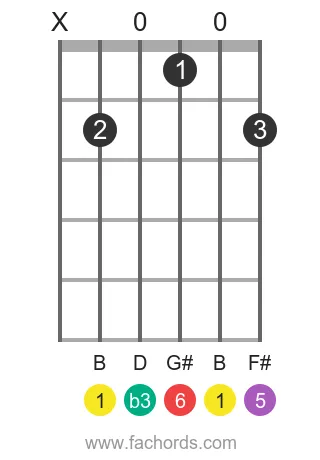
Visualize and learn to play the Bm6 chord by exploring its fretboard shapes on our interactive virtual fretboard. See how the notes B, D, F#, and G# are laid out across the strings, forming the 1, b3, 5, and 6 intervals, characteristic of this Minor Chord family member. Our innovative tool provides instant chord/arpeggio playback and real-time mic feedback, accurately verifying your playing as you discover new voicings and solidify your understanding.
The Bm6 chord introduces a touch of vintage and jazz sweetness to your progressions, adding a sophisticated harmonic color. Understanding its construction, built from a root, minor third, perfect fifth, and major sixth, is crucial for both theory and practical application. If you're interested in exploring how to build such sophisticated structures, our guide on chord construction is an excellent starting point. This particular minor sixth quality, part of the broader family of 6th chords, provides a unique flavor often found in classic jazz standards and soulful compositions.
Before diving into traditional diagrams, use the interactive fretboard above to explore different voicings of the Bm6 chord in various keys. This hands-on approach will help you intuitively grasp the fretboard geometry, leading to quicker learning of both easy and more complex chord shapes. Delve deeper into the theory behind this chord, apply it within songs, and transform your understanding from rote memorization to true musical insight.
Notes in the B m6 chord:
Tones of the Minor Sixth chord:
Bm6 Guitar Chord Voicings
Position 1
Open
Position 2
Movable
Position 3
Barre
Movable
Position 4
Barre
Movable
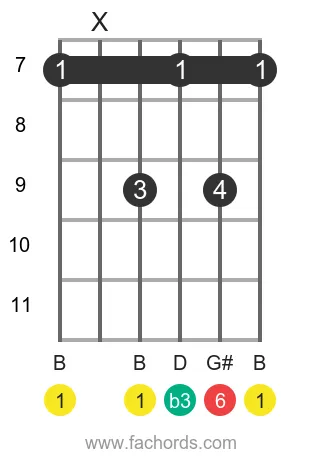
 Find more shapes in our all guitar chords online library. If you
prefer a printable pdf, download
the Free Guitar Chords Chart Pdf
Find more shapes in our all guitar chords online library. If you
prefer a printable pdf, download
the Free Guitar Chords Chart Pdf
You can also use this accessible Bm6 chord page, with written diagram instructions and screen-reader support for blind users.
FAQ
What notes and intervals make up the Bm6 chord?
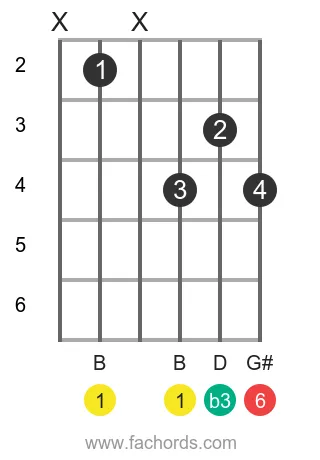
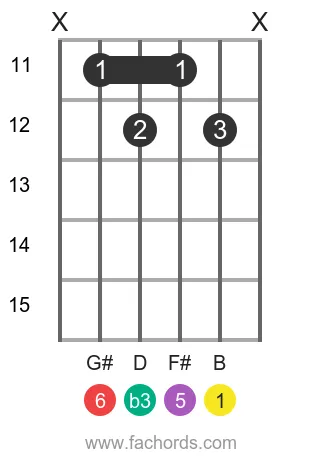
The Bm6 chord is composed of the notes B, D, F#, and G#. These notes correspond to specific intervals relative to the root note B: B is the Root (1), D is the Minor Third (b3), F# is the Perfect Fifth (5), and G# is the Major Sixth (6).
How is a Bm6 chord different from a standard B minor chord?
A standard B minor (Bm) chord consists of the Root, Minor Third, and Perfect Fifth (B, D, F#). The Bm6 chord builds upon this minor triad by adding one more note: the Major Sixth (G#). This added sixth interval gives the Bm6 a distinct, often fuller or more sophisticated sound compared to a simple B minor chord.
Why is the Bm6 chord called a 'minor sixth chord'?
The Bm6 is called a 'minor sixth chord' because its fundamental structure is a minor triad (defined by the Root, Minor Third, and Perfect Fifth), and it includes the Major Sixth interval. The 'minor' part refers to the minor third, and the 'sixth' refers to the characteristic major sixth interval that is added to the chord.
What is the role of the 6th interval in the Bm6 chord?
The 6th interval, specifically the Major Sixth (G# in the Bm6 chord), is the defining characteristic that classifies it as a sixth chord. It adds a unique color and richness to the basic minor triad, contributing to a distinctive sound that can be described as refined or slightly melancholic yet smooth. This interval differentiates it from other minor chord extensions.