Explore Bmmaj7 Guitar Chord Charts & Fretboard Shapes
Want a structured chord roadmap instead of jumping between pages?
Go to the full guitar chords tutorial.
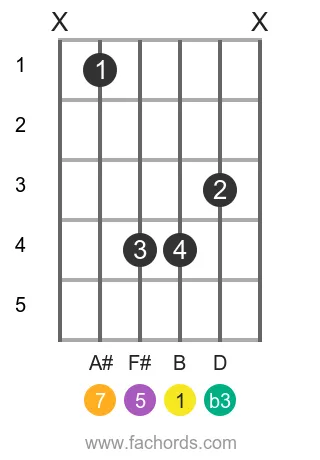
The Bmmaj7 chord presents a unique challenge and opportunity on the guitar fretboard, often requiring specific finger placements and an understanding of its visual layout across the strings. To help you master these positions, our interactive virtual fretboard provides clear diagrams for the Bmmaj7 chord, enabling you to play along and even verify your accuracy in real-time with our mic feedback feature. This fascinating member of the Minor Chords family is constructed from the notes B, D, F#, and A#, reflecting the intervals 1, b3, 5, and 7.
The combination of a minor third (b3) and a major seventh (7) interval gives the Bmmaj7 chord its characteristic melancholic yet sophisticated sound, often associated with genres like jazz, neo-soul, and even film scores. Understanding how these specific intervals contribute to its unique emotional color is key to truly mastering this chord. If you're keen to delve deeper into how chords are built from intervals, explore our guide on Chord Construction. For those working on fluidity between chord changes, our tips on Improve Chords Change can be especially helpful when incorporating complex chords like this one into your playing.
As you delve into this tutorial, you'll find various diagrams presenting the Bmmaj7 chord, ranging from simpler fingerings to more advanced theoretical layouts. Each diagram illustrates how to effectively place your fingers on the fretboard, while our theory sections explain the musical logic behind the notes, helping you understand its role in different musical keys and songs. Before you try to memorize every shape, we highly encourage you to utilize the interactive fretboard above to visually explore and experiment with these configurations, making the learning process intuitive and engaging.
B m(maj7) chord Notes:
Formula of the Minor Major Seventh chord:
How To Play The B Minor Major Seventh chord on guitar
Position 1
Movable
 Find more shapes in our all guitar chords online library. If you
prefer a printable pdf, download
the Free Guitar Chords Chart Pdf
Find more shapes in our all guitar chords online library. If you
prefer a printable pdf, download
the Free Guitar Chords Chart Pdf
You can also use this accessible Bm(maj7) chord page, with written diagram instructions and screen-reader support for blind users.


Created by
Giancarlo is a musician (teaching guitar since 2000), software engineer, AI consultant and published researcher
FAQ
What notes are used to build the B m(maj7) chord?
The B m(maj7) chord is composed of four specific notes: B, D, F#, and A#. These notes are derived from the root (B) and the unique interval structure of the chord.
What do the intervals '1, b3, 5, 7' represent in the B m(maj7) chord?
These numbers represent the specific scale degrees relative to the root note (B). '1' is the Root (B), 'b3' is the Minor Third (D), '5' is the Perfect Fifth (F#), and '7' is the Major Seventh (A#). Together, these intervals create the distinct sound of the B m(maj7) chord.
Why is this chord called 'minor-major seventh' (m(maj7))?
The name 'minor-major seventh' comes from its unique combination of intervals. The 'minor' part refers to the Minor Third (b3) interval, which gives the chord its minor quality. The 'major seventh' part refers to the Major Seventh (7) interval, which is the highest tone in the chord, creating a particular tension and color.
How does the B m(maj7) chord differ from a regular B minor 7 chord?
The key difference lies in the seventh interval. A regular B minor 7 chord contains a *minor* seventh (b7). In contrast, the B m(maj7) chord features a *Major* Seventh (7). This single interval change creates a significantly different and more complex harmonic quality, often described as bittersweet or melancholic.
Why is the B m(maj7) chord not considered suitable for beginners?
The B m(maj7) chord is more complex due to its specific interval structure and often requires more intricate fingerings on the guitar. It combines a minor third with a major seventh, which can be challenging to voice correctly and cleanly, demanding greater finger independence and practice compared to more common basic chords.
What specific musical quality does the B m(maj7) chord contribute to guitar playing?
The B m(maj7) chord contributes a 'beautiful and complex' sound. This unique quality comes from the interplay between the minor third and the major seventh. It creates a rich, often melancholic or ethereal atmosphere that can add significant depth and emotional resonance to musical compositions.
