Practice the B 7#5 Guitar Chord with Our Interactive Tool
Want a structured chord roadmap instead of jumping between pages?
Go to the full guitar chords tutorial.
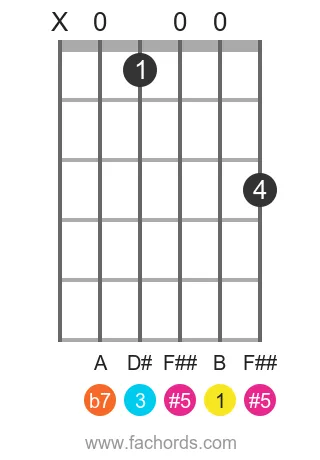
Are you ready to test your skills with the B 7(#5) chord? Our interactive fretboard is your ideal training ground. Get instant verification of your accuracy using real-time mic feedback as you play, then explore how this fascinating member of the Augmented Chords family is built. Composed of the notes B, D#, F##, and A, the B 7(#5) is structured using the intervals of 1, 3, #5, and b7. Load the chord, play it, and watch your progress.
Understanding the specific intervals that constitute the B 7(#5) chord is vital for mastering its unique sound. The 1, 3, #5, and b7 intervals correspond to the Root, Major Third, Augmented Fifth, and Minor Seventh, creating its distinctive augmented dominant quality. As a dominant chord, the B 7(#5) plays a crucial role in creating tension and resolution in musical progressions, particularly in genres like jazz. To deepen your understanding of how such complex harmonies are formed, explore our guide on chord construction. For more insights into the broader category of these tension-building sonorities, dive into our tutorial about dominant guitar chords.
As you scroll down, you'll discover various diagrams for the B 7(#5) chord, presented from the simplest to more advanced fingerings, alongside deeper theoretical explanations. Apply your knowledge by exploring how this chord is used in different keys and popular songs. We encourage you to start by experimenting with the interactive fretboard above; disciplined practice with real-time feedback will solidify your understanding and technique before moving to static charts.
B 7(#5) chord Notes:
How the Dominant Seventh Sharp Fifth chord is built:
B Dominant Seventh Sharp Fifth Guitar Chord Voicings
Position 1
Open
Position 2
Barre
Movable
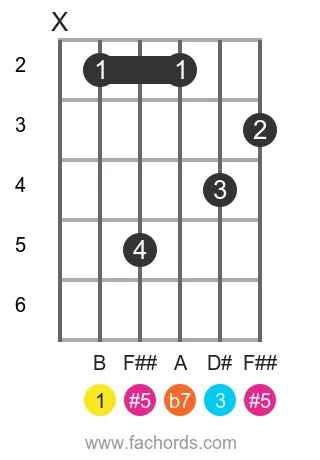
Position 3
Barre
Movable
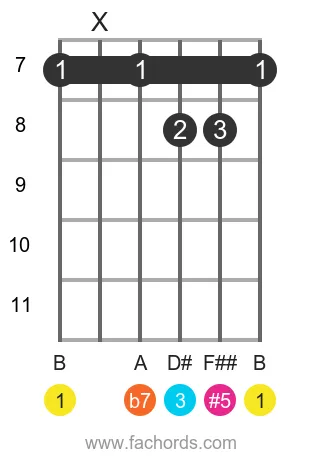
 Find more shapes in our all guitar chords online library. If you
prefer a printable pdf, download
the Free Guitar Chords Chart Pdf
Find more shapes in our all guitar chords online library. If you
prefer a printable pdf, download
the Free Guitar Chords Chart Pdf
You can also use this accessible B7(#5) chord page, with written diagram instructions and screen-reader support for blind users.

FAQ
What do the different parts of the B 7(#5) chord name signify?
The 'B' indicates the root note of the chord. The '7' tells us it includes a minor seventh interval. The '(#5)' specifies that the fifth interval is augmented, meaning it's raised a half step from a perfect fifth. So, it's a B dominant seventh chord with an augmented fifth.
Why is the B 7(#5) chord considered an 'augmented chord' and also a 'dominant chord'?
It's an augmented chord because it contains an augmented fifth (#5) interval. It's simultaneously a dominant chord because it includes a minor seventh (b7) interval. The combination of these two characteristics gives it a unique sound and function.
What are the specific notes that make up the B 7(#5) chord, and how do they relate to its intervals?
The B 7(#5) chord is composed of the notes B, D#, F##, and A. 'B' is the root (1). 'D#' is the major third (3) above B. 'F##' is the augmented fifth (#5) above B. 'A' is the minor seventh (b7) above B.
Why is the augmented fifth in the B 7(#5) chord noted as 'F##' instead of just 'G'?
The augmented fifth is notated as 'F##' to clearly indicate that it's a modified fifth degree of the B scale, specifically an F sharp that has been raised another half step. If it were written as 'G', it would imply a sixth interval, which would change the chord's theoretical structure and function.
What is the primary musical role or function of the B 7(#5) chord on the guitar?
As a dominant chord, the B 7(#5) primarily serves to create tension. This tension naturally leads to a strong sense of resolution in musical phrases, especially within jazz and other genres where dominant chords are used to guide harmonic movement.
