B13 Guitar Chord | Play, Hear and Practice Interactively
Want a structured chord roadmap instead of jumping between pages?
Go to the full guitar chords tutorial.
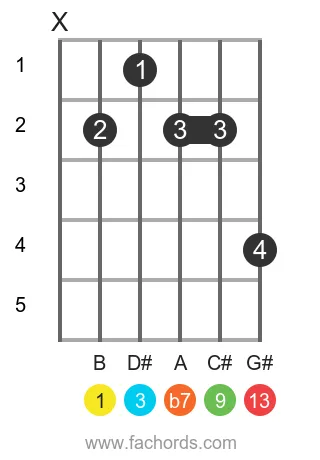
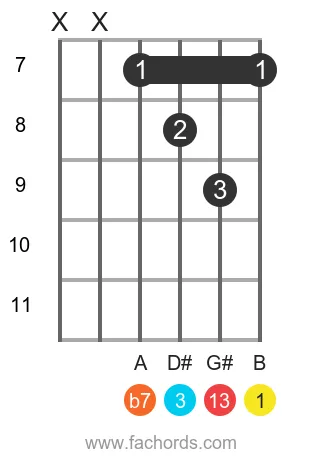
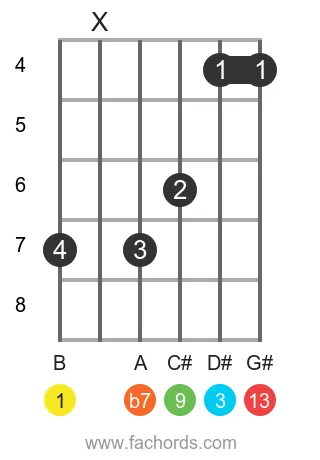
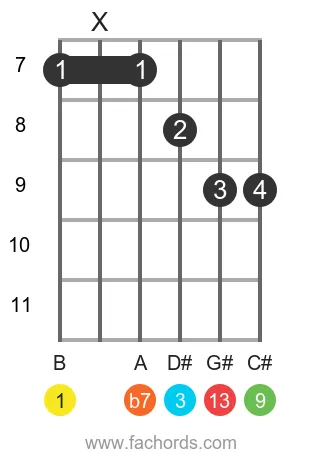
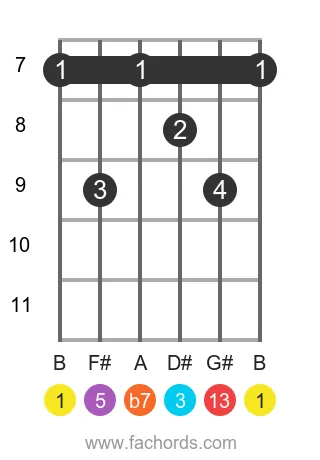
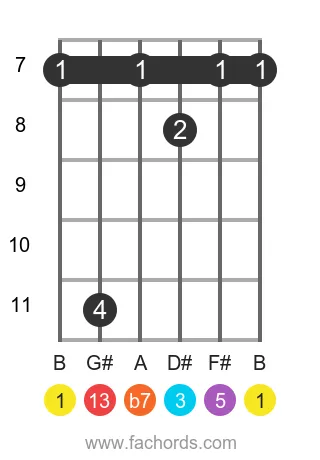
The B13 chord is a rich and complex extended dominant chord, part of the Dominant Chords family. It's built from seven notes: B, D#, F#, A, C#, E, and G#, corresponding to the intervals Root (1), Major Third (3), Perfect Fifth (5), Minor Seventh (b7), Major Ninth (9), Perfect Eleventh (11), and Major Thirteenth (13). To truly grasp this chord, use the interactive fretboard tool at the top of this page to visualize every fingering, hear it played as a strum or arpeggio, and get instant feedback on your own playing with the real-time microphone feedback.
This advanced chord offers a vibrant, full-bodied sound, perfect for adding depth to jazz, funk, or R&B. Understanding how these extended voicings are constructed is key, so dive deeper with our guide on Chord Construction. As a dominant chord, it naturally resolves, a concept explored further in our Dominant Chord tutorial. Since 13th chords often involve navigating larger shapes across the fretboard, especially when playing movable forms, our tips on Guitar Bar Chords can be invaluable. Mastering the transitions into and out of such complex chords will elevate your playing significantly; find guidance in our Improve Chords Change resource.
Below, you'll discover detailed chord diagrams ranging from accessible open positions to advanced barre shapes, along with practical music theory, common songs that feature the B13, and the keys where it shines. Before you scroll, take a moment to engage with the interactive tool above. Set your tempo with the drum machine, play the B13, and let the mic feedback confirm you're hitting all the notes cleanly. This active learning approach is the fastest way to add this impressive chord to your repertoire.
B dominant 13th guitar chord is also written as B13, Bdom13 or B7(13).
B 13 chord Notes:
Chord formula for the Dominant Thirteen chord:
B 13 Guitar Chord Diagrams
Position 1
Movable
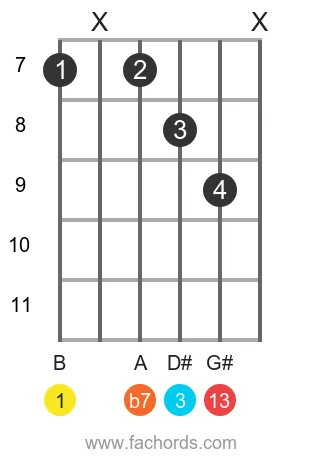
Position 2
Movable
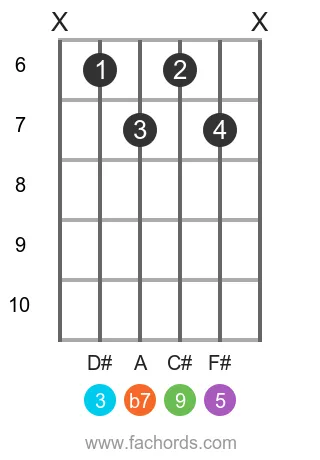
Position 3
Barre
Movable
Position 4
Barre
Movable
Position 5
Barre
Movable
Position 6
Barre
Movable
Position 7
Barre
Movable
Position 8
Barre
Movable
 Find more shapes in our all guitar chords online library. If you
prefer a printable pdf, download
the Free Guitar Chords Chart Pdf
Find more shapes in our all guitar chords online library. If you
prefer a printable pdf, download
the Free Guitar Chords Chart Pdf
You can also use this accessible B13 chord page, with written diagram instructions and screen-reader support for blind users.

Created by
Giancarlo is a musician (teaching guitar since 2000), software engineer, AI consultant and published researcher
FAQ
What are the fundamental notes and intervals that make up a B 13 chord?
The B 13 chord is composed of seven distinct notes: B, D#, F#, A, C#, E, and G#. These notes correspond to the following musical intervals relative to the root (B): 1 (Root), 3 (Major Third), 5 (Perfect Fifth), b7 (Minor Seventh), 9 (Major Ninth), 11 (Perfect Eleventh), and 13 (Major Thirteenth).
Why is the B 13 chord described as having a 'complex and rich sounding' quality?
The B 13 chord's complex and rich sound is attributed to its intricate structure. It includes seven different notes and spans a wide range of intervals (up to the 13th), creating a vibrant and full-bodied texture that adds depth to guitar playing.
What chord family does the B 13 chord belong to?
The B 13 chord is categorized as part of the Dominant Chords family. This classification indicates its specific harmonic characteristics and common functions in music.
Is the B 13 chord generally considered difficult for beginners to learn on guitar?
Yes, the B 13 chord is considered an advanced chord and can be quite challenging for beginners. Its complex structure, involving seven notes and numerous intervals, requires significant practice and patience to master on the fretboard.
What are the practical benefits of mastering the B 13 chord for a guitarist?
Mastering the B 13 chord allows a guitarist to significantly enhance their playing by adding depth, vibrancy, and a full-bodied sound to their music. It also expands their chord repertoire, enabling more sophisticated harmonic possibilities.