A m7 Guitar Chord | Play, Hear and Practice Interactively
Want a structured chord roadmap instead of jumping between pages?
Download the step-by-step Guitar Chord Ebook
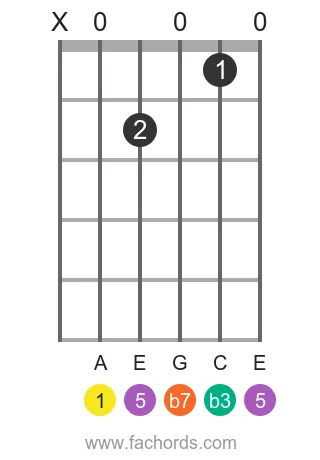
The A m7 chord, a versatile member of the Minor Chords family, is built from the notes A, C, E, and G. These notes correspond to the intervals 1 (Root), b3 (Minor Third), 5 (Perfect Fifth), and b7 (Minor Seventh). Use the interactive fretboard tool at the top of this page to visualize fingerings, hear the chord played as a strum or arpeggio, and get real-time mic feedback on your playing to ensure accuracy.
Understanding the intervals and structure of the A m7 chord unlocks its harmonic potential, especially in jazz and R&B contexts. To deepen your grasp of this and other similar chords, explore our tutorial about 3-Note 7th Chords. For a broader understanding of how chords are built, our Chord Construction guide is invaluable. Many A m7 shapes involve barre techniques; if these are new to you, our Guitar Bar Chords resource can help. Once you're comfortable with the fingering, focus on improving your chord changes for smooth musicality.
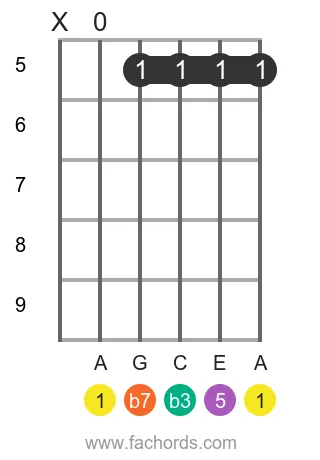
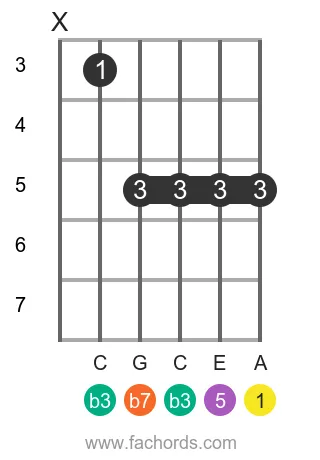
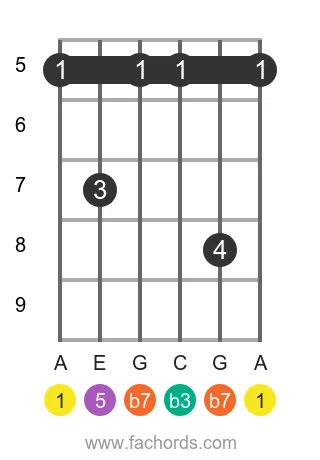
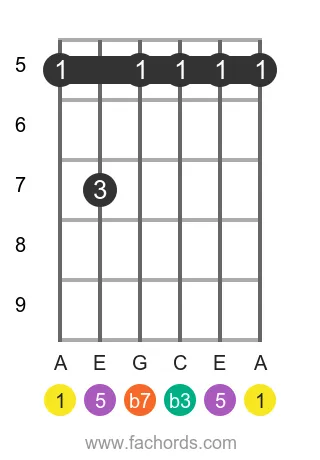
Below, you'll discover a comprehensive collection of A m7 chord diagrams, ranked from beginner-friendly open positions to more advanced barre shapes. We also delve into the music theory behind the chord, list popular songs that feature it, and identify common keys where it appears. Before you dive into the diagrams, make sure to use the interactive tool above to hear how the chord should sound and practice playing it yourself. Set your tempo with the drum tool and let the mic feedback guide your hand - this hands-on approach is the most effective way to truly master the A m7 chord.
Notes of the A m7 chord:
Chord formula for the Minor Seventh chord:
A Minor 7 Chord Tutorial
As many of you may know an A major chord is made up the root , major third , and perfect fifth from the scale:
A B C# D E F# G#
The notes A C# E make up that Amaj, if we wanted an A minor we would then use the root , minor third , and perfect fifth. Indeed, the A minor scale is:
A B C D E F G
In the Amin7 chord, the seventh at the end further denotes that we have a minor nondominant seventh chord (because the dominant chord is composed of a major chord plus a minor seventh). So with that minor seventh we get the notes:
A C E G
When To Use The Minor Seventh Chord
There are a variety of places to use the minor seventh, sometimes in place of a regular minor chord to add some tension .
Another way of using the Am7 is to substitute it for a regular 7th.
Keys With The Amin7 Chord
The best keys to use Amin7 in are Am , C , G , F and of course anywhere else that it may happen to fit.
As far as scales you will find the Am7 fits the best with the natural, harmonic, and melodic minor.
Minor 7ths can often be found in jazz , funk , pop , and rock . Whenever you have an Am that just doesn’t seem to fit try adding the minor seventh and seeing how that suits the song.
A Minor Key
| Key | i | ii | III | iv | v | VI | VII |
|---|---|---|---|---|---|---|---|
| A | Am7 | Bm/b5 | C | Dm | Em | F | G |
C Major Key
| Key | I | ii | iii | IV | V | vi | vii |
|---|---|---|---|---|---|---|---|
| C | C | Dm | Em | F | G | Am7 | Bm/b5 |
G Major Key
| Key | I | ii | iii | IV | V | vi | vii |
|---|---|---|---|---|---|---|---|
| G | G | Am7 | Bm | C | D | Em | F#m/b5 |
F Major Key
| Key | I | ii | iii | IV | V | vi | vii |
|---|---|---|---|---|---|---|---|
| F | F | Gm | Am7 | Bb | C | Dm | Em/b5 |
Songs With The Am7 Chord
You will find Am7 in a lot of good music, so it is an important chord to fit into your playing. Sometimes the difference will be subtle compared to Am, but still worth the change.
- One of the more popular songs starting with and featuring Am7 is “ Rocky Raccoon ” by The Beatles. In fact the progression that plays throughout the song begins each time with Am7.
- Another example of this chord in use is the funky pop “ That’s All ” by Genesis. The verse is a back and forth Am7 to D chord.
- Other examples are “ America the Beautiful ”, “ Georgia On My Mind ”, and “ Killing Me Softly ” in the verse.
How To Play The Am7 Chord
In the image below you can see the Am7 tones on the guitar fretboard:

Using the tones above we can come up with some of the more popular versions of how to play the Am7 chord.
Usually when we play a chord we want the root note (here A) to be the lowest played bass note . Sometimes we will find a chord shape where that isn’t the case, which means the chord is an inversion.
If the lowest note is C, E, or G instead of the A than that is an inversion.
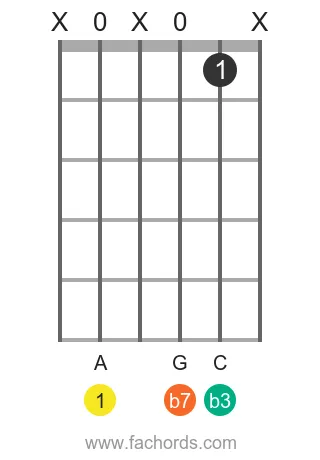
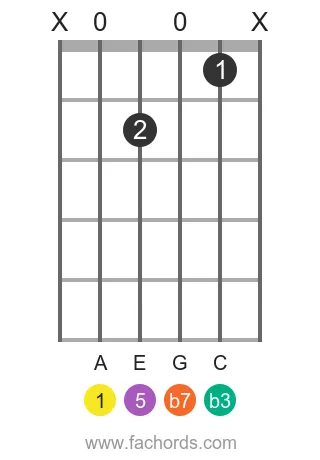
As usual there are multiple positions for this chord. The easiest being X02013 or X02010 or X02213 .



Or we can use barre chords to find a suitable Am7.
The chord Em7 is played 020000, if we move that up five frets we get an Am7 at 575555 .

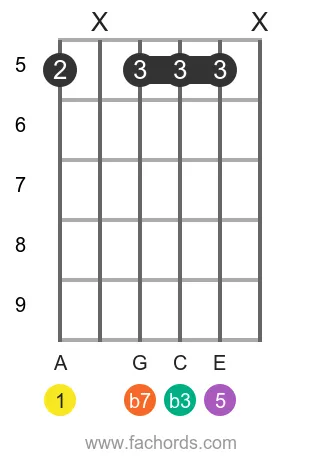
Or we can play the chord with an A bass string with X05555 :

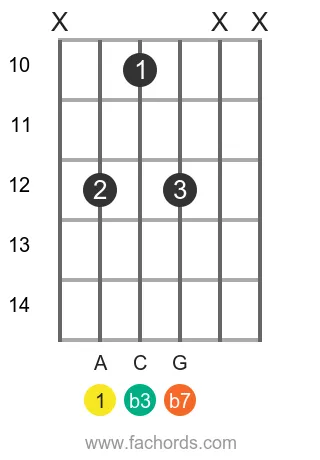
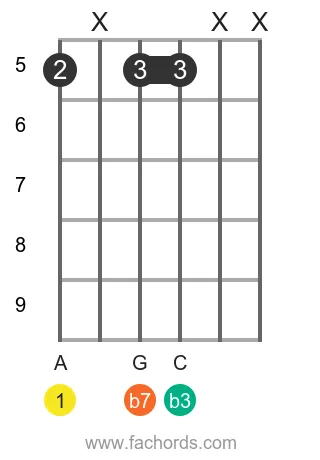
Of course we have some more complicated muted string versions of Am7, ad example 5X55X , which is a voicing commonly used in jazz, often called shell chord :

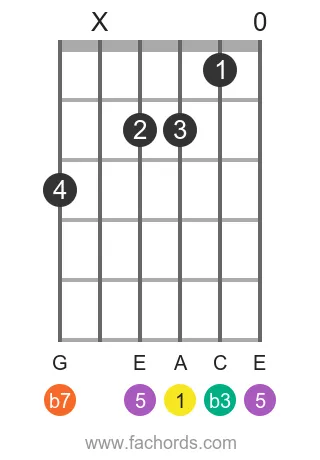
And here is a third inversion of the chord (third inversion meaning G is the bass note) 3X2210 .

Remember, any chords that require string muting will need a lot more practice !
A Minor Seventh Guitar Chord Voicings
Position 1
Open
Position 2
Movable
Position 3
Open
Position 4
Movable
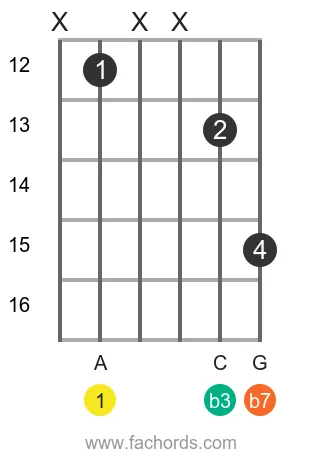
Position 5
Open
Position 6
Open
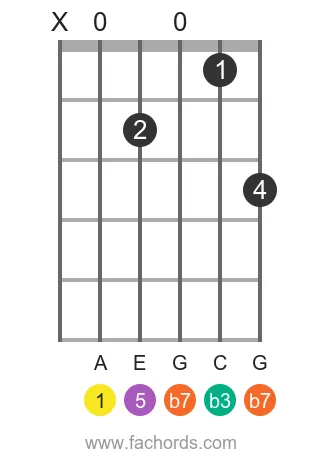
Position 7
Movable
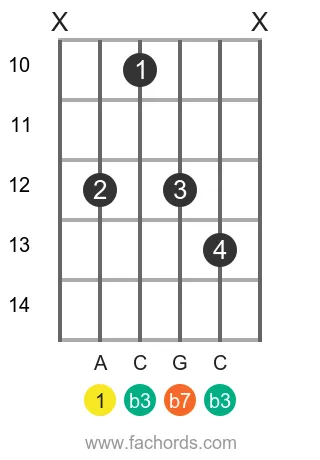
Position 8
Open
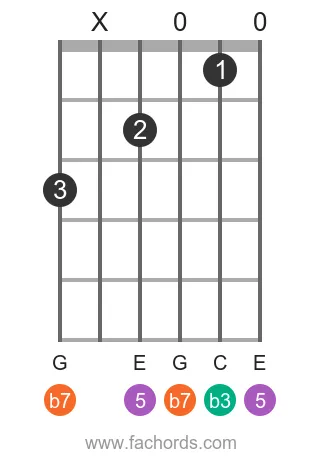
Position 9
Barre
Open
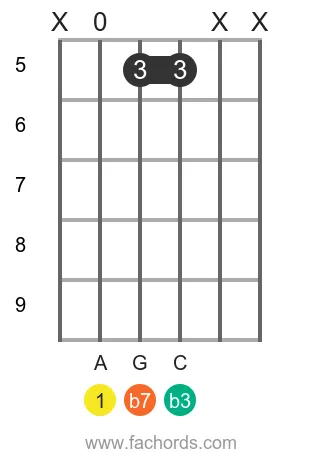
Position 10
Movable
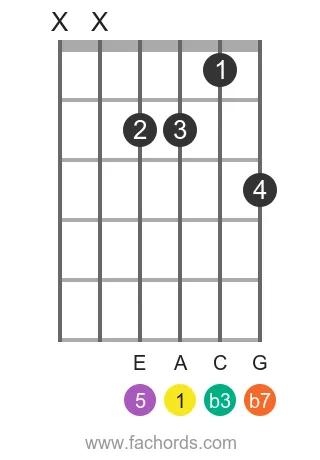
Position 11
Open
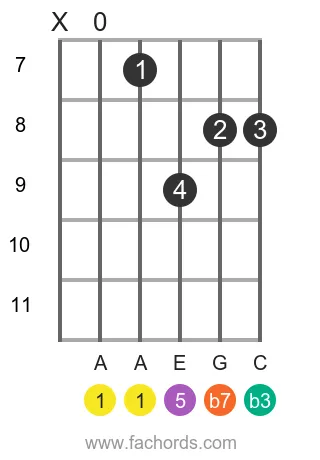
Position 12
Open
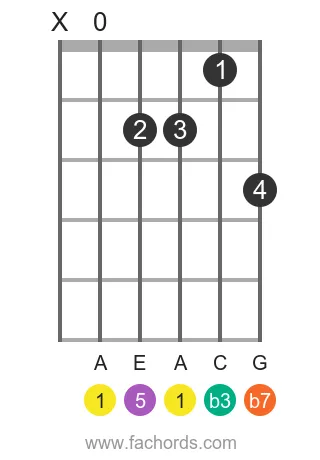
Position 13
Barre
Movable
Position 14
Open
Position 15
Barre
Movable
Position 16
Barre
Movable
Position 17
Barre
Open
Position 18
Barre
Movable
Position 19
Barre
Movable
Position 20
Barre
Movable
 Find more shapes in our all guitar chords online library. If you
prefer a printable pdf, download
the Free Guitar Chords Chart Pdf
Find more shapes in our all guitar chords online library. If you
prefer a printable pdf, download
the Free Guitar Chords Chart Pdf
You can also use this accessible Am7 chord page, with written diagram instructions and screen-reader support for blind users.

FAQ
What notes and intervals form the A m7 chord?
The A m7 chord is composed of the notes A, C, E, and G. These notes correspond to the intervals of 1 (Root), b3 (Minor Third), 5 (Perfect Fifth), and b7 (Minor Seventh) relative to the root note A.
How does the A m7 chord differ from a standard A minor chord?
A standard A minor chord is made up of the root, minor third, and perfect fifth (A, C, E). The A m7 chord adds a minor seventh (G) to these notes. This additional note changes the character of the chord, adding tension and making it a 'minor nondominant seventh chord'.
When should I use the A m7 chord in my guitar playing?
You can use the A m7 chord in several situations. It often adds a subtle tension when substituted for a regular A minor chord, giving a different feel. It can also be used in place of a regular 7th chord in certain contexts. This chord is particularly prevalent in genres like jazz, funk, pop, and rock.
In what musical keys is the A m7 chord commonly found?
The A m7 chord commonly appears in the keys of A minor (as the i chord), C major (as the vi chord), G major (as the ii chord), and F major (as the iii chord). It also fits well with the natural minor, harmonic minor, and melodic minor scales.
What are some common ways to play the A m7 chord on the guitar fretboard?
There are various ways to play A m7 on the guitar. Some common open position voicings include X02013, X02010, and X02213. You can also use barre chord shapes, such as 575555 (derived from an Em7 shape moved up five frets) or X05555. Additionally, there are jazz-oriented 'shell chord' voicings like 5X55X, which often involve muted strings.
What is an A m7 chord inversion, and how does it affect how I play the chord?
An A m7 chord inversion occurs when a note other than the root (A) is the lowest played bass note of the chord. For example, if C, E, or G is the lowest note instead of A, you are playing an inversion of A m7. An example given is the third inversion 3X2210, where G (the minor seventh) is the lowest note. Inversions offer different tonal colors and smooth out bass lines.
