Explore & Master the A#m6 Guitar Chord Interactively
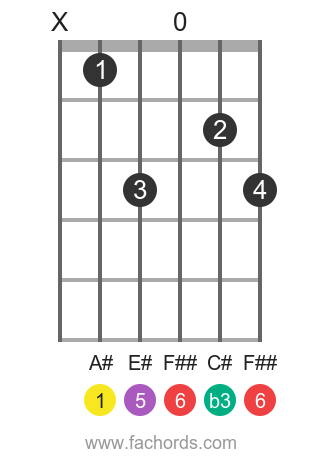
The A#m6 chord adds a vintage sweetness, often heard in jazz and soulful ballads, blending minor melancholy with a touch of sophistication. This unique sound is built from the notes A#, C#, E#, and F##, corresponding to the intervals 1, b3, 5, and 6, placing it firmly within the Minor Chords family with an added sixth. Discover how this chord sounds and feels by using our interactive fretboard tool on this page, where you can visualize every fingering, hear it as a strum or arpeggio, and receive instant real-time microphone feedback to ensure every note rings true.
This A#m6 chord truly excels at adding depth and a 'vintage' flair to your guitar playing, characteristic of the broader family of 6th Chords. It enriches the standard minor triad by incorporating that distinct sixth interval, offering a unique harmonic color. To delve deeper into how such sophisticated harmonies are constructed, our guide on Chord Construction is an excellent starting point. And as you integrate this chord into your playing, mastering the transitions between shapes is crucial; find valuable tips to Improve Chords Change for smoother playing.
Below this interactive exploration lab, you'll find a comprehensive collection of A#m6 chord diagrams, ranging from accessible open positions to more advanced movable shapes. We'll also unpack the music theory behind its construction, highlight songs where it features prominently, and identify the keys in which it commonly appears. Before diving into the static diagrams, we encourage you to spend time with the interactive tool above. Set your pace with the built-in drum machine, experiment with strumming, and use the real-time mic feedback to truly feel and perfect your finger placement. This hands-on approach is the most effective way to truly internalize the A#m6 chord.
Notes that compose the A# m6 chord:
Tones in the Minor Sixth chord:
A# Minor Sixth Guitar Chord Fingers Positions
Position 1
Open
Position 2
Barre
Movable
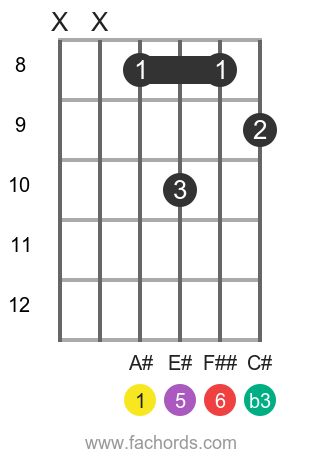
Position 3
Barre
Movable
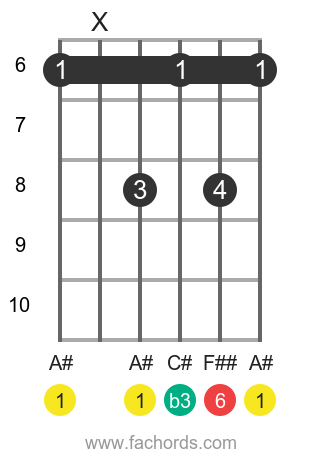
 Find more shapes in our all guitar chords online library. If you
prefer a printable pdf, download
the Free Guitar Chords Chart Pdf
Find more shapes in our all guitar chords online library. If you
prefer a printable pdf, download
the Free Guitar Chords Chart Pdf
You can also use this accessible A#m6 chord page, with written diagram instructions and screen-reader support for blind users.
FAQ
What specific notes do I play to form an A# m6 chord, and what intervals do they represent?
The A# m6 chord is constructed from four distinct notes. Starting from the root note A#, the specific notes are A# (the root, or 1st interval), C# (the minor third, or b3rd interval), E# (the perfect fifth, or 5th interval), and F## (the major sixth, or 6th interval). These intervals collectively create the characteristic minor six sound.
Why does the A# m6 chord use F double sharp (F##) instead of G natural for its sixth?
The use of F## instead of G natural is based on music theory principles that ensure correct intervallic spelling. Within the A# minor context, the sixth scale degree is F. To maintain the theoretical structure of a major sixth interval above A# (the root), F must be raised to F##. Using G natural, while enharmonically similar, would misrepresent the intervallic relationship within the chord (1, b3, 5, 6) and deviate from standard chord notation and construction rules.
What does "m6" signify in the name A# m6, and how does it affect the chord's sound?
In the A# m6 chord, the 'm' stands for 'minor,' indicating the presence of a minor third interval (C#) above the root (A#), which gives the chord its fundamental minor quality. The '6' signifies the addition of a major sixth interval (F##) to the basic minor triad. This added sixth creates a richer, more complex, and often sophisticated or melancholic sound compared to a simple minor chord.
How does the A# m6 chord differ from a regular A# minor chord?
A regular A# minor chord (A#m) is a basic three-note triad consisting of the root (A#), minor third (C#), and perfect fifth (E#). The A# m6 chord includes these three notes but adds an additional note: the major sixth (F##). This added major sixth interval is what distinguishes the A# m6, giving it a more nuanced and harmonically expanded sound than a simple A# minor triad.