Practice A#7b5 Guitar Chord: Interactive Fretboard & Ear Training
Want a structured chord roadmap instead of jumping between pages?
Go to the full guitar chords tutorial.
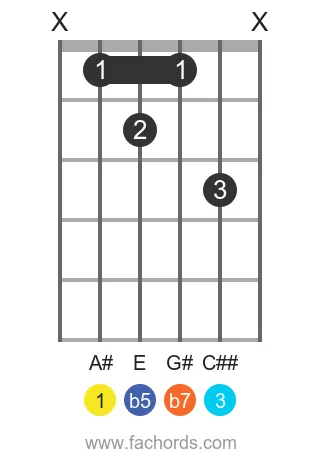
Dive into the expressive world of the A#7b5 chord, a captivating member of the Dominant Seventh Flat Five family often used to create tension and intriguing harmonic color in various musical styles. This unique sound is built from the notes A#, C##, E, and G#, which correspond to the intervals Root (1), Major Third (3), Diminished Fifth (b5), and Minor Seventh (b7). Explore its distinctive character immediately with our interactive fretboard tool: visualize fingerings, hear the chord played as a strum or arpeggio, and get instant confirmation of your accuracy with real-time microphone feedback.
The A#7b5 chord's unique blend of a dominant seventh and a diminished fifth interval creates a compelling tension that often resolves in surprising ways, adding an intriguing touch to your music. To understand the fundamental building blocks of chords like this, delve into our guide on Chord Construction. As a member of the Dominant Chord family, it brings a distinct harmonic flavor. Mastering this chord often involves barre shapes, so our Guitar Bar Chords tutorial can be a valuable resource. Once you've got the shapes down, focus on improving your chord changes for seamless playing.
As you scroll down, you'll discover a comprehensive collection of A#7b5 chord diagrams, presented from the easiest open positions to more challenging movable shapes. We also provide deeper music theory insights, popular songs that feature this chord, and the various musical keys where it commonly appears. But before you delve into the theory and static diagrams, take a moment to use the interactive tool above. Set a comfortable tempo with the drum and BPM tool, experiment with different fingerings, and let the mic feedback confirm your precision. Experience the sound and feel of the A#7b5 chord firsthand before you analyze its structure.
Notes in the A# 7b5 chord:
Chord Formula:
A#7b5 Guitar Chord Shapes
Position 1
Movable
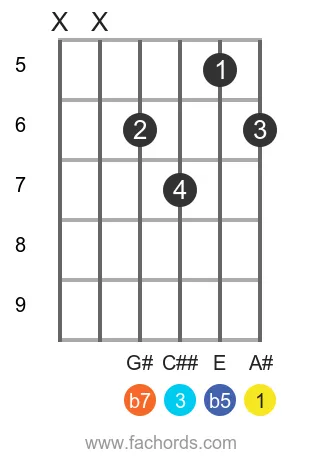
Position 2
Movable
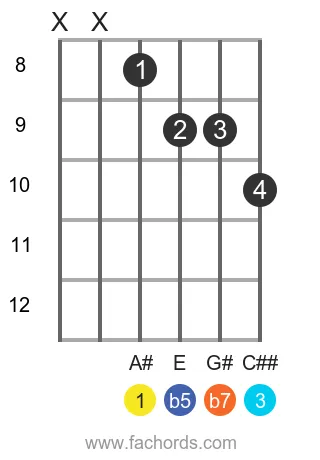
Position 3
Barre
Movable
 Find more shapes in our all guitar chords online library. If you
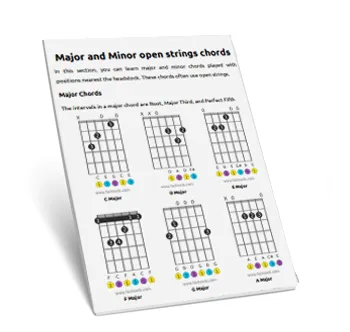
prefer a printable pdf, download
the Free Guitar Chords Chart Pdf
Find more shapes in our all guitar chords online library. If you
prefer a printable pdf, download
the Free Guitar Chords Chart Pdf
You can also use this accessible A#7b5 chord page, with written diagram instructions and screen-reader support for blind users.

Created by
Giancarlo is a musician (teaching guitar since 2000), software engineer, AI consultant and published researcher
FAQ
What is an A#7b5 chord?
The A#7b5 chord is a member of the Dominant Chords family. It is built from the notes A#, C##, E, and G#, which correspond to the intervals Root, Major Third, Diminished Fifth, and Minor Seventh.
What notes make up the A#7b5 chord?
The A#7b5 chord is composed of the specific notes A#, C##, E, and G#. These four notes together create its unique sound.
Which intervals define the structure of the A#7b5 chord?
The A#7b5 chord is constructed using four distinct intervals relative to its root (A#): the 1 (Root), 3 (Major Third), b5 (Diminished Fifth), and b7 (Minor Seventh). These intervals give the chord its characteristic harmonic structure.
What does the '7b5' in the chord name A#7b5 represent?
In the A#7b5 chord name, 'A#' indicates the root note. The '7' signifies the presence of a Minor Seventh interval, classifying it as a dominant type. The 'b5' indicates that the fifth interval is diminished, meaning it is a half-step lower than a perfect fifth, creating a Diminished Fifth interval.
Why is the A#7b5 chord considered a Dominant Chord?
The A#7b5 chord belongs to the Dominant Chords family primarily due to the inclusion of the Minor Seventh interval. Dominant chords, including the A#7b5, are known for their distinct and often tension-filled sound, which is a hallmark of this chord family.
What gives the A#7b5 chord its unique tonal qualities?
The A#7b5 chord derives its unique and distinct tonal qualities from the combination of its intervals: the Root, Major Third, Diminished Fifth, and Minor Seventh. Specifically, the Diminished Fifth (b5) in conjunction with the Minor Seventh (b7) creates a tension-filled sound that sets it apart from other chord types.